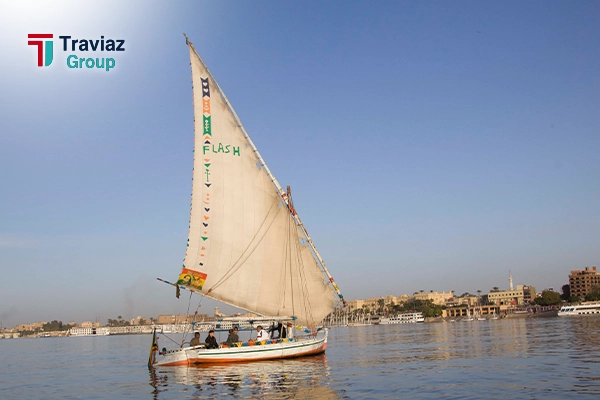
Four full nights aboard a five-star Nile cruise give this trip its defining character from Luxor to Aswan. The cruise is a core part of the program, as you wake up daily on the Nile and reach Edfu, Kom Ombo, and Philae temples directly from it before continuing to sail. The experience begins with a day in Cairo covering the Giza Pyramids and the Grand Egyptian Museum, then concludes with a full day at Abu Simbel before the return flight to Cairo. A private Egyptology guide accompanies you throughout the trip, and the program includes two domestic flights between Cairo and Luxor and between Aswan and Cairo.
From the moment you arrive at Cairo International Airport, your Traviaz Egyptology specialist meets you to assist with arrival procedures and baggage collection. You then transfer by private air-conditioned vehicle to your luxury hotel in Cairo.
After breakfast you begin your day with a private tour of the Giza Plateau and the Grand Egyptian Museum with your Traviaz specialist guide.
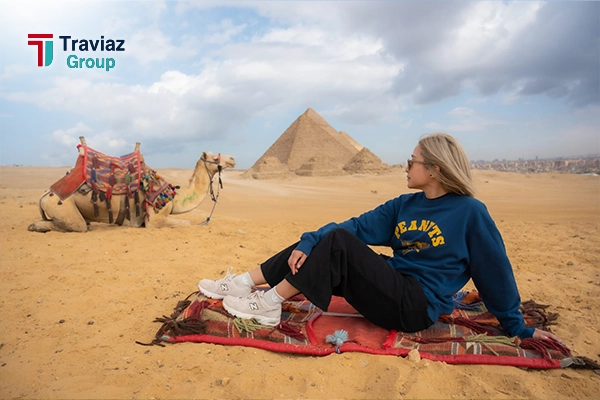
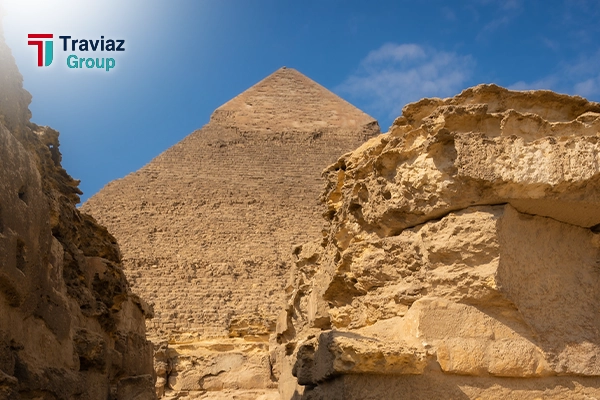
The Giza Pyramids complex represents one of the greatest royal architecture projects in ancient Egypt, and it contains the main pyramids, valley temples, and ceremonial causeways.
The construction of the Pyramid of Khufu dates back to approximately the twenty-sixth century BC, and it remained the tallest man-made structure for thousands of years.
The Great Sphinx occupies a prominent position in front of the Giza Plateau, carved from limestone in the form of a lion's body and a human head.
The statue faces east, and archaeologists believe its features are linked to Pharaoh Khafre, whose pyramid complex was built nearby.
The Valley Temple of Khafre reveals an advanced level of construction techniques during the Old Kingdom era. The temple was used as part of the king's preparation rituals before burial, and its granite and limestone blocks show the scale of the engineering effort that preceded the construction of the royal tomb.
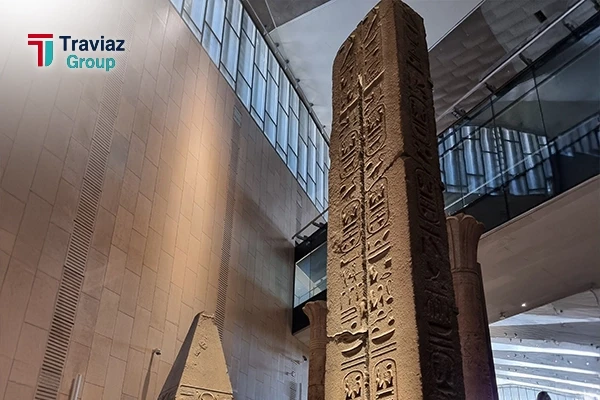
The Grand Egyptian Museum officially opened in November 2025 and now holds the main exhibition halls and the complete Tutankhamun collection within a single museum experience.
The visit also includes the main halls, the grand staircase, the entrance hall, the Khufu Boat Museum, and the outdoor gardens.
After breakfast you leave Cairo by air heading to Luxor, where your Traviaz guide receives you to begin the east bank tour before boarding the cruise.
You then complete the boarding procedures and settle into your cruise cabin as your journey on the Nile begins.
The Karnak complex extends over a wide area and contains a collection of halls, gateways, and temples that developed across successive historical periods.
Construction and expansion at the site continued for long centuries, with a large number of ancient Egyptian kings contributing new structures.
The Great Hypostyle Hall is known for its massive rows of stone columns, while the Avenue of Sphinxes historically connected Karnak to Luxor Temple.
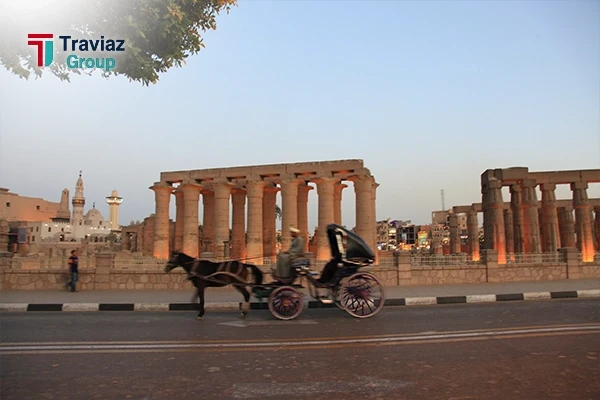
Luxor Temple dates back to the New Kingdom era and was linked to kingship rituals and the Opet Festival, which brought together the Karnak complex and the temple.
Amenhotep III and Ramesses II both left prominent marks on the site, and its structures show different stages in the development of religious architecture in ancient Thebes. After the tour you head to Luxor dock to board your Nile cruise, then begin your stay aboard the ship.
The morning hours are dedicated to exploring the west bank of Luxor, where the program brings together royal tombs, funerary temples, and famous landmarks.
After the tour you return to the cruise to continue sailing south toward Edfu via the Esna Water Lock.
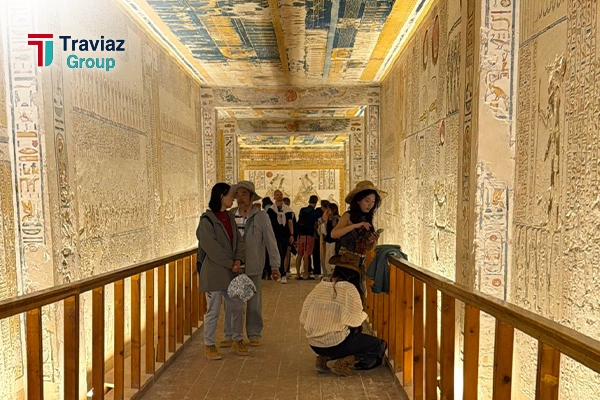
The Valley of the Kings holds dozens of royal tombs carved into the rock for the pharaohs of the New Kingdom, and the details of the visit differ according to the available tickets and the open tombs.
The basic entrance ticket generally allows visits to a set number of tombs, while special tombs such as Tutankhamun's require an additional ticket.
Behind the desert slopes, chambers decorated with religious texts and scenes linked to the king's journey to the afterlife appear.
The Colossi of Memnon stand on the Theban plain as the most prominent surviving remains of the funerary complex of Amenhotep III.
Each statue reaches approximately 18 meters in height, and both were carved from the stone known as quartzite, standing as witnesses to the scale of the royal structures that once stood behind them.
The Temple of Hatshepsut at Deir el-Bahari is distinguished by its terraced design that steps upward in front of the rocky slopes.
It was built in the fifteenth century BC and was linked to the worship of Amun, while its inscriptions document Hatshepsut's trade expedition to the Land of Punt.
After returning to the cruise, sailing begins southward toward Edfu via the Esna Water Lock, which allows ships to pass over the difference in water level between the two sections of the Nile.
The ship's movement inside the lock changes gradually as the chamber fills with water or drains depending on the direction of sailing. Watching this process from the cruise deck gives you a different experience that combines the river journey with hydraulic engineering.
Your morning begins with disembarking from the cruise at Edfu, then heading by traditional horse-drawn carriage to the temple before returning to the ship.
The journey then resumes toward Kom Ombo where the cruise docks close to the temple.
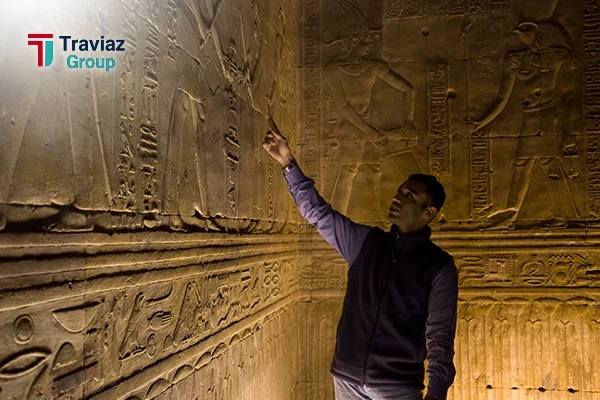
Edfu Temple is considered one of the best-preserved ancient Egyptian temples, with construction beginning in 237 BC and completing in 57 BC. Its burial for centuries under layers of sediment and later buildings helped protect many of its architectural and decorative elements.
The temple was dedicated to the god Horus, and the massive pylons and inscriptions documenting myths of the king and the gods stand out prominently at its entrance. The horse-drawn carriage between the cruise dock and the temple adds a distinctive practical dimension to the visit experience.
Kom Ombo Temple brings together the worship of Sobek and Haroeris within a double design that gives each god a dedicated axis and facilities.
The temple was built in the Ptolemaic era, and its walls carry religious scenes and inscriptions that include a depiction of ancient surgical instruments.
The Crocodile Museum sits next to the temple and displays a collection of mummified crocodiles and objects related to the worship of Sobek.
The cruise docks close to the site, making the transfer from the ship to the temple easy and direct.
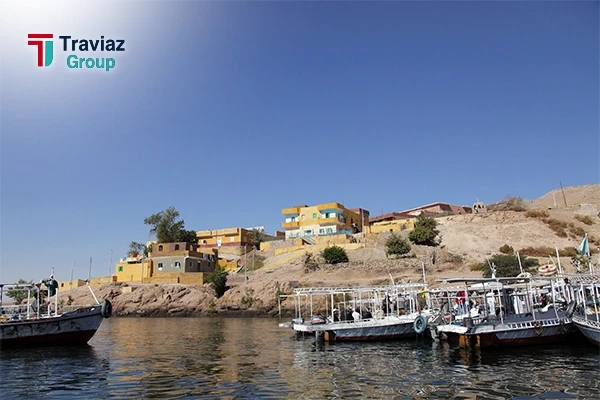
After breakfast with the cruise docked in Aswan, you set off with your Traviaz guide to explore the most prominent landmarks that explain the city's history and its ancient and modern engineering. The day's program brings together the High Dam, the Unfinished Obelisk, and Philae Temple in a single route.
The top of the High Dam reaches approximately 3,830 meters in length and 111 meters in height, while the generating station's capacity reaches approximately 10 billion kilowatt-hours annually.
The water retained behind the dam led to the formation of an artificial lake extending approximately 500 kilometers, and the project became a fundamental turning point in managing the Nile's waters and generating electricity in Egypt.
The Unfinished Obelisk in the Aswan quarries reveals the stages of work that the ancient Egyptians carried out while extracting granite blocks and carving obelisks.
Its project was attributed to the reign of Hatshepsut, and it was intended to become one of the largest obelisks ancient Egypt had ever known. It was left in place after cracks appeared in the rock, and it has since become a clear model of stone extraction and carving techniques.
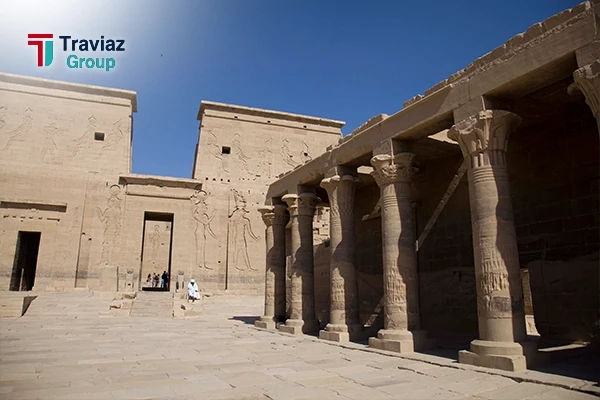
The current Philae Temple sits on Agilkia Island after being moved from its original location to protect it from the waters of Lake Nasser.
The relocation came as part of the UNESCO campaign to rescue Nubian antiquities, which covered 22 monuments and archaeological complexes with the participation of dozens of countries.
The gates and components of Philae Temple were dismantled and reassembled at the new site, and the temple is currently reached by boat across the waters of the Nile.
Before dawn you leave Aswan by private air-conditioned vehicle heading to Abu Simbel in an overland journey that takes about three hours.
After arriving you explore the temples, then return to Aswan to head to the airport and board your flight to Cairo.
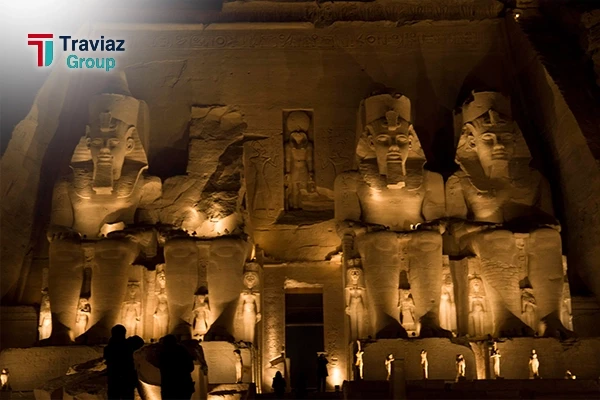
The two Abu Simbel temples were built during the reign of Ramesses II in the thirteenth century BC and were carved into the rock on the western bank of Lake Nasser.
Four massive statues of Ramesses II stand prominently before the Great Temple, while halls decorated with religious and military scenes linked to his era extend inside it.
The rescue operation for Abu Simbel was tied to the UNESCO campaign, which moved more than a thousand stone blocks to a site approximately 64 meters higher and approximately 180 meters further from the original location.
The temple's design also features the sunrise phenomenon, in which sunlight reaches the inner statues at specific times of the year.
Next to it stands the Temple of Nefertari, dedicated to the queen and the goddess Hathor, where statues of the queen appear at a scale close to that of the pharaoh's statues on the temple facade.
After the visit concludes you return to Aswan and then head to the airport to board the domestic flight to Cairo.
After the final breakfast at the hotel, a Traviaz representative arrives in a private air-conditioned vehicle to transfer you to Cairo International Airport.
The service includes assistance with departure procedures until you complete your journey from Egypt.
Meals: Breakfast.

Explore Cairo, Aswan, and Luxor in 6 days, visiting the Pyramids, Grand Egyptian Museum, Philae Temple, Valley of the Kings, and Karnak Temple. Includes 5-star hotels and a private guide.
Experience Egypt’s highlights in 5 days with luxury hotels and a private guide. Visit the Pyramids, Grand Egyptian Museum, Saqqara, Luxor, Aswan, and Philae Temple.
Enjoy a luxury Nile cruise from Aswan to Luxor, with stops at Edfu, Kom Ombo, Abu Simbel, and Nubian villages. Experience Egypt’s top archaeological sites and the Nile in one journey.