A private 6-day trip that takes you through Egypt's most prominent archaeological destinations with a licensed Egyptology guide, private air-conditioned car transportation, and accommodation in five-star hotels in Cairo, Luxor, and Aswan. It begins with a night Nile cruise in Cairo, passes through the Giza Pyramids and the Grand Egyptian Museum, then the Valley of the Kings and Karnak Temple in Luxor, the Temple of Philae in Aswan, and concludes with the Abu Simbel temples before returning to Cairo.
Upon your arrival at Cairo International Airport, a Traviaz representative receives you and assists you with arrival procedures, passport control, and luggage, then you transfer by private air-conditioned car to your hotel in Cairo.
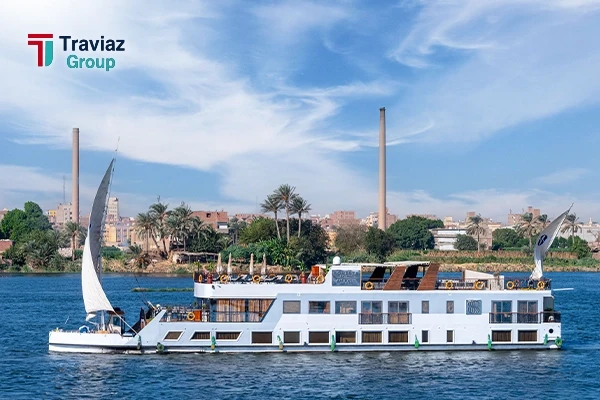
In the evening you set off on a two-hour Nile dinner cruise aboard one of the elegant riverboats. The cruise begins with the sunset and Cairo's lights reflecting on the Nile waters, and includes an open buffet of Egyptian and international cuisine and live performances featuring the Tannoura dance with its whirling dervishes and oriental dance with live oriental music.
After breakfast at the hotel you set off with Traviaz's specialized Egyptology guide to explore the Giza Pyramids complex and the Grand Egyptian Museum.
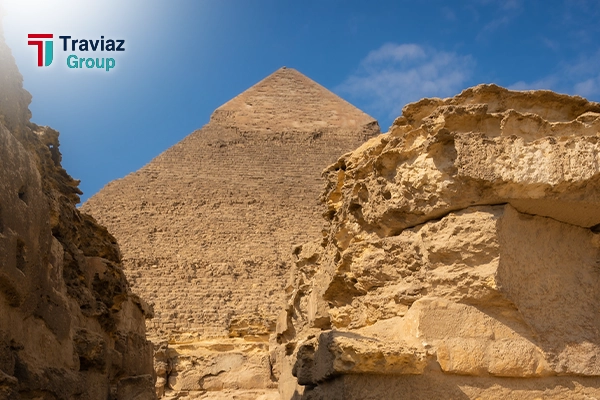
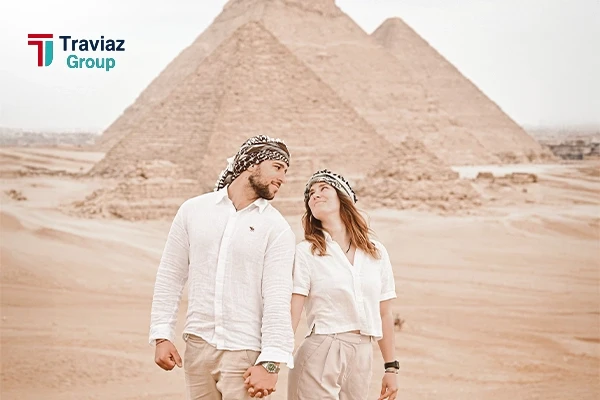
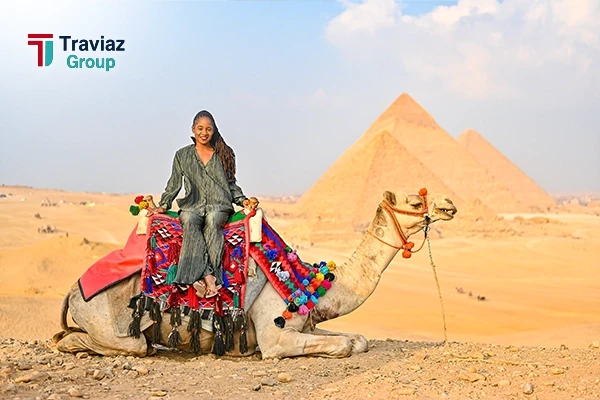
The Giza Pyramids complex is a royal facility of the Fourth Dynasty extending over an area of more than 16,000 hectares on the Giza Plateau.
It includes three main pyramids, the largest of which is the Pyramid of Khufu built between 2580 and 2560 BC and which remained the tallest building in the world for more than 3,800 years.
Your guide visits with you the three pyramids, the valley temples, and the ceremonial causeways that connected them to the Nile, and explains how the ancient Egyptians organized the workshops, the movement of stones, and the building of a complete funerary system all at once.
The Sphinx is the largest single-stone statue in the world, carved from a single block of limestone on the Giza Plateau and measuring 73 meters in length and 20 meters in height.
It was built around 2500 BC and is believed to represent the face of Pharaoh Khafre with the body of a lion.
The Sphinx faces directly east toward the sunrise at the spring and autumn equinoxes, indicating intentional astronomical precision in its design.
The Valley Temple adjacent to the Sphinx is built from limestone blocks some of which exceed one hundred tons in weight, and it is one of the oldest surviving stone buildings in the world.
It was used in purification and mummification rituals before the Pharaoh's body was transferred to his tomb.
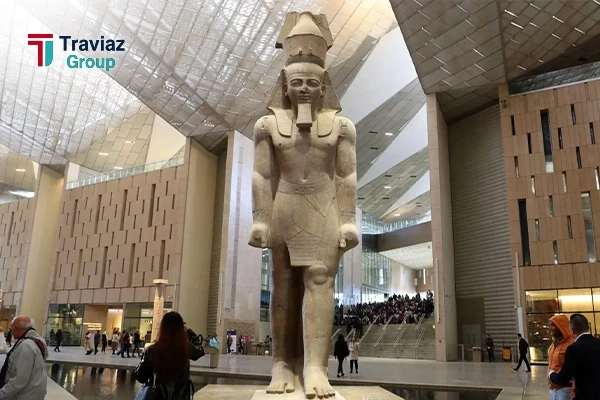
The Grand Egyptian Museum officially opened in November 2025 and is located only two kilometers from the Giza Plateau.
In its grand staircase hall it holds 87 massive statues of Pharaohs and gods on both sides of a staircase extending across six floors, and at its entrance stands the statue of Ramesses II weighing 82 tons and standing 11 meters tall.
The main wing of the museum is the Tutankhamun exhibition which displays the complete collection of his 5,398 artifacts for the first time in a single and integrated sequence.
After the tour you fly to Luxor and settle into your luxury hotel.
A full day in Luxor on both the eastern and western banks of the Nile.
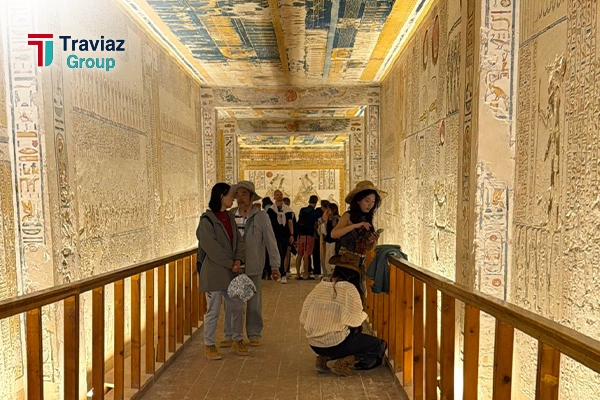
The Valley of the Kings on the western bank of the Nile was the official royal cemetery of the Pharaohs of the New Kingdom from around 1550 to 1069 BC.
It contains 63 rock-carved tombs of Pharaohs from the Eighteenth, Nineteenth, and Twentieth Dynasties, including Tutankhamun, Seti I, and Ramesses II.
The Pharaohs of the New Kingdom chose to be buried here instead of in pyramids to mislead thieves, but most tombs were looted in ancient times.
Tutankhamun's tomb is the only one found complete when Howard Carter discovered it in 1922.
The Temple of Hatshepsut at Deir el-Bahari was built in the fifteenth century BC and is considered one of the most beautifully designed Egyptian temples.
Hatshepsut, the most powerful queen of the Pharaonic era, built it in the form of terraced colonnades in front of the rocky slopes of the western bank mountains, and it is dedicated to the god Amun and to the eternal immortalization of the queen.
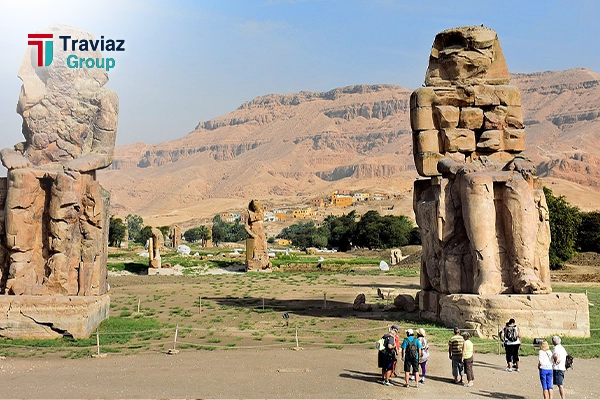
Two massive statues of Pharaoh Amenhotep III carved from quartzite, each standing 18 meters tall.
They have stood on the Theban plain for more than three thousand years and once guarded the entrance to a massive funerary temple of which nothing remains today.
The Karnak Temple complex on the eastern bank is the largest religious facility built in ancient history, extending over 247 acres and only 69 meters separating it from the great cathedral of Notre Dame.
It was built over two thousand years from the Middle Kingdom to the Ptolemaic era, and every Pharaoh who wanted to prove his piety added to it a gate, a hall, or an obelisk.
At its heart is the Great Hypostyle Hall covering 5,000 square meters and containing 134 sandstone columns, the tallest 12 of which reach 21 meters in height, making it the largest hall in any religious facility in history.
Some of the original blue and red colors are still preserved on the bases of its columns.
After breakfast you leave Luxor for Aswan to explore its archaeological city.
The High Dam, whose construction was completed in 1970, controls the annual Nile flood and generates approximately 10 billion kilowatt-hours of electricity annually, and created Lake Nasser, one of the largest artificial lakes in the world with a length exceeding 500 kilometers.
The Unfinished Obelisk in the ancient granite quarries of Aswan was ordered built by Queen Hatshepsut and would have been the largest in ancient Egyptian history at a length of 42 meters.
Work stopped on it because cracks appeared in the rock during carving. The workers left it in place so it was preserved half-carved in the rock and reveals to visitors the secrets of stone carving techniques in the Pharaonic era in a way that cannot be seen at any other site.
The Temple of Philae, built in the fourth century BC and dedicated to the goddess Isis, remained a center of worship until the sixth century AD, and it is one of the last pagan temples to be closed in Egypt.
When the construction of the High Dam began in the sixties and the waters of Lake Nasser rose, UNESCO led with fifty countries a rescue operation that took years: more than 40,000 stone blocks were dismantled and the entire temple was transferred to the island of Agilkia at a higher elevation and reassembled in its original orientation.
Today visitors reach the temple by boat through the Nile waters, which gives the visit an exceptional character.
You depart early by private air-conditioned car to cover 280 kilometers south of Aswan toward the Abu Simbel temples.
Pharaoh Ramesses II built them in the thirteenth century BC carved into the heart of the rocky mountain, and in front of the Great Temple stand four massive statues of him each standing 20 meters tall and considered among the largest seated statues in history.
Inside it extends a corridor 63 meters long inside the rock decorated with carvings of the Battle of Kadesh that Ramesses fought against the Hittites and which later led to the first written peace treaty in history.
Next to it is a smaller temple that Ramesses dedicated to his wife Queen Nefertari and the goddess Hathor, which is the only temple in ancient Egypt in which the queen's statues appear at the same size as the Pharaoh's statues.
The temples were designed with exceptional astronomical precision that causes the sun's rays to penetrate the entire corridor twice every year on February 22nd and October 22nd to illuminate the statues of Ramesses, Amun, and Ra-Horakhty inside the sanctuary, while the statue of Ptah remains in darkness as a symbol of his connection to the world of the dead.
After the visit ends you return to Aswan then fly to Cairo.
After the final breakfast at the hotel, a Traviaz representative comes with a private air-conditioned car to transfer you to Cairo International Airport with assistance in departure procedures.

Experience Egypt’s highlights in 5 days with luxury hotels and a private guide. Visit the Pyramids, Grand Egyptian Museum, Saqqara, Luxor, Aswan, and Philae Temple.
Enjoy a luxury Nile cruise from Aswan to Luxor, with stops at Edfu, Kom Ombo, Abu Simbel, and Nubian villages. Experience Egypt’s top archaeological sites and the Nile in one journey.
Explore Cairo, Luxor, and Abu Simbel in 5 days, visiting the Pyramids, Grand Egyptian Museum, Karnak, Valley of the Kings, Hatshepsut Temple, and Abu Simbel. Includes 5-star hotels, private guides, and domestic flights.