Combining Cairo, Abu Simbel, and Luxor in a short program is not easy, but this package was designed specifically to achieve that in just five days. Among Traviaz's Luxury packages, this tour is the option that brings Abu Simbel and Luxor together with Cairo in a single program, while the $610 package focuses on Cairo alone. The experience starts in Cairo, then moves by air to Aswan to visit Abu Simbel and Philae Temple, and then heads by train to Luxor to see the Valley of the Kings and Karnak Temple. Accommodation is five-star at all main stops, and a private Egyptology guide accompanies you throughout the trip.
After landing at Cairo International Airport, your Traviaz Egyptology specialist will be waiting for you.
He assists you with arrival procedures and baggage collection before heading in a private air-conditioned vehicle to your luxury hotel in Cairo.
Three hours on the Nile give you a different start to the trip that evening. You have dinner aboard a licensed upscale cruise boat while the lights of Cairo stretching along both banks of the river pass before you.
The buffet offers a selection of Egyptian and international dishes, and the atmosphere is suited for unwinding after a day of travel. The first night begins here, in the middle of a Cairo view from the Nile.
Meals: Dinner Accommodation: 5-Star Hotel in Cairo
Your morning starts with breakfast at the hotel, then you head with your Traviaz guide to the Giza Plateau and the Grand Egyptian Museum.
The day's program brings together monuments thousands of years old and a modern museum housing a vast collection of Egyptian artifacts.
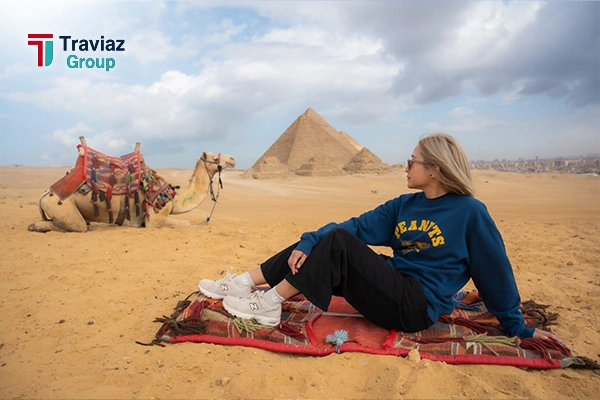
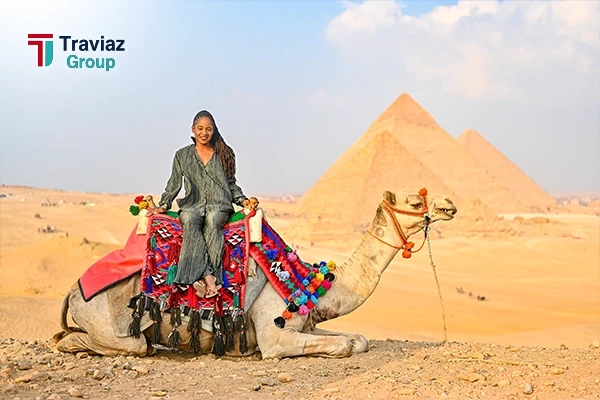
More than 16,000 hectares make up the Giza Plateau, which forms a royal funerary complex dating back to the Fourth Dynasty.
The area contains the three main pyramids, along with valley temples and ceremonial causeways. Giza alone has survived as the only remaining wonder of the ancient Seven Wonders of the World.
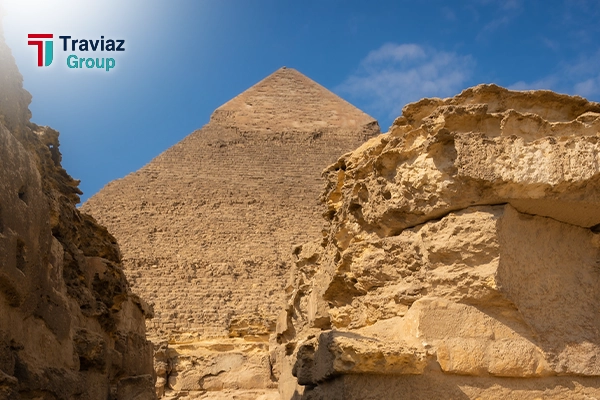
The Pyramid of Khufu itself was built between 2580 and 2560 BC, and six million tons of limestone and granite went into its construction.
This pyramid held the title of the tallest structure in the world for more than 3,800 years, and for that reason its construction details become even more compelling when a specialist guide explains them to you on site.
From the east, the Sphinx faces the sunrise during the spring and autumn equinoxes, which is one of the striking details in its design.
The statue measures 73 meters in length and 20 meters in height, and it was carved from a single block of limestone.
Its construction dates most likely to around 2500 BC, while its form combines the head of Pharaoh Khafre and the body of a lion, an image associated with power and wisdom.
Some of the stone blocks used in the Valley Temple exceed one hundred tons in weight, which shows the scale of work its construction required.
The temple sits next to the Sphinx and is considered one of the oldest preserved stone buildings in the world.
Its role was tied to funerary rituals, as it was used for purification and mummification before transferring the pharaoh's body to his tomb.
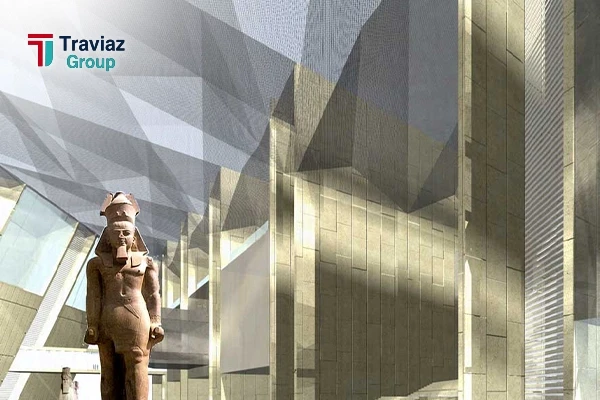
The Grand Egyptian Museum officially opened in November 2025, and it sits two kilometers from the Giza Plateau.
At the entrance stands an 11-meter statue of Ramesses II weighing 82 tons, while behind it the grand staircase holds 87 large statues of pharaohs and deities.
Inside the Tutankhamun wing, the complete collection of 5,398 artifacts is displayed for the first time in a single, cohesive sequence.
The museum's size makes having a guide who knows the most important pieces and routes genuinely useful for making the most of the visit.
Meals: Breakfast and Lunch Accommodation: 5-Star Hotel in Cairo
An early flight takes you to Aswan, where the southern part of the program begins heading toward Abu Simbel.
The day later brings you back to Aswan to visit Philae Temple, then concludes with a train journey to Luxor.
More than 3,000 years ago, the Abu Simbel temples were carved into the rock face by order of Ramesses II, between 1264 and 1244 BC.
The site sits on the western bank of Lake Nasser, 280 kilometers south of Aswan. Four statues of Ramesses stand before the Great Temple, each reaching 20 meters in height.
Inside the mountain, a 60-meter corridor extends inward, and its walls carry scenes from the Battle of Kadesh against the Hittites, a battle later linked to the first written peace treaty in history.
The astronomical design details of the temple are no less remarkable than its scale. On February 22 and October 22 each year, sunlight reaches the innermost sanctuary and illuminates the statues of Ramesses, Amun, and Ra-Horakhty, while the statue of Ptah, god of the underworld, remains in darkness.
This precise arrangement makes Abu Simbel something entirely different from a massive carved facade.
The site would not have remained in its current location without the rescue project that came with the construction of the High Dam in the 1960s.
UNESCO, in cooperation with 50 countries, led an operation that lasted four years from 1964 to 1968 and cost $40 million.
During the project, 1,036 stone blocks were dismantled, some weighing up to 20 tons, and then reassembled 65 meters above the original site inside an artificial mountain built to replicate the original.
Next to the Great Temple stands the Temple of Nefertari, which Ramesses II dedicated to his wife and to the goddess Hathor.
The site features statues of the queen at the same scale as the statues of the pharaoh, a rare characteristic that made the temple one of Abu Simbel's most distinctive monuments.
Reaching Philae Temple is done by boat across the waters of the Nile, as the temple now sits on Agilkia Island.
The site was dedicated to the worship of the goddess Isis and dates back to the fourth century BC.
The temple was also threatened by the waters of Lake Nasser, so it was included in the UNESCO-led rescue projects.
More than 40,000 stone blocks were dismantled and transferred to Agilkia, and the temple was then reassembled in the same orientation it held at its original location.
In the evening, you board the train from Aswan heading to Luxor.
Meals: Breakfast and Lunch Accommodation: 5-Star Hotel in Luxor
The fourth day takes you to both the east and west banks of Luxor, where archaeological sites reflecting different periods of ancient Egyptian history are spread across the landscape.
Your Traviaz guide accompanies you throughout the tour to explain the details of the sites you visit.
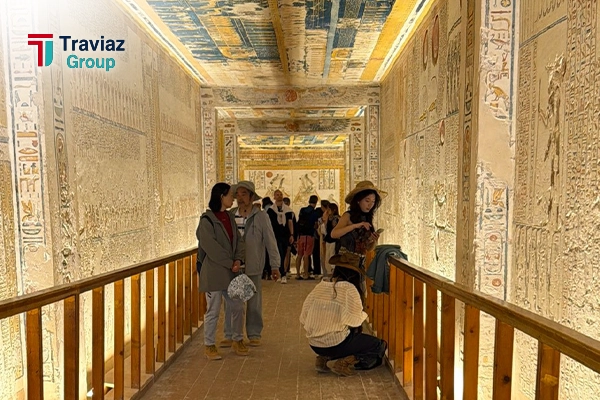
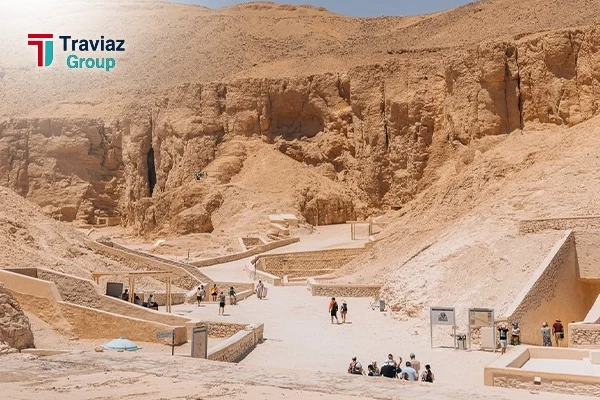
On the west bank of the Nile, the pharaohs of the New Kingdom chose the Valley of the Kings as the location for their royal tombs between approximately 1550 and 1069 BC.
The valley holds 63 tombs carved into the rock, and the choice of location was tied to the desire to move away from the traditional pyramid form and mislead tomb robbers.
Tutankhamun's tomb was discovered intact by Howard Carter in 1922, while the tomb walls carry religious texts and scenes depicting the pharaoh's journey to the afterlife.
The decorative details differ from one tomb to the next, so each visit inside the valley presents a different scene.
Three ascending terraces form the basic design of Hatshepsut's temple at Deir el-Bahari, built in the fifteenth century BC against the rocky cliffs.
Hatshepsut wanted the temple to support her legitimacy as ruler of Egypt, so its design and inscriptions were tied to the image of her reign and her standing.
The walls also record a trade expedition to the Land of Punt and present its scenes as an early documentation of long-distance trade relations.
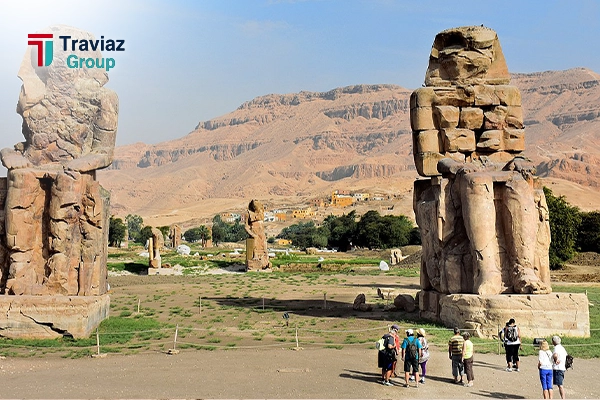
For more than three thousand years, the two statues of Amenhotep III have stood on the Theban plain. Each reaches 18 meters in height and was carved from quartzite.
The two statues once guarded the entrance to a massive funerary temple, and only limited remains of that temple survive today.
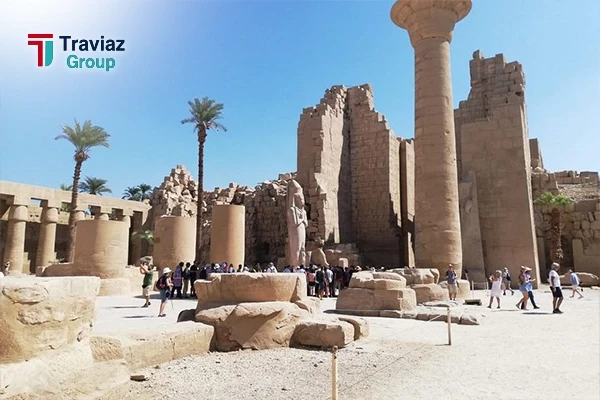
247 acres is the area covered by the Karnak Temple complex, which developed over approximately two thousand years as each pharaoh added new sections to it.
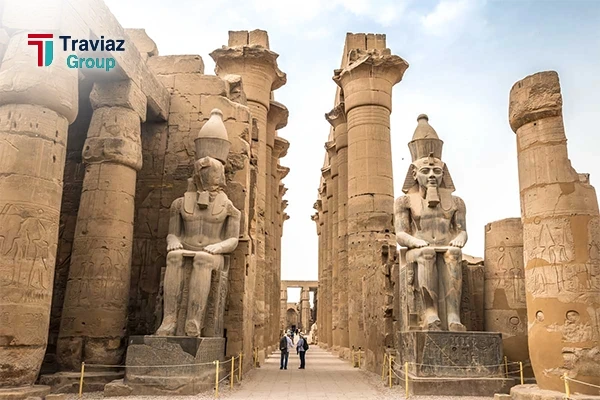
The Great Hypostyle Hall holds 134 sandstone columns and covers an area of up to 5,000 square meters, making it one of the largest halls in ancient religious structures.
Some traces of the original colors have survived on the bases of several columns despite roughly 3,000 years having passed.
The complex's scale and the number of its buildings make exploring it with a specialist guide considerably more rewarding during the tour.
Meals: Breakfast and Lunch Accommodation: 5-Star Hotel in Luxor
The program ends after the final breakfast at the hotel. A Traviaz representative transfers you in a private air-conditioned vehicle to Luxor Airport, and the Traviaz team assists you with departure procedures until the journey concludes.
Meals: Breakfast

Explore Cairo, Aswan, and Luxor in 6 days, visiting the Pyramids, Grand Egyptian Museum, Philae Temple, Valley of the Kings, and Karnak Temple. Includes 5-star hotels and a private guide.
Experience Egypt’s highlights in 5 days with luxury hotels and a private guide. Visit the Pyramids, Grand Egyptian Museum, Saqqara, Luxor, Aswan, and Philae Temple.
Enjoy a luxury Nile cruise from Aswan to Luxor, with stops at Edfu, Kom Ombo, Abu Simbel, and Nubian villages. Experience Egypt’s top archaeological sites and the Nile in one journey.