
Edfu Temple Guide 2026 | History, Highlights & Travel Tips
Among the many monumental landmarks of Upper Egypt, Edfu Temple stands out as one of the most impressive and best-preserved ancient temples in the country. While travellers often focus on Luxor or Aswan, those who stop in Edfu discover a remarkably intact sanctuary dedicated to one of Egypt’s most powerful gods.
Unlike partially ruined temples elsewhere in Egypt, Edfu Temple offers visitors the rare opportunity to walk through a nearly complete ancient structure—from its towering entrance to its sacred inner sanctuary. For travellers cruising along the Nile or exploring Upper Egypt by land, Edfu Temple is more than a brief stop; it is a highlight that connects mythology, architecture, and religious tradition in one extraordinary site.
Because of its preservation, historical depth, and manageable size, Edfu Temple is frequently described as one of the most rewarding temple visits in Egypt.
What is Edfu Temple?
Quick Overview
Edfu Temple is an ancient Egyptian temple located on the west bank of the Nile River in the city of Edfu. It is one of the most complete surviving temples from the Greco-Roman period and remains a central highlight of Upper Egypt sightseeing.
Unlike larger temple complexes that evolved over centuries, Edfu Temple follows a unified architectural plan, making it easier for visitors to understand its layout and purpose.
Dedicated to Horus
Edfu Temple is dedicated to Horus, the falcon-headed god associated with kingship, protection, and divine power. In ancient Egyptian mythology, Horus was the son of Osiris and Isis, and he symbolized rightful rule and cosmic order.
The temple served as a major religious centre where rituals honouring Horus were performed. The walls of Edfu Temple contain detailed inscriptions describing sacred ceremonies and mythological battles, particularly the legendary conflict between Horus and Seth.
One of the Best-Preserved Temples in Egypt
One of the main reasons Edfu Temple attracts global attention is its remarkable state of preservation. Much of the temple’s original structure, reliefs, and inscriptions remain intact. Visitors can clearly see hieroglyphs, decorative motifs, and architectural details that have survived for over two thousand years.
For travellers interested in understanding how ancient Egyptian temples originally looked, Edfu Temple provides one of the clearest examples available anywhere in Egypt.
Why It’s a Highlight in Upper Egypt
Upper Egypt is home to some of the most famous archaeological sites in the world. However, Edfu Temple offers something distinct: completeness. While temples in Luxor are monumental in scale, Edfu Temple allows visitors to experience a fully enclosed sacred complex almost as ancient worshippers once did.
For many travellers, visiting Edfu Temple becomes one of the most memorable stops between Luxor and Aswan.
Where is Edfu Temple located?
Between Luxor and Aswan
Edfu Temple is strategically located between Luxor and Aswan, approximately 110 kilometres south of Luxor and 100 kilometres north of Aswan. Its central position makes it a convenient and logical stop on any Upper Egypt itinerary.
Because of this location, Edfu Temple is often included in travel routes connecting the major highlights of the Nile Valley.
Nile Cruise Stop
For many visitors, Edfu Temple is experienced during a Nile cruise. Most cruises travelling between Luxor and Aswan include a scheduled stop in Edfu, allowing passengers to visit the temple before continuing their journey.
Typically, visitors transfer from the dock to Edfu Temple by horse-drawn carriage or private vehicle. Although the stop duration may vary, the temple is structured in a way that makes exploration efficient without feeling rushed.
Distance from Luxor & Aswan
- Luxor to Edfu: approximately 2 hours by car
- Aswan to Edfu: approximately 1.5–2 hours by car
This accessibility makes Edfu Temple an easy addition to a broader Upper Egypt exploration.
How to Get There
Travellers can reach Edfu Temple by the following methods:
- Nile cruise
- Private car transfer from Luxor or Aswan
- Organized guided tour
- Train to Edfu city, followed by local transport
Regardless of transportation method, Edfu Temple remains one of the most straightforward archaeological sites to access in Upper Egypt.
Continue your Upper Egypt journey with Luxor sightseeing
History of Edfu Temple
Ptolemaic Period
Edfu Temple was constructed during the Ptolemaic period, a time when Egypt was ruled by Greek descendants of Alexander the Great. Despite foreign leadership, traditional Egyptian religious practices continued to flourish.
The temple reflects this fascinating cultural blend—Greek political control combined with deeply rooted Egyptian spiritual traditions.
Built Between 237 and 57 BC
Construction of Edfu Temple began in 237 BC under Ptolemy III and was completed in 57 BC under Ptolemy XII. The extended building timeline allowed for detailed decoration and architectural refinement.
Because the temple was completed within a relatively consistent historical period, its design remains stylistically unified—something rarely seen in older Egyptian temples that evolved over centuries.
Greco-Roman Influence
Although dedicated to an ancient Egyptian deity, Edfu Temple incorporates subtle Greco-Roman architectural influences. The proportions, construction methods, and decorative style reflect both Egyptian continuity and Hellenistic innovation.
This fusion makes Edfu Temple particularly important for understanding how Egyptian religion adapted during foreign rule.
Religious Significance
Edfu Temple functioned as a sacred centre for the worship of Horus. Annual festivals celebrated the divine marriage of Horus and Hathor, symbolizing cosmic harmony.
The temple’s inscriptions preserve detailed religious texts that describe rituals, offerings, and mythological events. These texts are invaluable for scholars and add depth to any visit.
Architecture & Highlights of Edfu Temple
For travellers searching “what to see inside Edfu Temple,” the site offers a clearly defined progression from public courtyard to sacred inner sanctuary.
The Massive Pylon Entrance
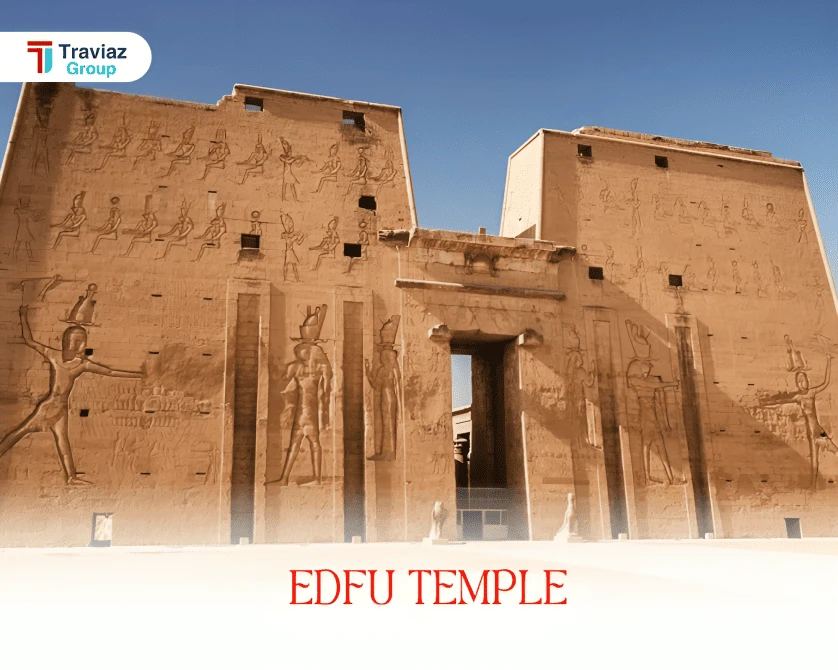
The entrance to Edfu Temple is dominated by a towering pylon rising approximately 36 meters high. This monumental gateway is decorated with reliefs depicting the king smiting enemies in the presence of Horus.
The scale of the pylon creates an immediate impression of power and divine authority, setting the tone for the entire visit.
Courtyard & Colonnades
Beyond the pylon lies an open courtyard surrounded by elegant colonnades. This area would have been accessible to the public in ancient times.
Visitors today can walk freely through the courtyard, observing detailed reliefs and inscriptions that narrate ritual activities.
Hypostyle Hall
The hypostyle hall features massive columns supporting a decorated ceiling. The lighting inside this hall creates a dramatic atmosphere, especially in the early morning.
Hieroglyphic inscriptions on the walls document ceremonial offerings and religious texts associated with Horus.
Sanctuary of Horus
At the heart of Edfu Temple lies the sanctuary, the most sacred space within the complex. Here, a granite shrine once housed the cult statue of Horus.
This inner chamber represents the spiritual core of the temple and is one of the most meaningful parts of the Edfu Temple experience.
Mythological Reliefs (Battle of Horus & Seth)
One of the most fascinating features of Edfu Temple is the detailed depiction of the mythological battle between Horus and Seth. These reliefs narrate the struggle between order and chaos—a central theme in ancient Egyptian belief.
For visitors interested in mythology, these carvings transform Edfu Temple from an architectural monument into a storytelling masterpiece.
After visiting Edfu Temple, explore the top things to do in Luxor & Aswan in 2026
Why Is Edfu Temple So Well Preserved?
Buried in Sand for Centuries
One of the main reasons Edfu Temple remains so intact is that it was buried under desert sand for centuries. The sand protected the structure from erosion and human damage.
When rediscovered and excavated in the 19th century, much of the temple’s original design had been shielded from deterioration.
Later Settlement Around It
Over time, local settlements developed around and even above parts of the temple structure. While this initially obscured the monument, it also contributed to its protection by limiting exposure.
Restoration Efforts
Modern archaeological restoration efforts have further stabilized and preserved Edfu Temple. Careful cleaning and conservation work continue to protect inscriptions and reliefs for future generations.
Thanks to these combined factors, Edfu Temple stands today as one of the most complete temple experiences available in Egypt.
Is Edfu Temple worth visiting?
For many travellers planning their Upper Egypt itinerary, a common question arises: Is Edfu Temple worth visiting? The answer, for most visitors, is yes—especially for those interested in mythology, architecture, and well-preserved monuments.
Crowd Level
Compared to major sites in Luxor such as Karnak Temple or the Valley of the Kings, Edfu Temple generally experiences moderate crowd levels. While it can be busy when multiple Nile cruise ships dock simultaneously, the site rarely feels overwhelming.
Because the temple layout is spacious and clearly structured, visitors can move comfortably through its sections. Outside peak cruise hours, Edfu Temple offers a surprisingly calm and enjoyable atmosphere.
Experience vs Luxor Temples
Luxor’s temples are monumental and historically layered across thousands of years. However, Edfu Temple offers something different: structural completeness.
Unlike Karnak, which evolved over centuries, the Edfu Temple was built within a defined period. This makes its architectural flow easy to understand. Visitors can follow a logical progression from entrance to sanctuary without navigating multiple construction phases.
For travellers who want to visualize how an ancient Egyptian temple functioned as a unified sacred space, Edfu Temple provides one of the clearest examples in the country.
Unique Mythological Theme
One of the defining features of Edfu Temple is its strong mythological focus. The temple walls depict detailed narratives of the legendary battle between Horus and Seth—a symbolic struggle between order and chaos.
This mythological storytelling sets Edfu Temple apart from many other temples, where inscriptions often focus more heavily on royal propaganda. Here, visitors encounter religious drama carved in stone, offering insight into ancient Egyptian cosmology.
Ideal for Photography
Because of its preservation and architectural symmetry, Edfu Temple is highly photogenic. The towering pylon entrance, column-lined courtyard, and shadowed hypostyle hall create striking visual contrasts.
Morning light enhances relief details, while the enclosed layout makes it easier to capture balanced compositions without modern distractions. For photography enthusiasts, Edfu Temple consistently delivers strong visual opportunities.
Best Time to Visit Edfu Temple
Timing can significantly influence your overall Edfu Temple experience.
Early Morning
The best time to visit Edfu Temple is early in the morning. Temperatures are cooler, lighting is softer, and crowds are lighter before multiple cruise groups arrive.
Arriving early allows visitors to explore the hypostyle hall and sanctuary with more space and time for reflection.
Cruise Timing
If you are visiting Edfu Temple during a Nile cruise, your schedule will depend on docking times. Some cruises arrive early, while others dock later in the morning.
Understanding your cruise timing can help you plan your route through the temple more efficiently. Moving directly to key highlights before larger groups arrive often improves the overall experience.
Weather
Edfu, like most of Upper Egypt, has a desert climate. The ideal travel season runs from October to April, when temperatures are more comfortable for walking and exploring.
Summer visits (May to September) are possible but require careful hydration and early-day scheduling due to intense heat.
How Long Do You Need at Edfu Temple?
Most visitors spend between 1 and 2 hours exploring Edfu Temple.
1–2 Hours Typical
Because the temple follows a clear layout—from pylon entrance to sanctuary—1–2 hours is generally sufficient to see the major architectural and mythological highlights.
Travellers who enjoy photography or detailed examination of inscriptions may prefer to spend closer to two hours onsite.
Guided vs Independent
Exploring Edfu Temple independently is straightforward due to its logical design. Informational signs provide basic context, and the route is easy to follow.
However, a guided visit significantly enhances the experience. An expert explanation helps interpret mythological reliefs, religious symbolism, and architectural alignment that may otherwise go unnoticed.
For travellers who value deeper historical insight, guided exploration transforms Edfu Temple from a visual landmark into a cultural narrative.
Edfu Temple During a Nile Cruise
For many visitors, Edfu Temple is experienced as part of a Nile cruise between Luxor and Aswan.
Typical Stop Duration
Cruise stops typically last between 1.5 and 3 hours, depending on the itinerary and river traffic at the Esna Lock. This time frame is generally sufficient for a comprehensive temple visit.
However, managing time efficiently is essential, especially when multiple cruise groups arrive simultaneously.
Horse Carriage Transfer
Most cruise passengers travel from the dock to Edfu Temple by horse-drawn carriage. This short ride through town adds a local cultural element to the visit.
While charming, the carriage transfer can cause brief congestion during peak cruise hours, so allowing extra time is advisable.
What Most Travelers Miss
Many cruise visitors focus solely on the main courtyard and hypostyle hall. As a result, they may overlook:
- Smaller relief details along outer walls
- The full narrative sequence of Horus and Seth
- Architectural symmetry visible from specific vantage points
Taking a few extra minutes to explore side corridors and read inscription panels can significantly enrich your Edfu Temple experience.
How to Maximize Your Visit
To make the most of Edfu Temple during a cruise stop:
- Visit early if possible
- Move directly to the sanctuary before larger groups gather
- Allocate time for mythological relief panels
- Stay hydrated during warmer months
Even within a limited timeframe, thoughtful pacing can transform a routine stop into a memorable highlight.
Why Include Edfu Temple in Your Upper Egypt Itinerary?
Connects Luxor & Aswan
Edfu Temple sits naturally between Luxor and Aswan, making it a logical and convenient addition to any Upper Egypt journey. Rather than viewing it as a transit stop, it can serve as a cultural bridge between these two iconic destinations.
Religious Continuity
Edfu Temple reflects the endurance of ancient Egyptian religious traditions during the Ptolemaic period. Even under Greek rule, devotion to Horus remained central.
Including Edfu Temple in your itinerary allows you to trace the continuity of belief systems across centuries of political change.
One of the Most Complete Temples in Egypt
Perhaps the strongest reason to visit Edfu Temple is its completeness. Few ancient Egyptian temples remain as intact structurally.
For travellers seeking a clear and immersive understanding of temple design, Edfu Temple offers one of the most authentic architectural experiences in Egypt.
Plan Your Visit to Edfu Temple
Thoughtful planning enhances any visit to Edfu Temple.
Guided Tour Benefits
A guided tour provides the following:
- Context for mythological scenes
- Explanation of architectural symbolism
- Historical background of the Ptolemaic era
- Efficient navigation during peak hours
This deeper insight transforms Edfu Temple from a visual monument into a fully contextualized historical experience.
Logistics Tips
- Wear comfortable walking shoes
- Bring water, especially in warmer months
- Schedule your visit early in the day
- Coordinate timing carefully if arriving by cruise
Because Edfu Temple is compact and well-organized, logistics are relatively simple compared to larger temple complexes.
Combine with Kom Ombo
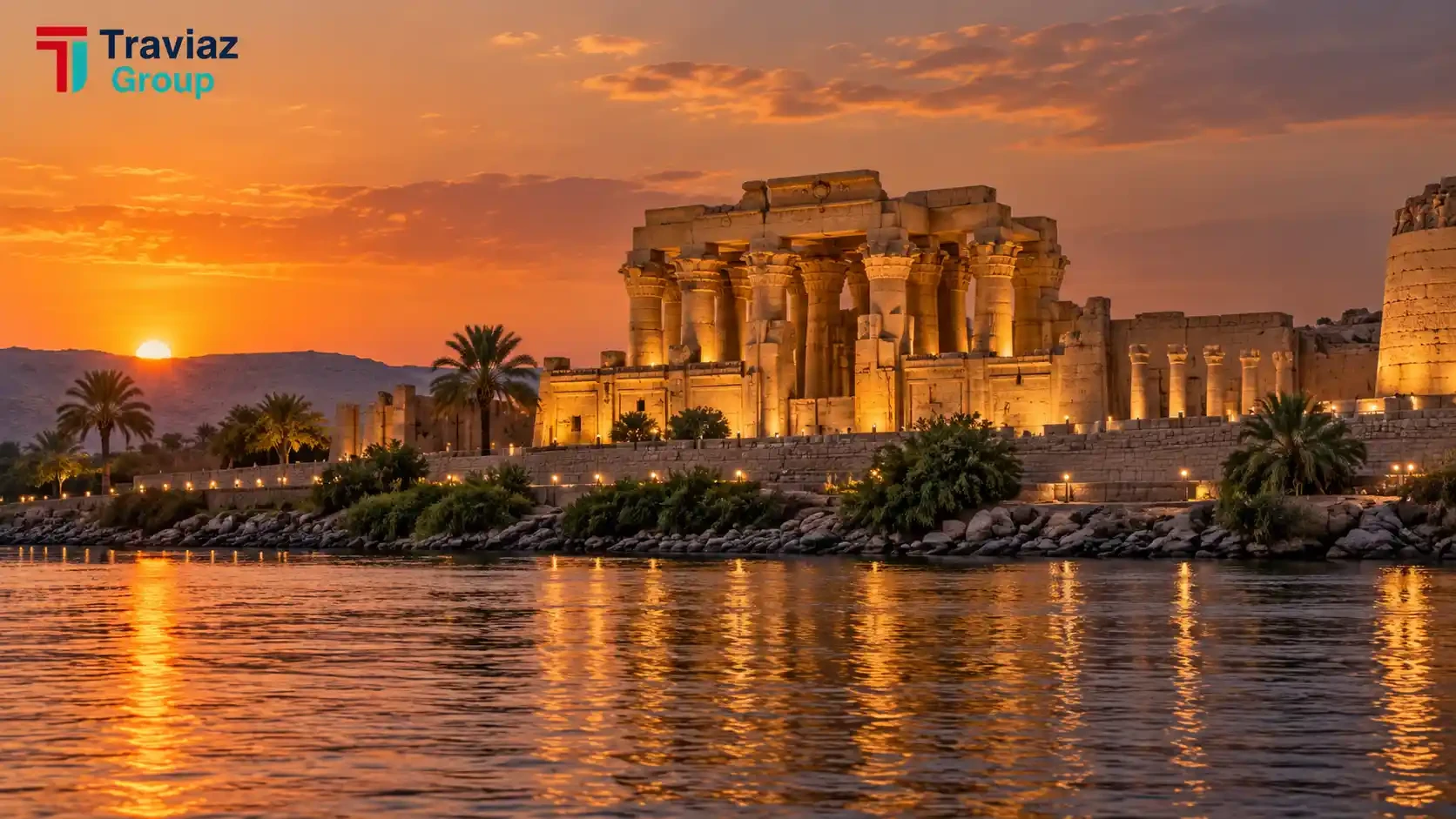
Many travellers combine Edfu Temple with Kom Ombo Temple during a Nile cruise or private transfer between Luxor and Aswan. This pairing allows visitors to compare two distinct temple designs and religious focuses within a single travel day.
A Seamless Experience
For travellers seeking a structured Upper Egypt itinerary that includes Luxor, Edfu Temple, Kom Ombo, and Aswan, curated experiences arranged by Traviaz ensure smooth logistics, expert guidance, and balanced pacing—allowing you to explore Egypt’s most complete temples with clarity and comfort.
FAQs About Edfu Temple
What is Edfu Temple famous for?
Edfu Temple is famous for being one of the best-preserved ancient temples in Egypt. It is dedicated to the god Horus and is particularly known for its detailed mythological reliefs depicting the battle between Horus and Seth. Its massive pylon entrance and intact sanctuary make it one of the most complete temple experiences in Upper Egypt.
Who built Edfu Temple?
Edfu Temple was built during the Ptolemaic period between 237 BC and 57 BC. Construction began under Ptolemy III and was completed under Ptolemy XII. Although built under Greek rule, the temple follows traditional ancient Egyptian religious and architectural design.
How far is Edfu Temple from Luxor?
Edfu Temple is located approximately 110 kilometers (about 68 miles) south of Luxor. The journey typically takes around two hours by car or is included as a stop on most Nile cruises traveling between Luxor and Aswan.
How long do you need at Edfu Temple?
Most visitors need between 1 and 2 hours to explore Edfu Temple comfortably. This allows enough time to see the pylon entrance, courtyard, hypostyle hall, sanctuary, and the main mythological reliefs without feeling rushed.
Is Edfu Temple worth visiting during a Nile cruise?
Yes, Edfu Temple is absolutely worth visiting during a Nile cruise. It is one of the most complete temples in Egypt and provides a clear understanding of ancient temple design and religious practices. For many travellers, Edfu Temple becomes one of the highlights of their Upper Egypt journey.
Can you visit Edfu Temple without a guide?
Yes, Edfu Temple can be visited independently, as the layout is easy to follow. However, a guide enhances the experience by explaining the religious symbolism, mythological narratives, and historical context that may not be immediately visible.
Conclusion
Edfu Temple is more than just a stop between Luxor and Aswan — it is one of the most complete and visually powerful temples in Egypt. From its towering pylon and richly carved reliefs to the sacred sanctuary of Horus, Edfu Temple offers visitors a rare opportunity to experience ancient Egyptian architecture in its near-original form.
What makes Edfu Temple truly exceptional is its clarity. Unlike vast temple complexes that evolved over centuries, this monument presents a unified religious space that allows travellers to understand ancient rituals, symbolism, and temple design with remarkable precision.
Whether you are travelling independently or as part of a Nile cruise, including Edfu Temple in your Upper Egypt itinerary adds depth, balance, and historical continuity to your journey along the Nile.
For travellers seeking a seamless and expertly curated experience across Luxor, Edfu, Kom Ombo, and Aswan, customized itineraries arranged by Traviaz ensure smooth logistics, licensed Egyptologist guidance, and thoughtfully structured visits — allowing you to explore Egypt’s most complete temples with insight and comfort.
Plan beyond the highlights, travel with clarity, and let Edfu Temple become a defining moment of your journey through Upper Egypt.