Three Egyptian cities in a 5 day Egypt tour that combines the most prominent landmarks of historic Cairo, the most important Pharaonic sites of Luxor, and the coastal atmosphere of Alexandria, without needing a long holiday or a high budget.
The Cairo Alexandria Luxor tour begins with the Pyramids and the Grand Egyptian Museum, then moves by air to Luxor to explore the Valley of the Kings, Karnak, and the Temple of Hatshepsut, before returning to Cairo and heading toward Alexandria.
The program is one of the best budget egypt tours including a specialist Egyptologist guide, a private air-conditioned car, five-star hotel accommodation, meals, entry fees for the specified sites, and two domestic flights to save travel time
Upon your arrival at Cairo International Airport, a Traviaz representative meets you to assist with arrival procedures and luggage collection, then a private air-conditioned car accompanies you to your five-star hotel.
The first day is dedicated to settling in after travel and preparing for the upcoming tours, without adding sightseeing visits that may tire you before the program begins.
This day combines the most famous Giza landmarks with a visit to the Grand Egyptian Museum, before heading to Cairo airport to fly to Luxor.
After breakfast at the hotel, you set off with your private guide to explore the main sites according to the visit order and entry times.
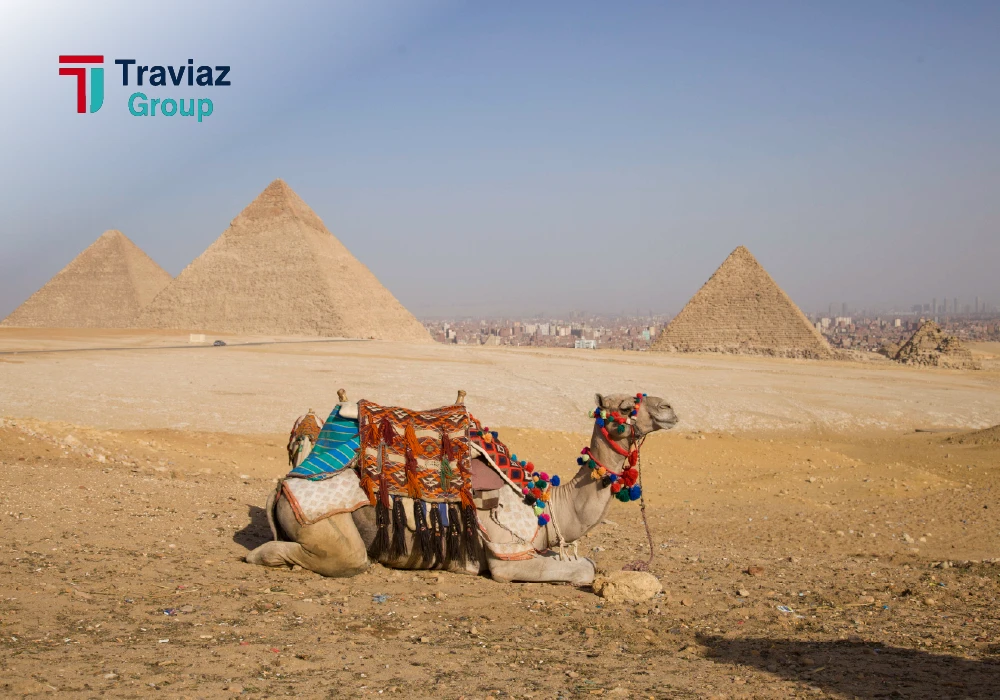
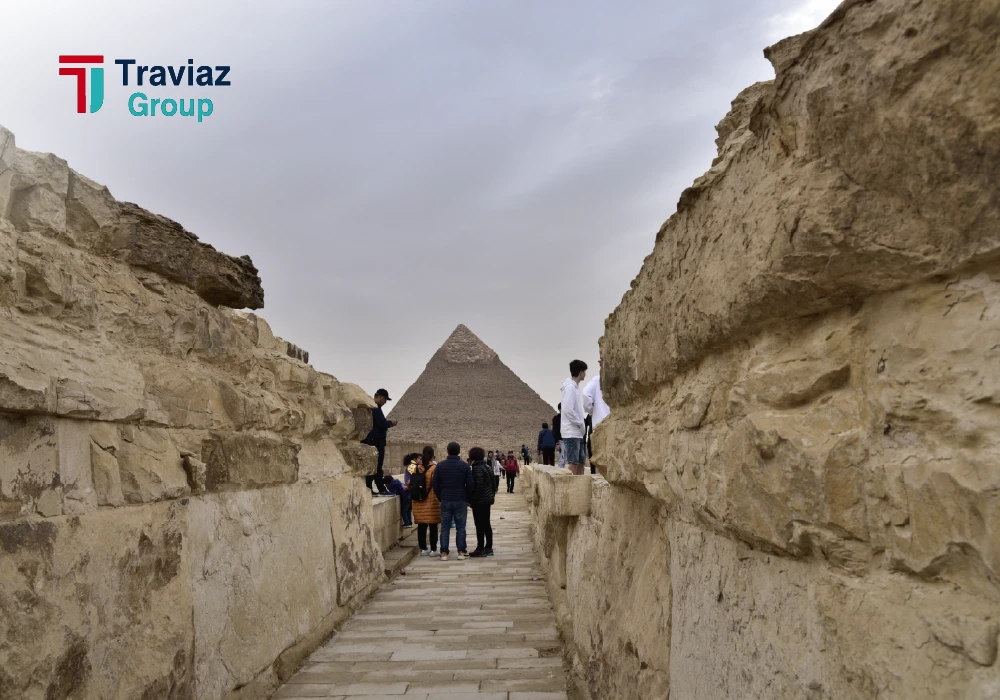
The Giza Plateau holds the three main pyramids, built for kings of the Fourth Dynasty during the Old Kingdom period.
The Pyramid of Khufu is the largest among them, built approximately between 2580 and 2560 BC, its original height reaching approximately 146.6 meters, while the length of each side of its base reaches approximately 230 meters.
The pyramid remained the tallest man-made structure in the world for long centuries, exceeding according to common estimates 3,800 years.
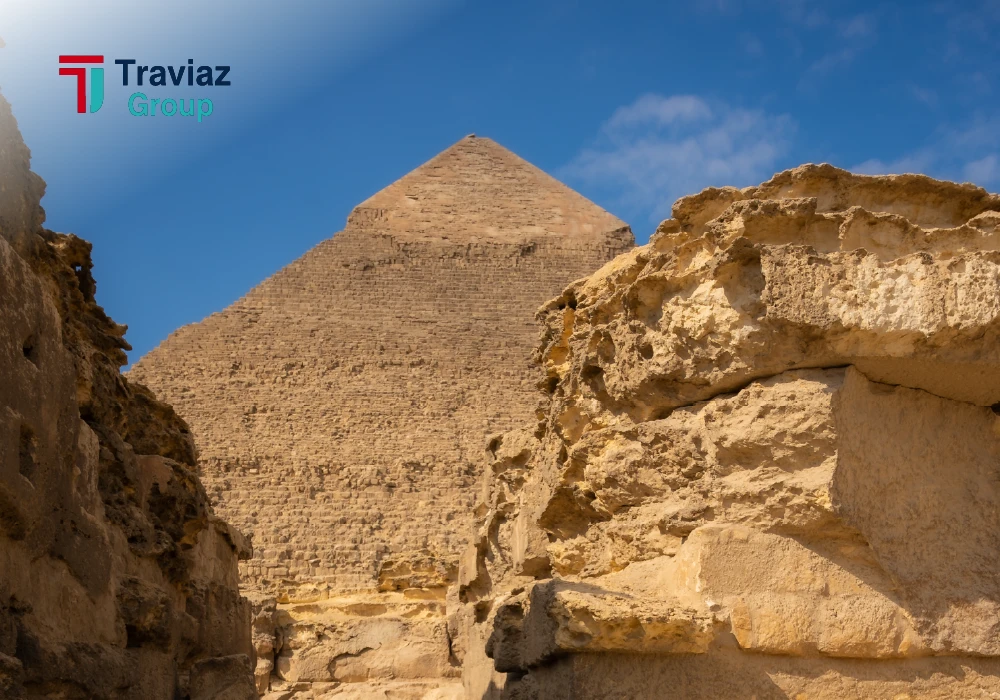
The Pyramid of Khafre draws attention with the remains of the light stone casing still visible near its summit, while the Pyramid of Menkaure is distinguished by the presence of red granite in sections of its lower casing.
Near the pyramids, the Great Sphinx rests, carved from limestone, at a length of approximately 73 meters.
The Dream Stele also stands between its paws, a stele linked to Pharaoh Thutmose IV that was erected during the second millennium BC.
The Grand Egyptian Museum is located near the Giza Plateau and presents a wide collection of artifacts documenting the history of Egyptian civilization across different eras.
The museum opened officially on the first of November 2025 according to the information in the program, and it holds more than 100,000 artifacts.
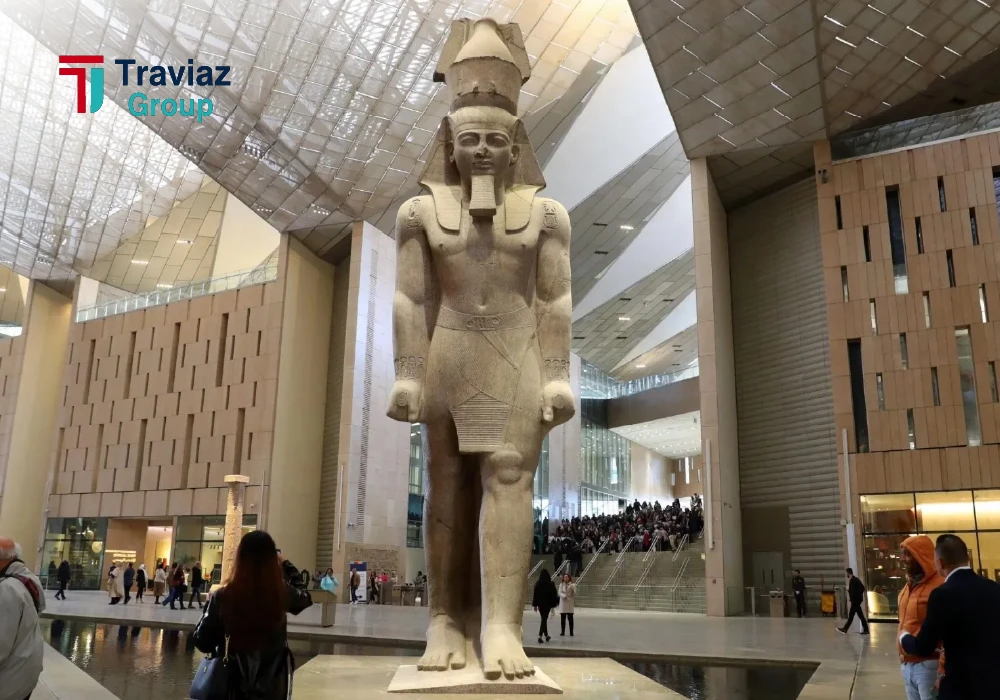
Upon entering the atrium hall, the massive statue of Ramesses II greets you, before continuing along the route toward the Grand Staircase flanked by prominent artifacts, then the main exhibition halls.
Among the most notable collections linked to the museum are the Tutankhamun artifacts, numbering more than 5,000 pieces from tomb KV62.
The way the collection is displayed provides the chance to learn about multiple aspects of the young king's life and burial rituals, alongside seeing the famous golden mask, whose gold weight is estimated at approximately 11 kilograms.
After the tour ends, you have lunch at a local restaurant, then transfer to Cairo airport to fly to Luxor. The flight takes approximately one hour, and arrival is usually in the evening depending on the flight time.
Upon arrival, a Traviaz driver meets you and transfers you to your five-star hotel.
The tour in Luxor begins with exploring its main archaeological sites, with time dedicated to the West Bank before returning to Cairo in the evening.
This day allows you to learn about the royal tombs and funerary temples, then visit the Karnak Complex which reflects multiple phases of ancient Egyptian history.
The New Kingdom kings, during the period extending approximately from 1550 to 1070 BC, chose the Valley of the Kings as the burial site for a number of Egypt's pharaohs.
The valley holds more than 63 tombs carved into the rock, dating to kings and nobles from different eras, and the choice of rock tombs was a means of distancing the burial sites from the exposed form of the ancient pyramids and limiting their exposure to looting.
The basic ticket usually allows visiting a limited number of tombs, generally covering three tombs according to the current ticketing system, while the Tomb of Tutankhamun KV62 requires a separate ticket.
The interior walls are distinguished by paintings and carvings depicting the king's journey in the afterlife, alongside religious texts covering resurrection, judgment, and the stages the deceased passes through according to ancient Egyptian beliefs.
The funerary temple of Queen Hatshepsut was built at Deir el-Bahari during the fifteenth century BC, in the reign of the Eighteenth Dynasty.
Hatshepsut ruled as pharaoh, and her reign lasted more than twenty years, leaving prominent architectural landmarks among them this temple known as "Djeser-Djeseru," whose name translates to a meaning linked to Holy of Holies.
Senenmut, one of the most prominent figures linked to her architectural projects, designed the temple in the form of three terraced colonnades harmonizing with the limestone cliff behind them.
The carvings on its walls recount the details of her trading expedition to the land of Punt, and they also address the legitimacy of her rule and her connection to the god Amun.
After her death, her images and names were subjected to some defacement during the reign of Thutmose III, but the building remained as a witness to her architectural and political ambition.
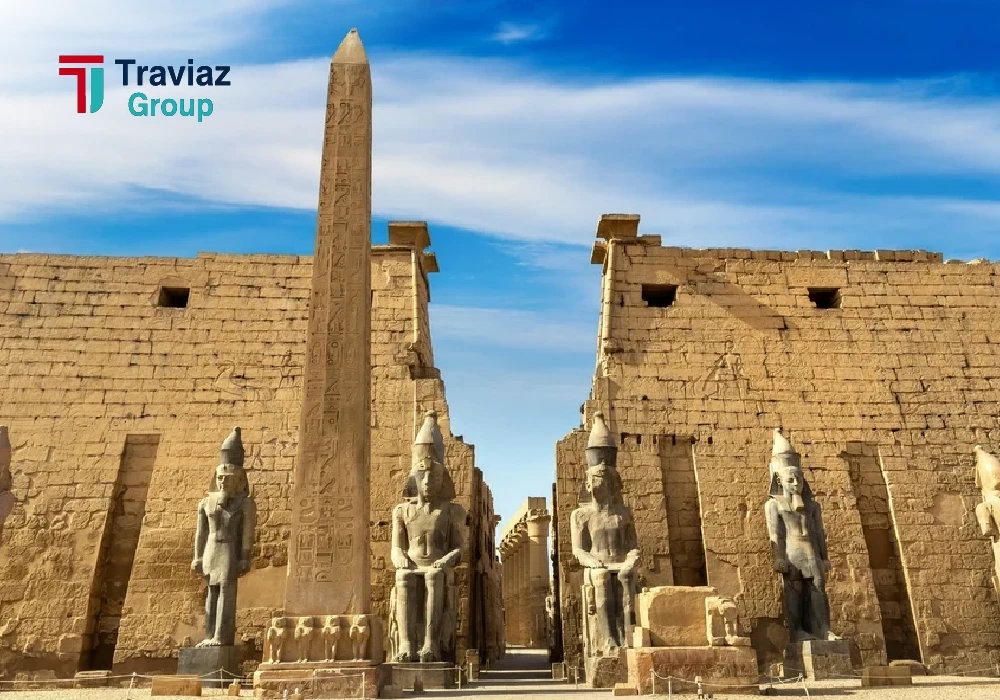
The Karnak Temple Complex extends on the East Bank of the Nile and is considered one of the largest religious complexes in ancient Egypt.
Its sections were built and new buildings were added to it over long centuries, until it became a site holding temples, corridors, courtyards, and monuments reflecting multiple phases of Egyptian state history.
The Great Hall known as the Hypostyle Hall stands out among the complex's most important landmarks, holding 134 stone columns distributed across 16 rows and covering an area of approximately 5,000 square meters.
Construction of the hall began in the reign of Seti I, and Ramesses II completed sections of it, with the massive columns and carved decorations giving the visitor the chance to understand the level of architectural development that ancient Egypt achieved.
After lunch in Luxor, you head to the city's airport to board the flight to Cairo, and the flight takes approximately one hour. Upon arriving in the evening, a Traviaz driver transfers you to the hotel to continue the stay in the capital.
You leave Cairo in the morning heading to Alexandria in an overland journey taking approximately two and a half hours via the desert road, depending on traffic conditions.
On the Mediterranean coast, Alexandria presents a different character from the capital, as ancient Egyptian monuments stand alongside Greek, Roman, and Ottoman influences, and the layers of its history appear in its landmarks, buildings, and streets.
The Catacombs of Kom El Shoqafa carry a name linked to the hills of broken pottery found in the area.
The site was discovered in 1900 after a donkey fell into a ground opening that revealed the entrance to the funerary complex, which subsequently became one of Alexandria's most prominent archaeological sites.
The history of these catacombs dates back to the Roman era, and they include underground levels reaching a depth of approximately 35 meters.
The importance of the site lies in the blending of artistic and cultural elements from Egypt, Greece, and Rome within a single funerary space.
In some scenes, the Egyptian god Anubis appears in Roman military attire, while the decorations combine ancient Egyptian symbols with details inspired by Greek art and Roman architecture.
These elements reveal the cultural interaction that characterized Alexandria during the early centuries of the Common Era.
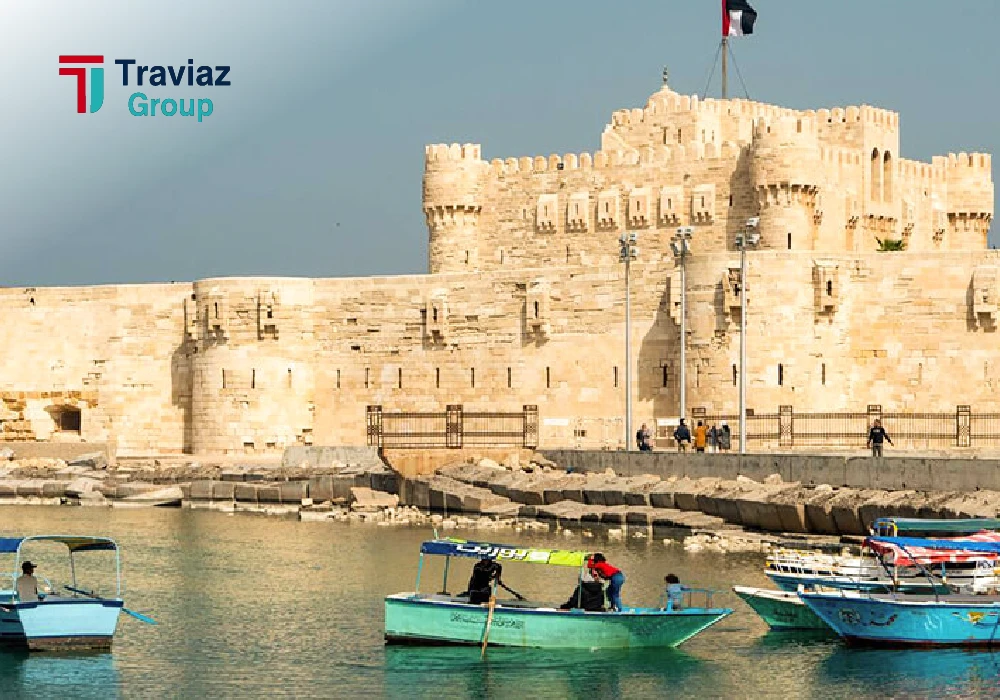
The Citadel of Qaitbay is located on the Mediterranean coast, and the Mamluk Sultan Qaitbay ordered its construction in 1477 AD on the site linked to the ancient Lighthouse of Alexandria, one of the Seven Wonders of the Ancient World.
After the lighthouse suffered repeated damage from earthquakes during the Middle Ages, stones from the ancient site were used in building the citadel, according to what historical accounts mention.
The citadel combines a defensive function with historical importance, and it also gives visitors views of the sea and the surrounding harbor.
Inside it are architectural elements worth exploring, among them the mosque and some stone details reflecting the history of the structure and the development of its use over time.
The modern Bibliotheca Alexandrina opened in October 2002 near the site of the ancient library linked to the city's scientific and cultural history.
The ancient library was founded during the Ptolemaic era in the third century BC and became one of the most famous centers of knowledge in the ancient world, with its name linked to scholars such as Euclid, Archimedes, and Eratosthenes.
The modern building is distinguished by a circular tilted design resembling a sun disc, and it holds reading and research facilities, museums, and specialist centers, alongside large collections of books and references.
The visit provides the chance to learn about a contemporary dimension of Alexandria's identity, while recalling the position the city held in the history of science and knowledge.
After finishing the Alexandria visits, you return by car to Cairo in preparation for departure the following day.
Start your day with breakfast at the hotel, then prepare for departure and head to Cairo International Airport.
A Traviaz representative assists you with departure arrangements according to the agreed service, to conclude your trip after visiting Cairo, Luxor, and Alexandria over five days.

7 day egypt tour combines the Giza Pyramids, the Sphinx, and the Grand Egyptian Museum in Cairo, then the Luxor temples and the Valley of the Kings, with a private Egyptologist guide and at competitive prices.
The trip begins in Cairo, then heads south to Aswan on an overnight train, continues along the Nile to Luxor, before returning to Cairo on day six.
If 5 days is too much, we can do a 2-day tour of Egypt. Enjoy a thoughtfully designed 2-day women-only experience in Egypt, which will be perfect for you. This tour package was specially created to offer you comfort, meaningful exploration, and absolute confidence. On this 2-day tour, you will visit some of the most impressive landmarks in Egypt, all within a fully supportive, relaxed travel environment.