
The Ultimate Aswan High Dam Visitor Guide: Everything You Need to Know
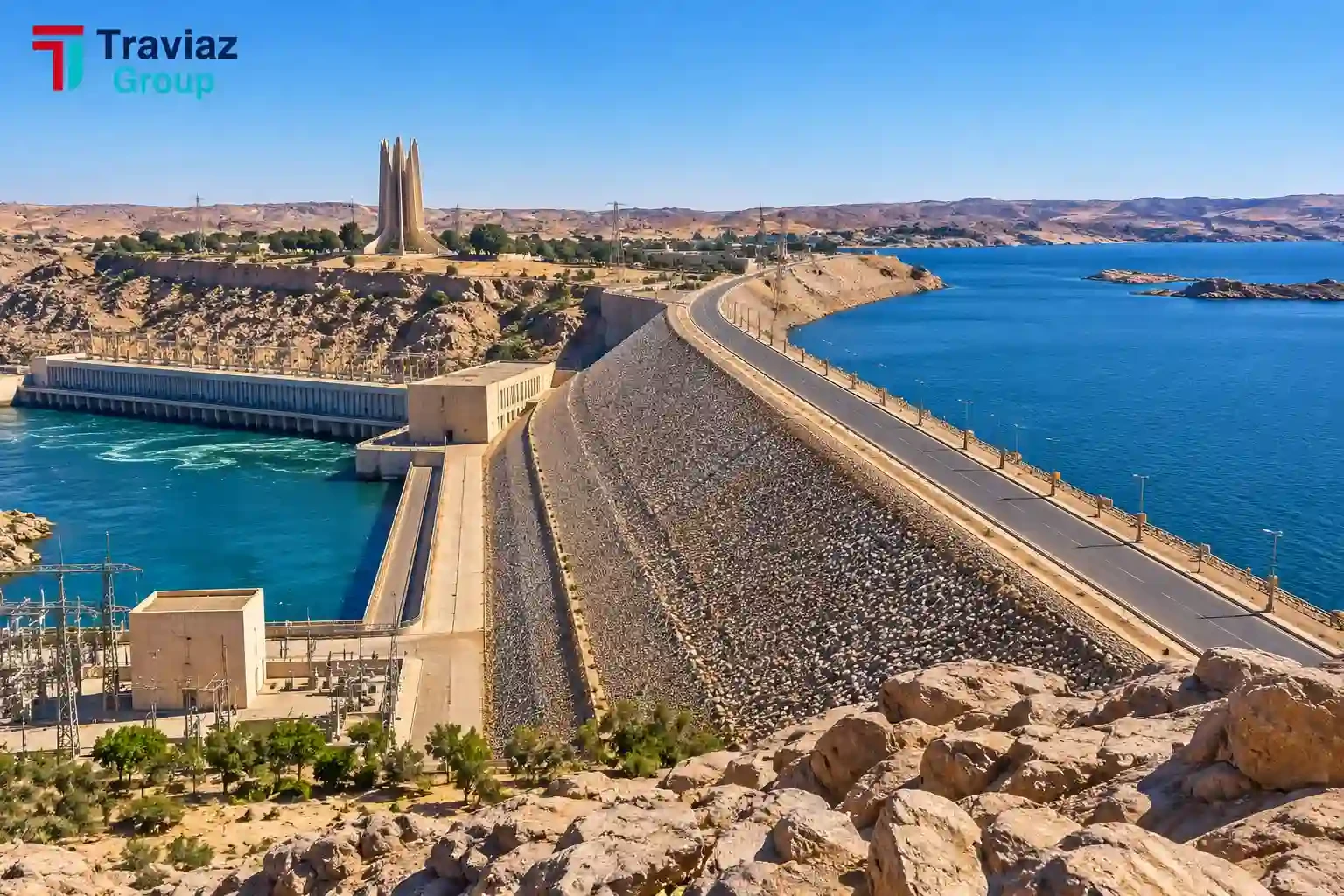
The Aswan High Dam is considered one of the greatest civil engineering projects of the twentieth century, and it was built to control the Nile floods and store its waters. It was completed in 1970 after a full decade of construction, and approximately 35,000 Egyptian workers supported by Soviet experts took part in its execution. Lake Nasser formed behind the dam and is considered the third largest artificial water reservoir in the world by volume. Traviaz experts visit the dam regularly with their guests and know the details of the visit that may not appear in travel guides, from military checkpoints to the best angles for photographing Lake Nasser.
Essential Practical Information for Your 2026 Visit
Before arriving at the High Dam, there is practical information that determines the difference between a smooth visit and one full of unexpected obstacles.
Always carry your passport in case it is requested at checkpoints, and make sure to bring sunscreen and a hat since the site is completely exposed.
Arrange the return trip with the driver before departure, as taxis may be scarce in the area when needed. Below are the full details for every aspect of the visit:
What is the Aswan High Dam Entrance Fee for Foreigners in 2026?
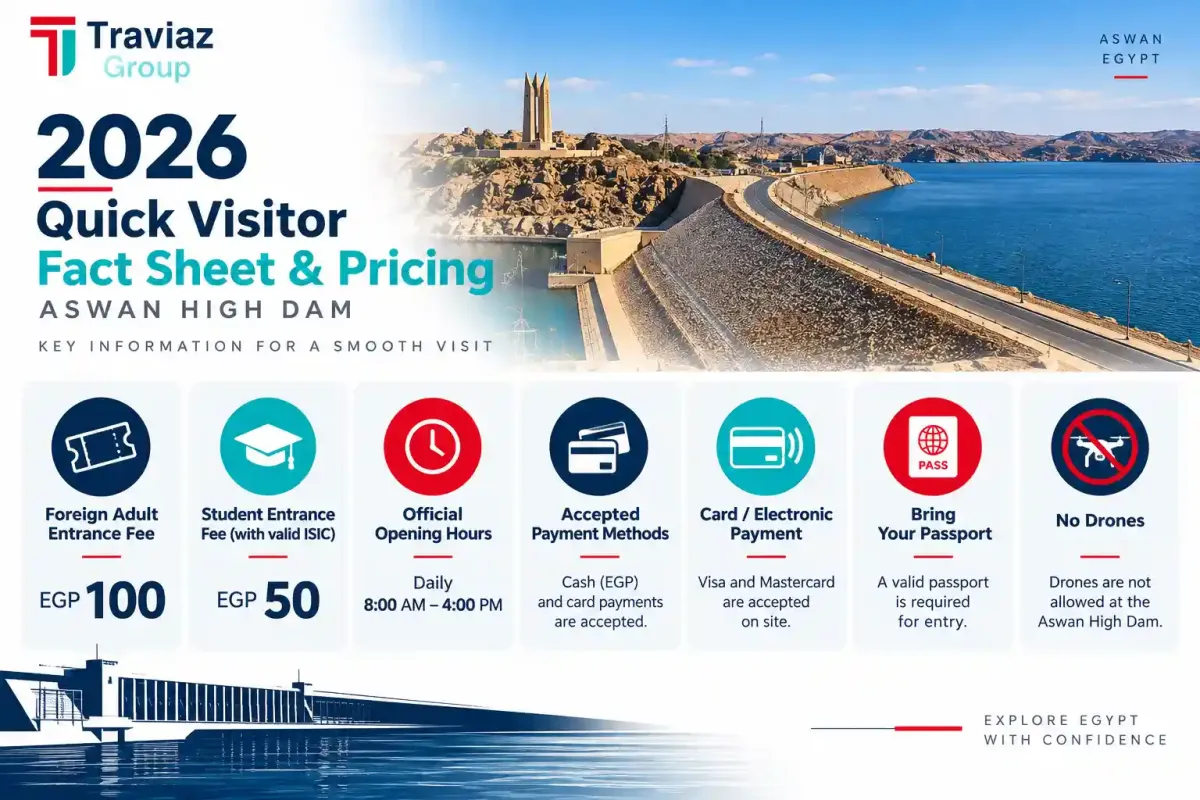
The High Dam ticket price for foreign visitors is 200 Egyptian pounds, which is approximately 4 to 5 US dollars. Students holding a valid ISIC card receive a 50% discount according to circulating ticket information.
Tickets are purchased from booths at the dam entrance before the military checkpoint. Most accredited tour companies, such as Traviaz, include the ticket price within the tour package without additional fees.
Egypt is gradually moving toward electronic payment at tourist sites, but carrying cash remains useful to avoid any sudden technical malfunction.
Opening Hours & The Best Time of Day to Visit
The dam area generally opens during daylight hours, with commonly reported times running from 7:00 AM to 5:00 PM.
Visit hours may change during Ramadan and official holidays, so checking in advance with the tour provider is advised. The early period between 8:00 and 10:00 AM is the most suitable for avoiding the arrival of group tour buses and the intensifying heat of Aswan.
One to one and a half hours is enough to see the site carefully without exhaustion.
Security Restrictions and Photography Rules
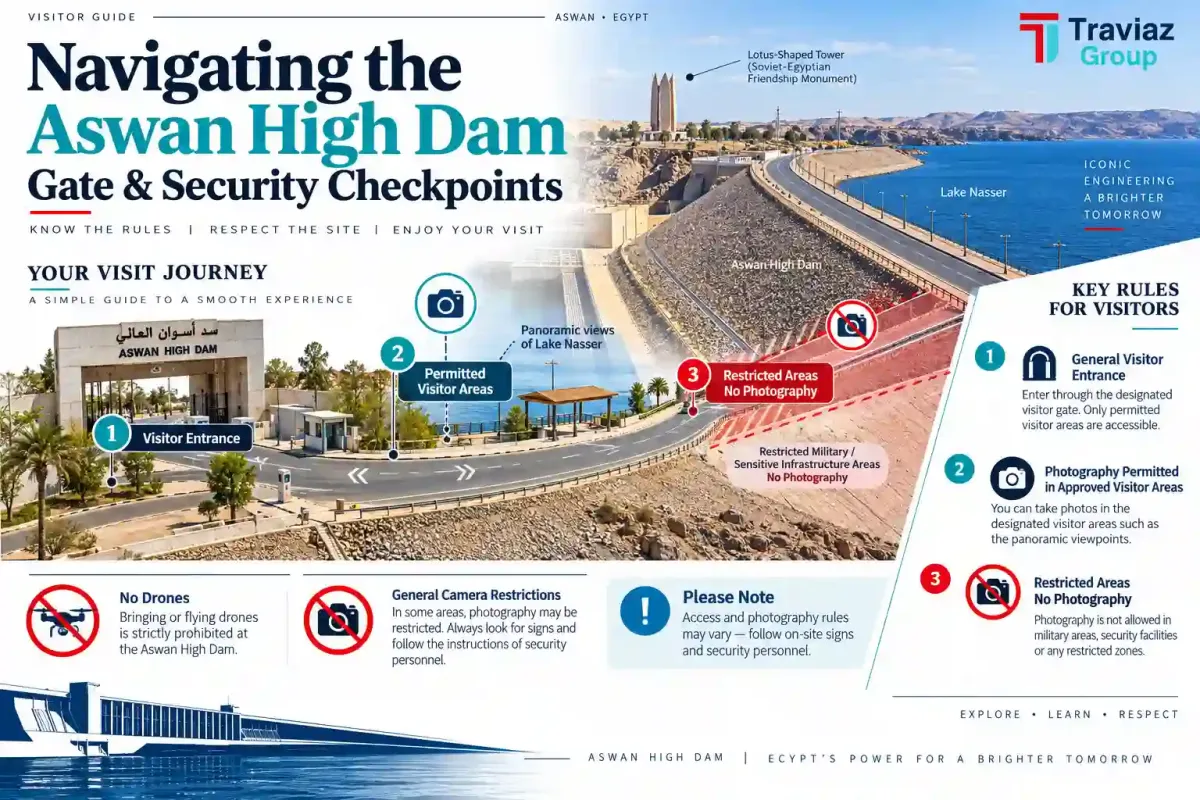
The High Dam is a strategic national facility subject to special security procedures, and for that reason the visit passes through several requirements upon arrival.
Entry procedures include mandatory checkpoints, bag inspection, and sometimes a request for a passport. Photography with a personal phone or camera is permitted in the pedestrian areas and the main viewing point according to current instructions.
Photographing military installations, the power station, and checkpoints is explicitly prohibited. Failure to comply with photography instructions may result in device confiscation or security measures. Drones are banned above the dam and in its surrounding airspace without the required official permits.
How to Get to the Aswan High Dam
Reaching the High Dam requires more advance planning than many visitors expect, especially regarding arranging the return trip. Available transport options differ in comfort, cost, and flexibility, so it is better to decide on the means before leaving Aswan. Below are the main options with a practical assessment of each:
Distance from Aswan City Center and Nile Cruise Ships
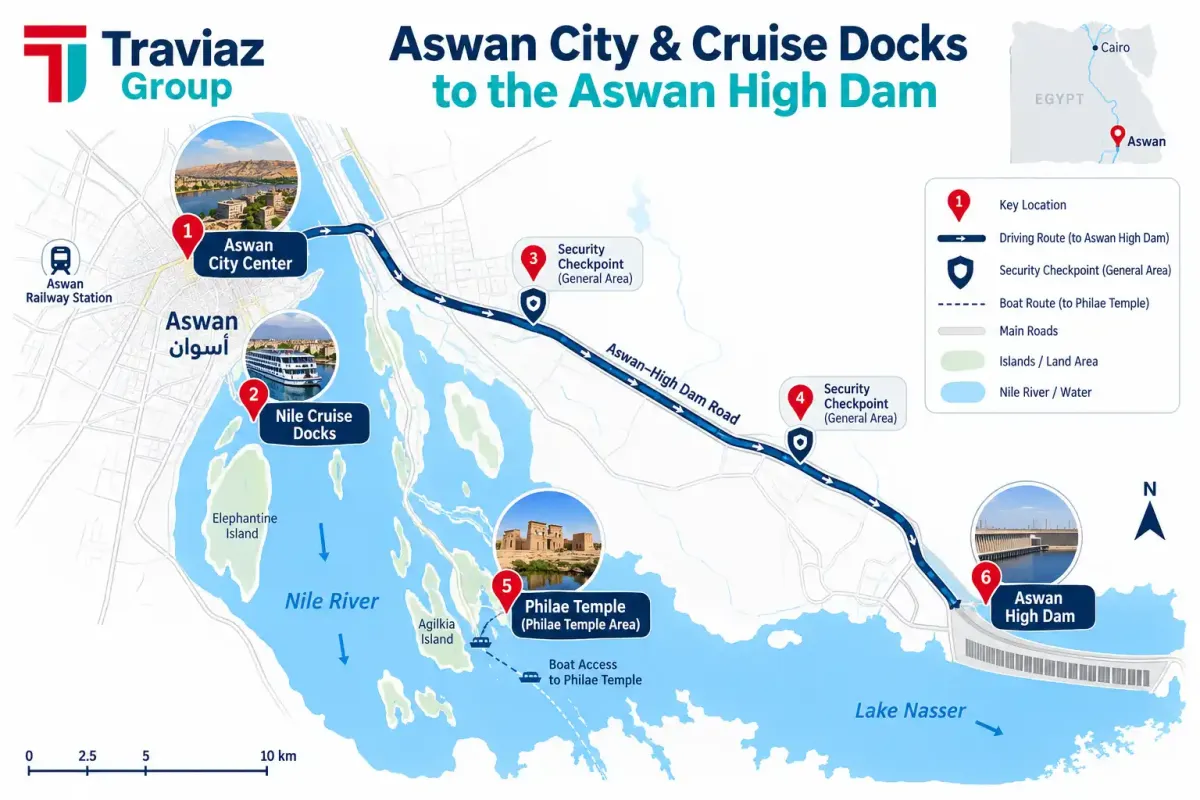
The High Dam sits approximately 8 kilometers south of Aswan city center, and the car journey takes about 15 to 20 minutes under normal conditions. Nile cruise passengers docked in Aswan need a vehicle from the dock to the dam.
There is no reliable direct river trip that can be depended on between the ship berths and the dam. The dam's location can easily be found via Google Maps by searching "Aswan High Dam."
Taxi Fares and Transportation Hacks
Taking a taxi one way only from Aswan to the dam is a common mistake among many independent travelers. Taxis are scarce in the dam area, and whoever arrives without arranging the return may find themselves waiting in the Aswan heat.
The practical solution is to negotiate a round-trip price with the driver waiting until the visit ends. The price usually ranges between 150 and 250 Egyptian pounds for the full trip, with the cost varying depending on trip conditions.
Agree on the price before getting in and specify the waiting time precisely to avoid any dispute on the return.
The Stress-Free Route: Private Transfers with Traviaz
A private certified driver through Traviaz eliminates much of the transport anxiety and negotiation, and allows the visitor to focus on the experience rather than being occupied with return logistics.
The air-conditioned vehicle becomes a practical necessity in the Aswan heat, while a driver who knows the area saves valuable time by avoiding congested roads. The Traviaz integrated package includes the dam, the Unfinished Obelisk, and Philae Temple within a single half-day.
The package starts from $40 per person according to the price listed in the program, with the cost varying depending on booking details.
What to Expect On-Site: Facilities, Views, and Comfort
The actual visit to the High Dam differs from visiting ancient temples, because you are standing before modern infrastructure more than a traditional archaeological site.
The scene centers on the dam body, Lake Nasser, the Nile, and the viewing points available to visitors. Below is a realistic expectation of what can be found upon arrival:
Bathrooms, Wheelchair Access, and Visitor Facilities
Bathrooms are located in the reception area at the main entrance, and their condition is reasonable compared to the bathrooms at some archaeological sites.
Pedestrians move along paved walkways above the dam body and on the pavements surrounding the main viewing point. A wheelchair can be used in most main areas, but some stone surfaces and slight inclines may require assistance.
There is no visitor center or museum inside the site, and services are concentrated around the viewing point and the inspection procedures.
What Should You Wear and Bring?
The High Dam is a completely exposed site with no trees or natural shade, so good preparation determines how comfortable the visit will be. Bring SPF 50 sunscreen and apply it before arriving, as direct sun exposure begins the moment you enter the open areas.
A wide-brimmed hat is a practical necessity during temperatures that may exceed 40 degrees Celsius. Carry a water bottle of at least two liters, as vendor availability inside the site may be limited. Sunglasses protect the eyes from the sun's reflection off the waters of Lake Nasser. Light, light-colored clothing remains the best choice as it reflects heat rather than absorbing it.
Can You Walk Across the Entire Length of the Dam?
Visitors can walk across the dam body from one side to the other according to the areas open to visits and the current security instructions. This experience gives a perspective that cannot be obtained from other viewing points.
On the southern side, the vast expanse of Lake Nasser appears stretching approximately 550 kilometers toward Sudan. On the northern side, the Nile appears returning to its natural course after passing through the dam.
Walking the full available route takes about 15 minutes depending on visit conditions, but accessibility may differ according to security restrictions.
The Lotus-Shaped Tower (Soviet-Egyptian Friendship Monument)
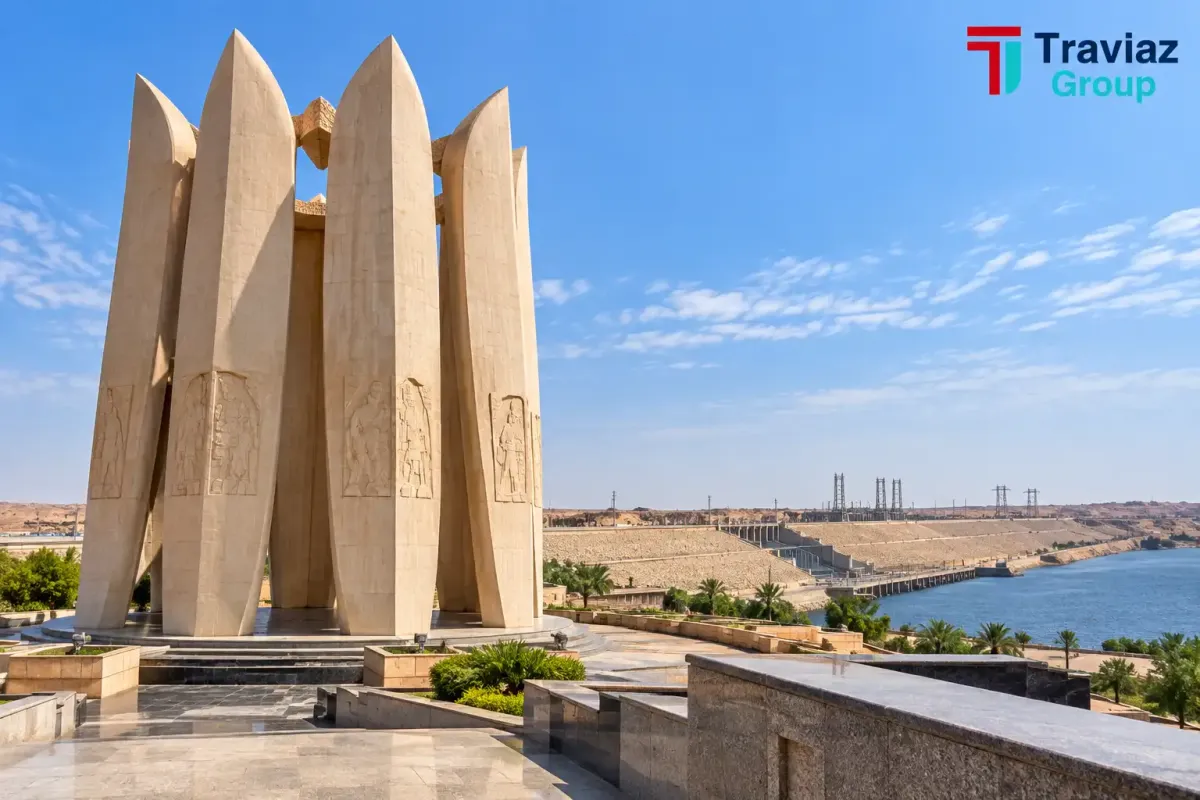
The distinctive tower rises on the western bank of the dam with a design inspired by the shape of the lotus flower. The monument was erected to commemorate the Egyptian-Soviet cooperation that contributed to building the dam after Western funding was withdrawn in 1956.
The tower can be climbed for a panoramic view of the dam, the Nile, and Lake Nasser from a single angle. Climbing requires a separate additional ticket beyond the basic entrance ticket.
The Aswan High Dam Experience vs. Nearby Landmarks
The value of the High Dam appears more clearly when it is read within the context of the surrounding landmarks and the story of the antiquities affected by the formation of Lake Nasser.
This connection helps in understanding the relationship between the modern project and the rescue of the Nubian temples. The following comparison helps in building a logical daily itinerary that maximizes the value of each site:
Is the High Dam Worth Visiting Compared to the Temples?
The High Dam does not compete with the temples in archaeological spectacle, but it completes them with a deeper historical and engineering meaning.
Whoever visits Abu Simbel and Philae without seeing the dam misses an essential part of the story linked to the rescue of these temples. The rise of Lake Nasser's waters threatened many archaeological sites, and an international campaign began to rescue and move them to safer locations.
One to one and a half hours within a full-day tour with Philae and the Unfinished Obelisk makes a suitable itinerary for those who want to understand the complete story.
Aswan High Dam vs. Unfinished Obelisk: Which First?
The Unfinished Obelisk in the granite quarry represents the ancient Egyptians' technique of extracting and carving stone, while the dam represents twentieth-century engineering in water management.
The two sites bring together two different stages of Egyptian engineering development across thousands of years. Start with the obelisk in the early morning when the air is cooler and photography conditions are better. Head to the dam in mid-morning before the heat reaches its peak.
Aswan Low Dam vs. High Dam: What is the Difference?
The British built the Low Dam in 1902 with the aim of reducing floods and regulating the Nile's waters, but it did not fully control them. The Low Dam became less able to meet Egypt's needs as the population grew and agricultural land expanded.
The High Dam brought a broader solution by storing a massive amount of water, with a designed storage capacity reaching 169 billion cubic meters. The project at the same time led to the submersion of vast areas of Nubian lands and the resettlement of tens of thousands of Nubians away from their original villages.
Engineering Marvel: How Does the Aswan High Dam Work?
The High Dam presents an exceptional model of water management and large-scale infrastructure, especially for those interested in engineering and natural resources.
The project combines water storage, flow regulation, and electricity generation within a single facility. Below are the technical specifications that embody the scale of this achievement and how it works:
How Big is the Aswan High Dam?
The dimensions of the dam and Lake Nasser illustrate the scale of the project directly, and the basic specifications bring together length, height, and storage capacity.
The High Dam extends 3,830 meters, which is more than 3.8 kilometers, and reaches a height of 111 meters. The width of the dam's base in some sections reaches approximately one kilometer, while the width at the top is about 40 meters.
The total volume of construction materials used equals several times the volume of the Pyramid of Khufu according to comparisons used to illustrate the project's scale.
Lake Nasser extends approximately 500 kilometers, with some estimates reaching around 550 kilometers southward toward Sudan. The lake's area is approximately 5,250 square kilometers, while its designed storage capacity reaches 169 billion cubic meters.
The Hydroelectric Plant and Industrial Impact
The hydroelectric power station integrated into the dam body contains 12 turbines, and its total production capacity is 2,100 megawatts.
When the dam was completed in 1970, the station was producing what was equivalent to a large portion of Egypt's electricity consumption at the time, with a figure of approximately half being cited.
This sustained electricity production made it possible to support various industries, including aluminum manufacturing and the development of the chemical fertilizer industry.
The electricity also helped expand the agricultural irrigation network and support agricultural expansion across wide areas of Egypt.
History and Ecological Impact
The decision to build the High Dam was not purely an engineering decision, but was tied to political, civilizational, agricultural, and water factors whose effects have extended to this day.
The project changed the way Egypt manages the Nile's waters, while it also produced significant environmental and social changes.
The following sections explain the story of the project from the reasons for construction through to its impact on the environment and antiquities:
Why Was the High Dam Built and Who Built It?
The need to build the High Dam arose from Egypt's historical suffering with the fluctuation of the Nile flood between years of severe flooding and periods of drought.
Years of strong flooding threatened crops, while years of low water led to the drying out of land and the reduction of resources available for agriculture.
Egypt requested funding from the United States, Britain, and the World Bank in 1956, but Western funding offers retreated amid escalating political disputes. The Soviet Union then intervened and provided the funding, experts, and equipment needed to execute the project.
Approximately 35,000 Egyptian workers took part in the construction alongside Soviet expertise, and the dam later became an important symbol of Egyptian national sovereignty.
What Lake Was Created by the Aswan High Dam?
Lake Nasser formed behind the High Dam, and its designed storage capacity reaches 169 billion cubic meters. The lake is considered the third largest artificial water reservoir in the world by volume, according to classifications that rely on reservoir capacity.
The lake achieved important benefits for Egypt, but it also produced environmental changes linked to the retention of water and sediment. Its most prominent benefits included water security during drought years, commercial fishing, and year-round irrigation rather than full dependence on the flood season.
On the other hand, the lake retained the fertile silt behind the dam, which reduced the arrival of natural deposits to agricultural land. This change increased farmers' dependence on chemical fertilizers to maintain soil fertility.
How Did the Dam's Construction Impact Ancient Monuments?
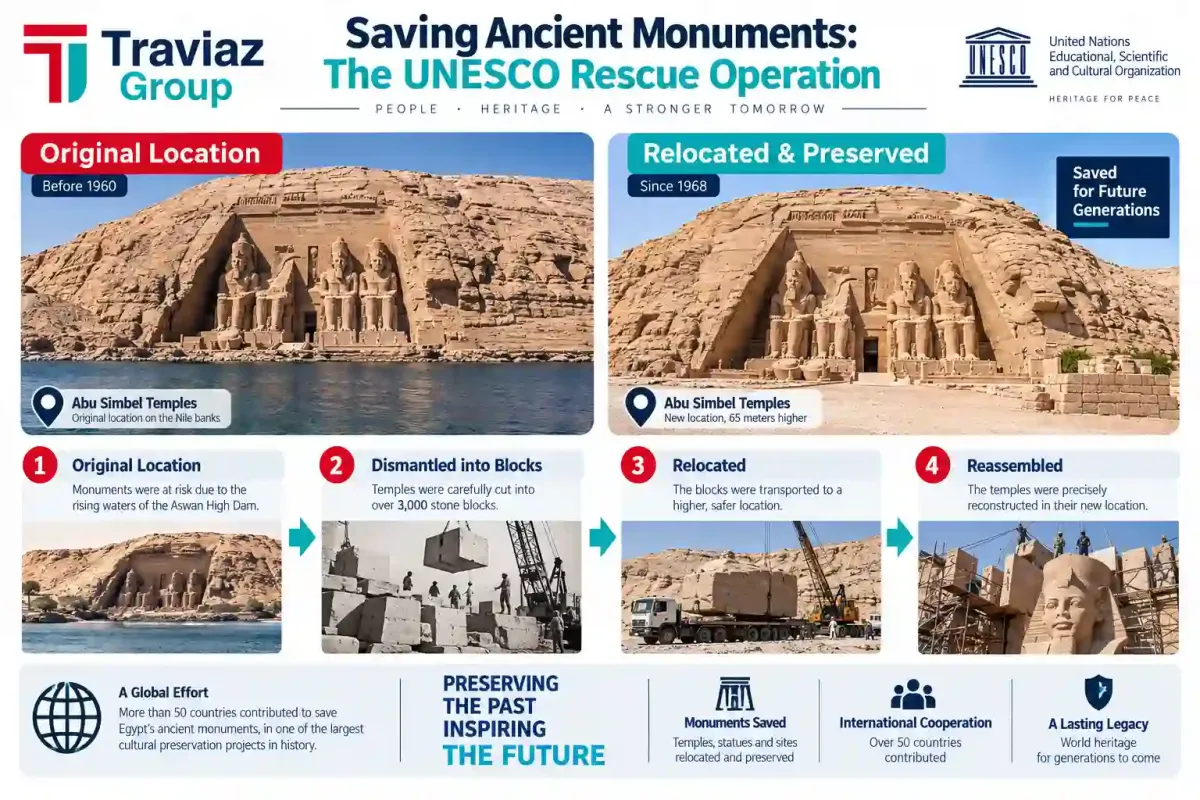
When the waters of Lake Nasser rose, dozens of archaeological sites became threatened with complete submersion, and UNESCO launched a massive international campaign in 1960 to rescue them.
The campaign covered a large number of Nubian temples and sites, and rescue operations continued until 1980. The campaign is reported to have saved 22 monuments and architectural complexes from submersion, within one of the largest antiquity rescue operations in history.
Abu Simbel Temple was cut from its original rock into more than a thousand stone blocks, then moved approximately 65 meters upward and reassembled with engineering precision. The reconstruction process preserved the solar illumination phenomenon that Ramesses II designed inside the temple.
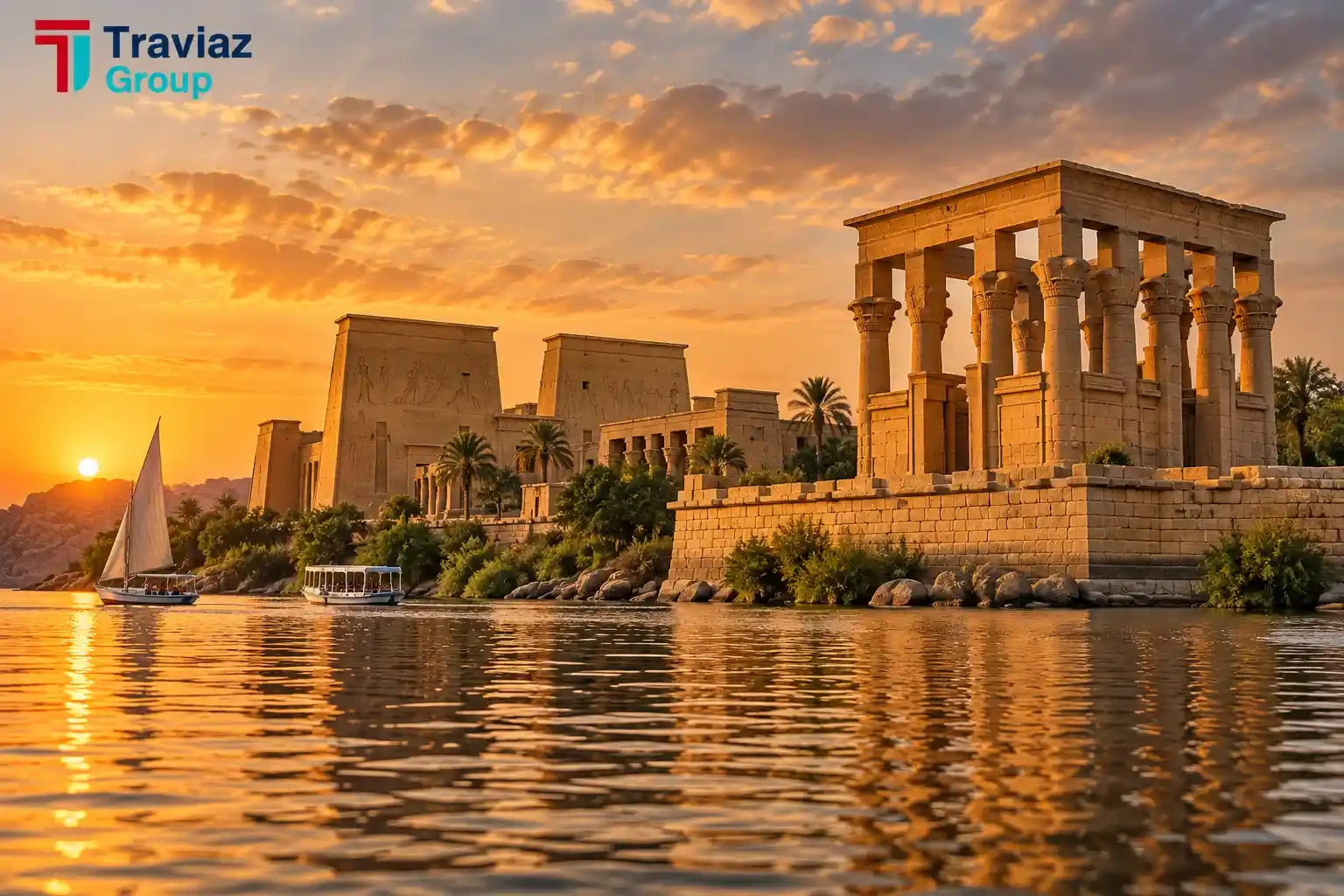
Philae Temple was moved in its entirety from its original island to the neighboring island of Agilkia at a higher elevation. Kalabsha Temple was also moved to its current location near the dam, as part of the Nubian antiquities rescue efforts.
Best Booking Tour Options for Aswan Engineering Marvels
The High Dam can be combined with the nearby engineering and archaeological landmarks within a half-day program when the route is organized properly. Arranging visits in a logical order reduces travel time, and also helps avoid the peak heat during the day. Below are the most important planning options for the tour before choosing a booking method:
Planning a Joint Philae Temple, Unfinished Obelisk, and High Dam Tour
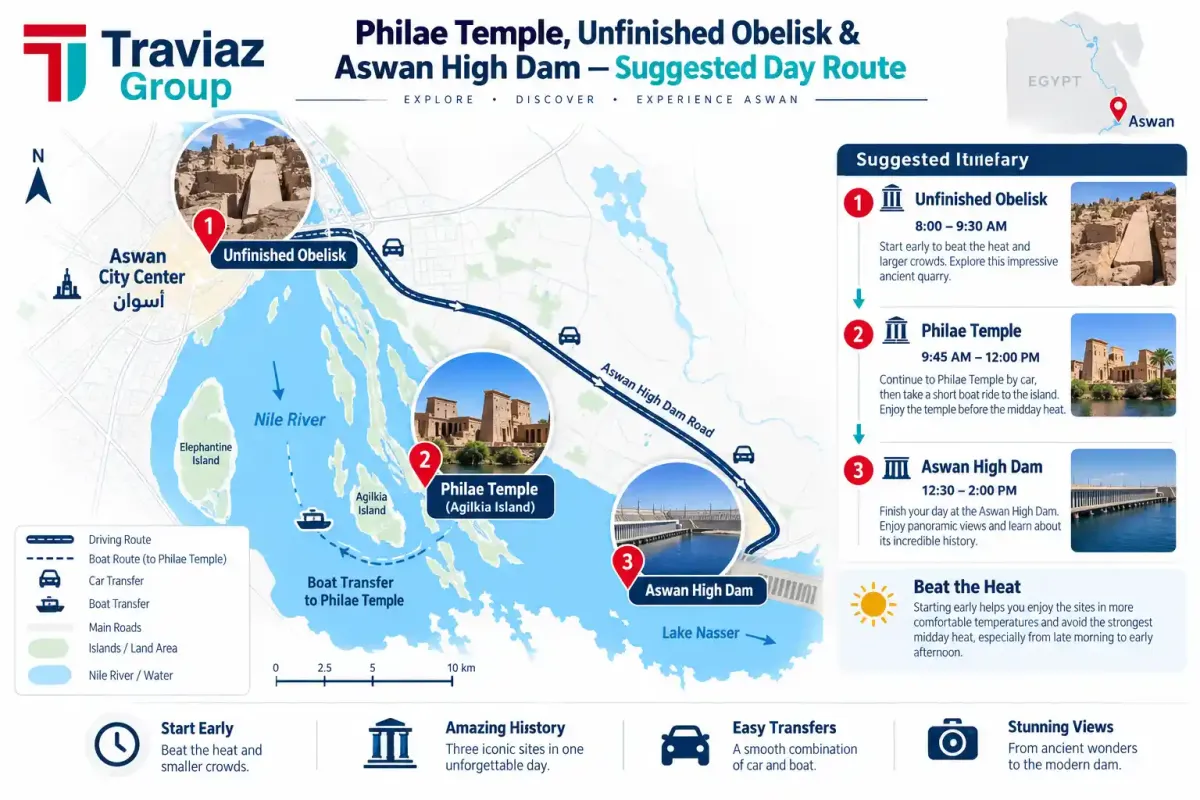
A half-day is enough to cover all three sites if the tour follows a logical order that minimizes travel and avoids peak heat. Start with the Unfinished Obelisk at 8:00 AM when the quarry is in relative shade and the atmosphere is cooler. Head to the dam between nine and ten to enjoy the view before the sun intensifies. Finish the tour with Philae Temple, which gains a different beauty during the evening visit and under warm natural lighting.
Why Book a Private Guide Through Traviaz?
A private certified guide through Traviaz transforms the High Dam visit from a silent viewing point into a complete historical and engineering experience. The guide connects the story of the submersion that threatened Abu Simbel with the rescue efforts made possible by the UNESCO campaign.
He also explains the background of Nasser's decision to build the dam after the West refused to fund the project. The private tour helps connect the dam with the Unfinished Obelisk and Philae Temple within a single program. For booking and inquiries about integrated Aswan packages, Traviaz can be contacted.
FAQs
When was the High Dam completed?
Construction began in 1960, and the dam body was completed in 1970 after a full decade of construction with the participation of approximately 35,000 Egyptian workers and Soviet expertise. The dam was officially inaugurated on January 15, 1971, so 1970 is associated with the completion of the project's body and 1971 with its official inauguration.
Can the dam be reached by boat from the Nile?
There is no regular and reliable river service between Aswan and the High Dam. A private car or taxi remains the practical means of access, and private transport within the tour package can also be relied upon.
Is the dam open during Ramadan?
The dam is open during Ramadan, but visit hours may change according to the schedules applied during the month. Checking the updated times with the tour provider before going is always advised, especially when planning a program with a fixed time.
Is there a student discount at the High Dam?
There is circulating information about holders of a valid ISIC card receiving a 50% discount on the ticket price. Confirming the discount application when purchasing the ticket is preferable, as price categories and discounts may change according to the instructions in effect at the time of the visit.