
Exploring Philae Temple in Aswan: The Ultimate 2026 Guide to the Temple of Isis
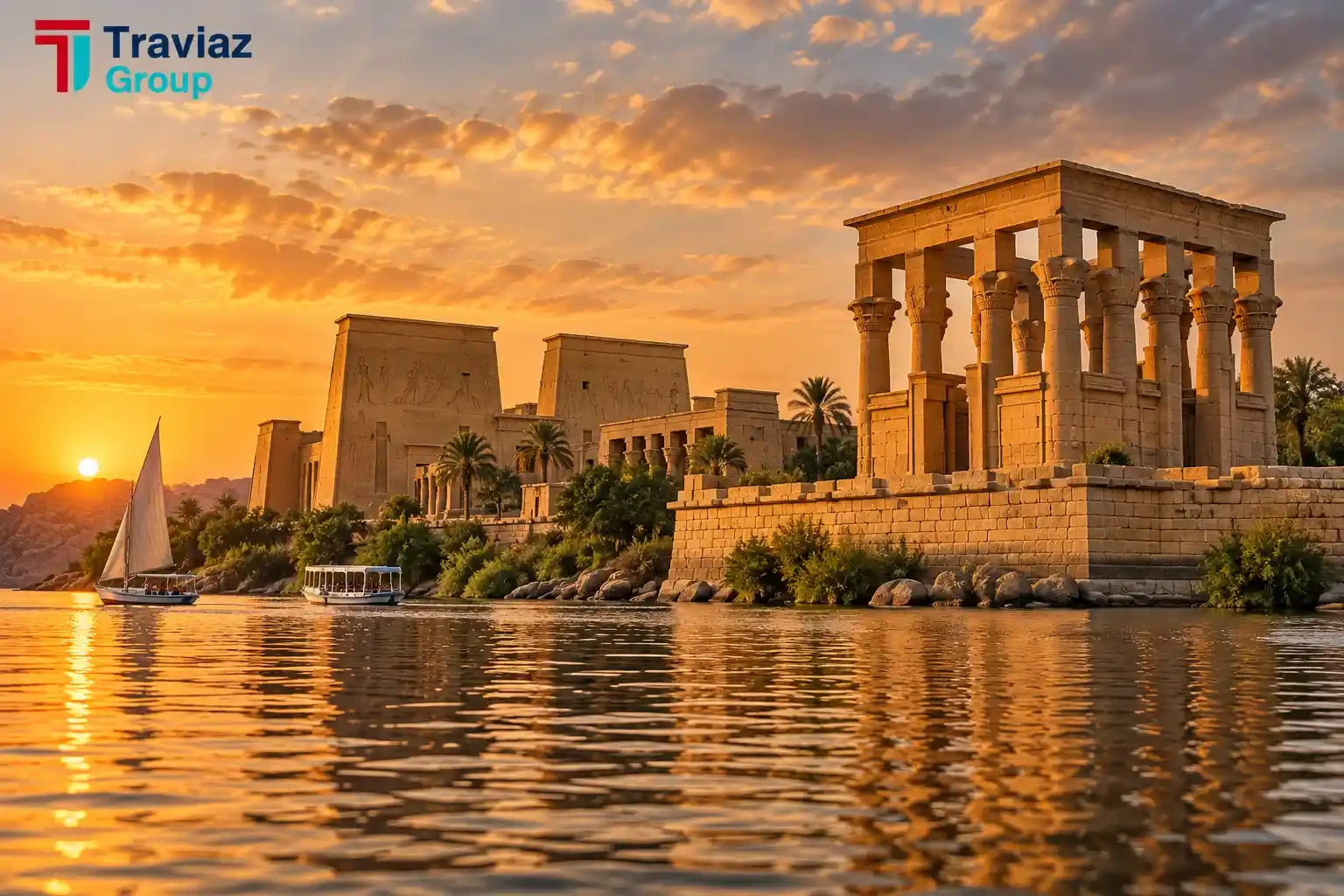
Philae Temple in Aswan is the Temple of Isis built on Agilkia Island, 8 kilometers south of Aswan city. Access to the site is only possible by boat crossing the waters of the Low Dam reservoir.
The temple's construction dates back to the fourth century BC, and it remained the last ancient Egyptian temple actively used for worship until the fifth century AD.
Its greatest distinction among Egypt's temples is that it does not stand on its original site, as UNESCO rescued it from permanent submersion under the waters of Lake Nasser in one of the largest archaeological rescue operations in human history.
What is the Philae Temple Famous for and Is It Worth Visiting?
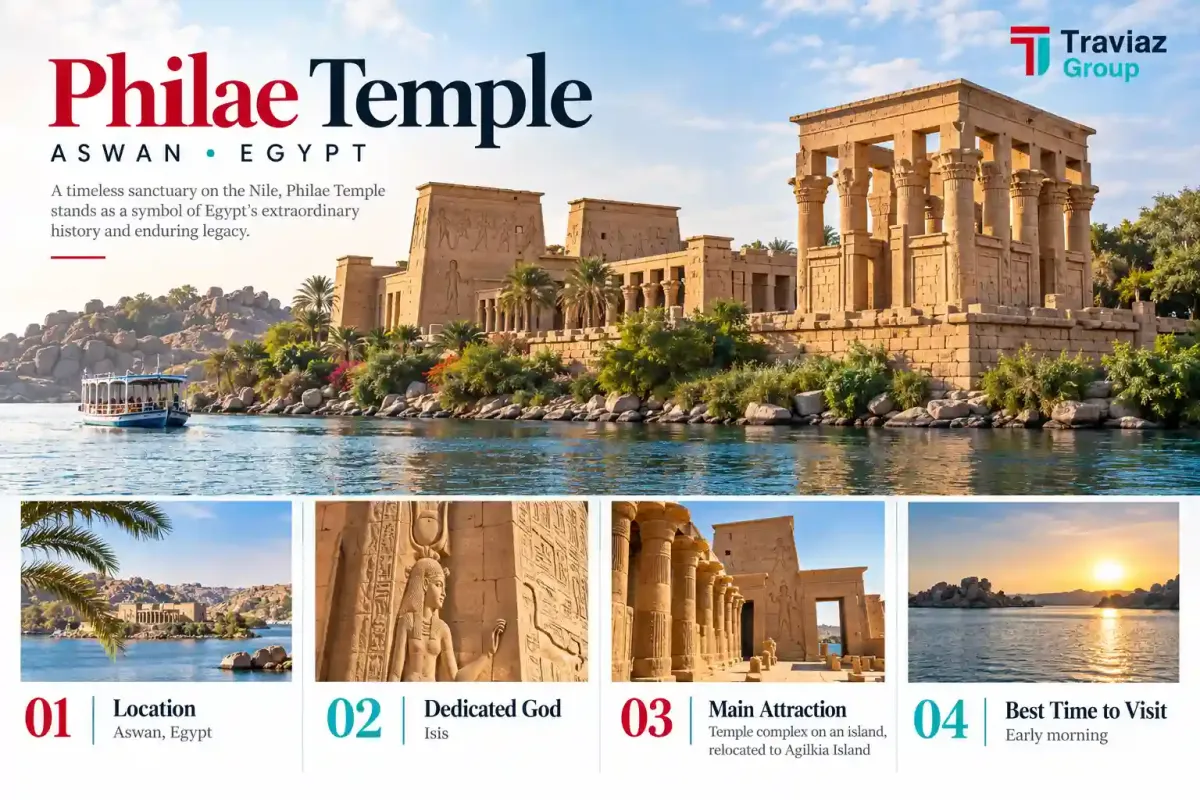
The importance of Philae Temple goes beyond its striking architectural beauty, as it represents one of the most significant sites for understanding the continuation of ancient Egyptian religion through later eras.
The temple is considered the last known site in the ancient world where hieroglyphics were actually used, as scholars found the last known hieroglyphic inscription carved on its walls, dating back to 394 AD.
The goddess Isis, associated with motherhood, magic, and healing, is the temple's main religious figure. Its walls tell the complete myth of Osiris, from his murder at the hands of his brother Seth to the revival of his body by Isis.
The combination of Egyptian, Greek, and Roman styles within a single complex adds a rare architectural value that does not repeat itself with this consistency at any other site.
Philae Temple vs Abu Simbel and Edfu Temple
Scale and immediate visual impact are among Abu Simbel's strongest points over Philae. Philae, on the other hand, is distinguished by its architectural diversity and its historical extension across multiple layers.
Edfu Temple is classified as the most architecturally complete among Egypt's smooth-sided temples, while Philae's island setting offers a completely different arrival experience.
Kom Ombo is known for its unique theological duality, while Philae adds to its religious and architectural value the story of its rescue from submersion, which makes every wall and every column a witness to an exceptional human effort.
History of Philae Temple: Through the Centuries
The Philae complex did not take shape during the reign of a single king or within a limited period of time. Construction, modification, and addition within it extended across ten continuous centuries, and for that reason the site carries accumulated historical layers that distinguish it from most other Egyptian temples.
The sections below explain the development of the complex from its beginnings through to its relocation to Agilkia Island:
Who Built Philae Temple?
The oldest structures found in the Philae complex date back to the reign of Nectanebo I of the Thirtieth Dynasty during the fourth century BC.
Most of the buildings the visitor sees today are linked to the Ptolemaic era, particularly the work of Ptolemy II Philadelphus who built the first great gateway.
Ptolemy III and Ptolemy XII added the main pylons and halls, then the Roman period saw the construction of the Kiosk of Trajan and the Gateway of Hadrian.
The final result was a complex that represents a living record of politics and religious architecture across approximately one thousand continuous years.
Mythological Significance: The Story of Isis and Osiris
The myth of Osiris occupies the center of the religious life that Philae's walls reveal. According to the ancient Egyptian narrative, Seth killed his brother Osiris and tore his body into fourteen pieces which he scattered across different locations in Egypt.
Isis's journey to find the scattered pieces was arduous, but she eventually managed to gather them and reassemble the body using her magic. Osiris's return to life enabled Isis to conceive their son Horus.
The ancient Egyptians' belief that one of Osiris's body parts came to rest at Philae made the island a pilgrimage center that visitors traveled to from across the ancient world.
Worship continued in the temple until 537 AD, when the Byzantine Emperor Justinian ordered its closure and conversion into a Christian church.
Why Was Philae Temple Moved to Agilkia Island?
The fate of the original Philae Island was tied to the construction of the High Dam during the 1960s. It was clear at the time that the waters of Lake Nasser would permanently submerge the island, which threatened the entire complex.
UNESCO's international appeal launched in 1960 helped mobilize efforts to rescue the threatened Nubian monuments, and a coalition of 50 countries participated in funding and executing the operation.
The period between 1972 and 1980 saw the complex dismantled into 40,000 stone blocks, then transferred to the neighboring island of Agilkia.
Agilkia's terrain was shaped to resemble the original Philae Island, and each block was then reassembled in its precise position with great engineering accuracy.
The current appearance of the temple makes it look as though it has always stood in its place, on a Nile island surrounded by water on all sides.
Architectural Masterpieces Inside the Temple of Isis
Philae brings together structures belonging to different eras, but their elements complement each other within a single architectural composition.
Each part of the complex reveals a different aspect of the site's religious, political, and artistic history. These are the most prominent landmarks that deserve a separate pause during the tour:
The First Pylon
The first great gateway reaches 18 meters in height and 46 meters in width, which places it among the widest preserved pharaonic gateways in Egypt. The outer facade carries scenes of Ptolemy XII presenting offerings to Isis, Horus, and Hathor.
The purpose of these scenes was not merely decorative, as the Ptolemaic dynasty used them to assert its religious legitimacy before the Egyptians despite its Greek origins.
The Forecourt and Mammisi
The forecourt extends between the two great gateways, with columns arranged on both sides to shade the ritual path that participants in ceremonies would follow.
The western side holds the Mammisi, meaning "birth house," a building dedicated to celebrating the birth of Horus, son of Isis.
The interior inscriptions present scenes of the divine child's upbringing, and they carry a style that recalls some birth scenes that appeared later in Christian art.
The Second Pylon and Hypostyle Hall
The second pylon, smaller in size, opens the way into the hypostyle hall whose columns are decorated with plant capitals of varied forms. Some columns carry Christian inscriptions added after the temple was converted into a church.
These details give the hall particular historical value, as they visually reveal the religious transformation the region underwent over centuries.
The Sanctuary of Isis (Inner Temple)
The sanctuary sits in the deepest part of the temple and is considered the most sacred room on the island. The sacred statue of Isis was kept inside this room, and only priests were permitted to enter it.
The condition of the interior walls remains exceptional, and the inscriptions detail the daily priestly rituals with precision that reveals a side of the temple's inner life.
Temple of Hathor
The eastern side of the complex holds the small Temple of Hathor, known for its rare musical scenes. The inscriptions depict musicians playing traditional instruments, including the harp, the flute, and percussion instruments.
These scenes give the visitor a different image of the celebratory and ritual life inside Philae, away from the usual royal scenes.
Kiosk of Trajan
The Kiosk of Trajan is the most photographed structure at Philae and represents the most famous image of the entire complex.
The Roman Emperor Trajan built it during the first century AD, and it consists of fourteen columns carrying large plant capitals, with side walls but no roof.
The light filtering between the columns casts moving shadows on the ground, and these shadows change with the hours of the day, so the kiosk remains an ideal location for photography at different times.
The Gateway of Hadrian
The Gateway of Hadrian sits on the western side of the complex and contains a distinctive scientific inscription depicting the mythical springs of the Nile. The ancient Egyptians believed these springs represented the source of the annual flood.
The inscription's importance goes beyond its religious value, as it is considered one of the most prominent iconographic documents illustrating the ancient Egyptians' conception of the mythological geography of the Nile.
Entry Fees, Opening Hours, and How to Buy Tickets (2026 Updated)
A Philae visit budget depends on three main elements: the temple entrance ticket, the boat fare, and the Sound and Light Show ticket if an evening visit is chosen. The expected prices for 2026 are shown in the table below:
|
Element |
Price |
Note |
|
Temple ticket for foreign adults |
550 Egyptian pounds (~$14) |
Covers full complex entry |
|
Student ticket |
275 Egyptian pounds |
Valid student card required |
|
Children under 6 |
Free |
|
|
Round-trip boat fare |
300 pounds per boat |
Fits 6 to 10 people |
|
Sound and Light Show ticket |
600 Egyptian pounds (~$13) |
Separate from the daytime ticket |
Temple opening hours run daily from 7:00 AM to 4:00 PM. Payment is generally made in Egyptian pounds cash, with some ticket booths accepting bank cards intermittently during 2026. Keeping a cash amount in Egyptian pounds remains the safest option to avoid any difficulty at the gate.
How to Get to Philae Temple from Aswan
The journey to reach Philae consists of two essential stages, and neither can be skipped. Knowing the steps in advance reduces confusion and helps avoid uncomfortable negotiations:
Getting to the Marina
The Philae marina sits on the eastern bank of the reservoir past the Low Dam, 8 kilometers south of central Aswan. A taxi ride from the city takes about 15 minutes and costs between 150 and 200 pounds one way.
Uber is available from within the city, but its reach to the marina may not be reliable at all times. Walking from Aswan to the temple is not practical due to the distance and the nature of the terrain.
The Boat Ride: Avoiding the "Philae Boat Scam"
The visitor upon arriving at the marina may face a number of boat operators who start with high offers ranging between 100 and 200 pounds per person.
The official approved price for a full round-trip boat with waiting is 300 pounds, while its capacity ranges between 6 and 10 people. Sharing the boat with another group is a suitable economical option.
Buying the temple ticket first from the ticket booths on the shore gives the visitor a better negotiating position before dealing with boat operators.
Traviaz clients bypass this stage entirely, as the package includes the pre-booked boat at a fixed price.
Best Time of Day to Visit Philae Temple
The most suitable time to visit Philae is determined by the purpose of the tour. Early morning, late daytime hours, and an evening visit each offer a different experience, and below are the details for each option:
For Photographers and Those Interested in Lighting Quality
The first and second hours after opening, between 7:00 and 9:00 AM, give a soft golden light that brings out the details of the Kiosk of Trajan and the pylon inscriptions.
The calm during this period is better before Nile cruise groups begin arriving between ten and eleven.
To Avoid Heat and Congestion
Arriving before nine in the morning allows about an hour and a half in moderate weather and less crowded conditions. After ten, groups start flowing in and temperatures rise noticeably.
For Those Visiting in Summer
Aswan's heat during July and August may exceed 42 degrees Celsius, so checking weather conditions before the visit becomes a practical matter.
A morning visit before nine or attending the Sound and Light Show in the evening represent the two most suitable options during summer.
The Sound and Light Show at Philae Temple
The Sound and Light Show at Philae ranks among the most famous evening performances in Egypt, and a large part of its appeal comes from the fact that reaching the island by boat after dark is itself an element of the experience, not merely a means of transport.
Show times during summer include three sessions daily at 7:00, 8:00, and 9:00 PM, while in winter the show begins an hour earlier.
Seven languages take turns presenting it, including Arabic, English, and French. The English-language session is usually held on Tuesdays and Fridays, but the schedule may change, so confirming it at the time of booking is advised.
The show's duration ranges between 45 minutes and an hour, and it includes a dramatic audio commentary narrating the myth of Isis and Osiris, alongside colored lighting that moves between the columns and pylons.
The nighttime boat fare is separate from the show ticket and ranges between 200 and 300 additional pounds.
Practical Visitor Information: Dress Code, Accessibility, and Facilities
Every visitor benefits from knowing a few practical details before arriving at the site, as they affect the comfort and flow of the visit. The points below cover the most important rules and facilities:
Dress Code and Photography Rules
Modest clothing covering the shoulders and knees is necessary when visiting religious temples in Egypt.
Photography using a personal phone or camera is permitted throughout the complex. Commercial photography requires a prior permit from the Antiquities Authority
Wheelchair Accessibility
Reaching the island requires boarding and disembarking from a moving boat, which is a genuine challenge for wheelchair users.
The floors inside the complex vary between uneven ancient stones and dirt paths, and there are also thresholds in some interior areas that require assistance.
Visitors with mobility difficulties are advised to contact Traviaz before the visit to arrange a suitable means of access and a more appropriate boat.
Toilets, Cafes, and Facilities
Bathrooms are available in the marina area before boarding the boat, and similar facilities exist on the island. There is no large cafe inside the site, but some vendors offer water and simple drinks.
Bringing a sufficient amount of water is a practical necessity, as prices on the island are higher than those within the city.
Why Book Your Philae Temple Tour with Traviaz?
The layers of meaning within the Philae complex cover religious myth, diverse architectural history, and the story of rescue from submersion.
A private certified guide through Traviaz presents these elements in a clear narrative sequence, so each stop inside the complex becomes a logical extension of the one before it.
Traviaz packages include air-conditioned transport from the hotel, the agreed boat fare, the temple ticket, and a specialist guide within a single organized and smooth tour.
To book or prepare an Aswan program that includes Philae, the High Dam, the Unfinished Obelisk, or Abu Simbel, traviaz.com can be visited.
FAQs
Is Philae Temple in Luxor or Aswan?
Philae Temple's location is Aswan specifically, on Agilkia Island which sits 8 kilometers south of the city. There is no direct connection between the temple and Luxor, even though both cities are located in Upper Egypt.
Can you visit Abu Simbel and Philae on the same day?
Combining the two sites in a single day is possible, but extremely exhausting. The Abu Simbel trip starts before dawn and takes several hours, while adding Philae during the second half of the day may leave the visitor finishing the day without fully enjoying either site. Traviaz's recommendation is to dedicate a separate day to each site.
Is there a student discount at Philae?
Students receive a ticket for 275 pounds instead of 550 pounds for adults, provided a valid ISIC international student card is presented.
Is the Sound and Light Show worth the extra cost?
An evening visit to Philae offers a completely different experience from the daytime tour. Riding the boat in the dark toward a lit island surrounded by colored columns and pylons adds a distinctive scene that does not repeat itself in the same way at any other site in Egypt