
Ancient Egyptian Temples: The Ultimate Bucket List Guide to the Pharaohs' Wonders
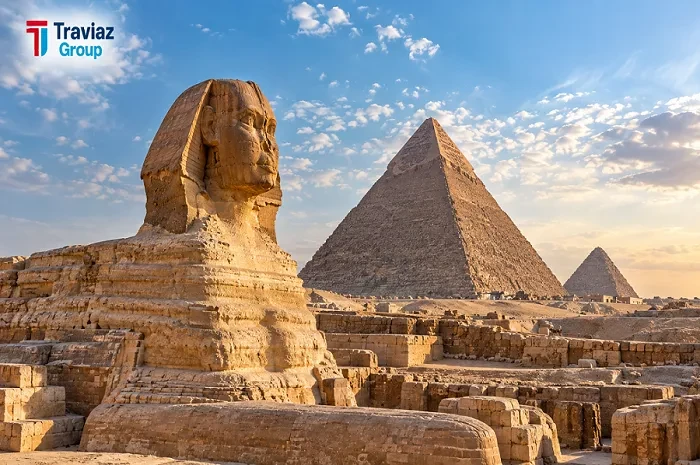
Ancient Egyptian temples are not tombs. They are architectural structures built as permanent homes for the gods, where priests performed daily rituals, pharaohs demonstrated their divine authority, and entire cities organized their lives around the calendar of religious festivals. Built primarily from sandstone, limestone, and granite, they differ from the pyramids in both purpose and location: the pyramids are royal funerary monuments concentrated around Giza and Saqqara in the north, while the temples are distributed along the Nile heading south into Upper Egypt.
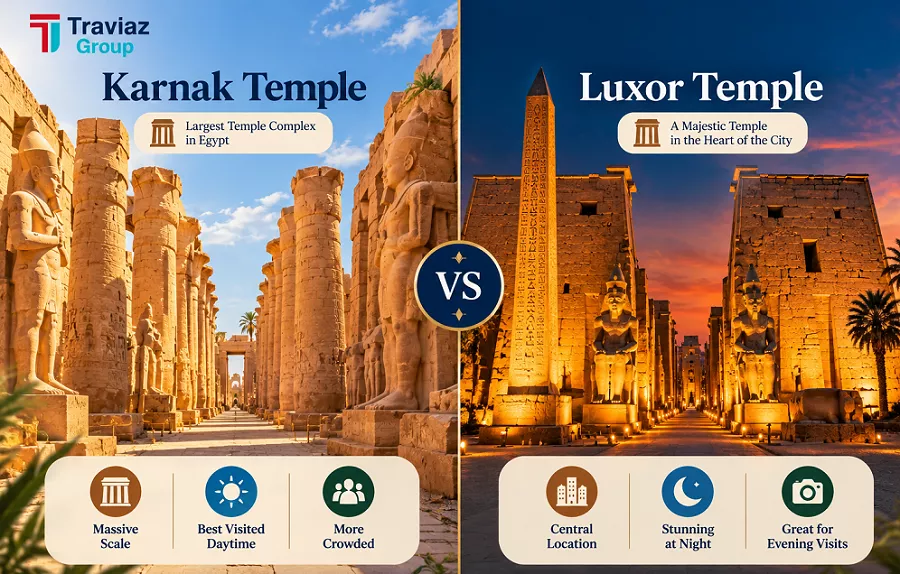
Egypt has hundreds of archaeological sites of a temple nature, but between twenty and thirty major temples are open to visitors and fully equipped for tourism. The three most visited and recognized are Karnak, Luxor, and Abu Simbel. Karnak is the largest religious complex ever built in the ancient world. Luxor Temple sits in the heart of a modern city and opens after dark. Abu Simbel is the most remote and the most remarkable for its relocation story.
This guide covers the twelve best temples to visit, how to get between them, what to wear, when to go, how much it costs, and how Traviaz's local Egyptologist guides help you see more than any independent visit would allow.
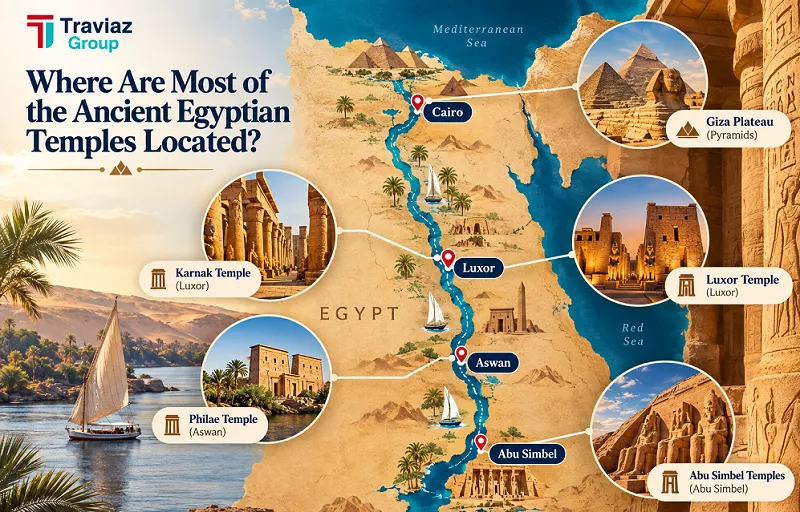
Where Are Most Egyptian Temples Located?
Ancient Egyptian temples are distributed geographically across three main clusters that are easy to travel between. The Luxor cluster includes Karnak, Luxor Temple, Hatshepsut, and Medinet Habu, all within close range of each other.
The Aswan cluster covers Philae, Kom Ombo, and Edfu, which are the main stops on any Nile cruise. Abu Simbel, Dendera, Esna, and Abydos each require separate arrangements outside the traditional route.
The 12 Best Ancient Egyptian Temples to Visit
Karnak Temple: The Largest Architectural Complex in History
Karnak Temple sits on the east bank of Luxor and stands as the largest religious architectural complex ever built in the ancient world. Across more than two hundred and forty-seven acres, this complex held buildings added by more than thirty pharaohs over two thousand years.
The Great Hypostyle Hall contains one hundred and thirty-four stone columns, some rising twenty meters high. Every column is carved with reliefs and scenes covering its entire surface from base to base to top. Queen Hatshepsut's obelisk, cut from a single piece of granite, rises thirty meters and remains the tallest standing obelisk in Egypt to this day.
The side corridors away from the main path give you a chance to photograph without the crowds. Arriving before eight in the morning saves you from the congestion and gives you better natural light for photography.
Luxor Temple: Best at Sunset
Luxor Temple sits right in the heart of the modern city, just two and a half kilometers from Karnak. Amenhotep III built it around 1400 BC and Ramesses II later expanded it. The temple facade features six colossal statues of Ramesses II, each reaching fourteen meters in height.
The Avenue of Sphinxes, stretching two kilometers and seven hundred meters, connects it to Karnak Temple with more than a thousand sphinx statues lining both sides. This temple is one of the few open after sunset, fully illuminated to give you a visual experience entirely different from daytime. Visiting between six and eight in the evening during winter is the best time to enjoy both the lighting and the quiet together.
Abu Simbel Temple: A Journey Worth the Effort
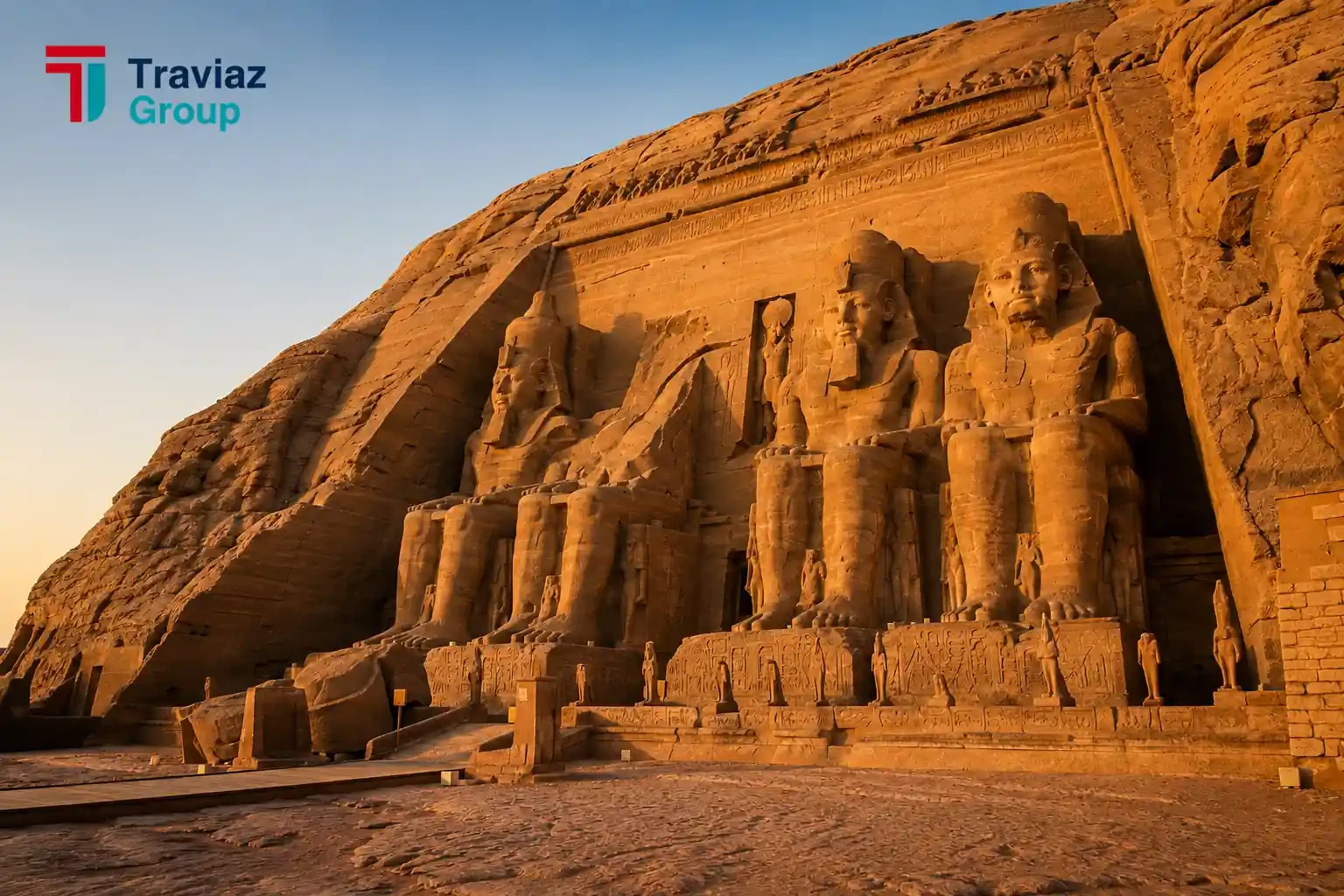
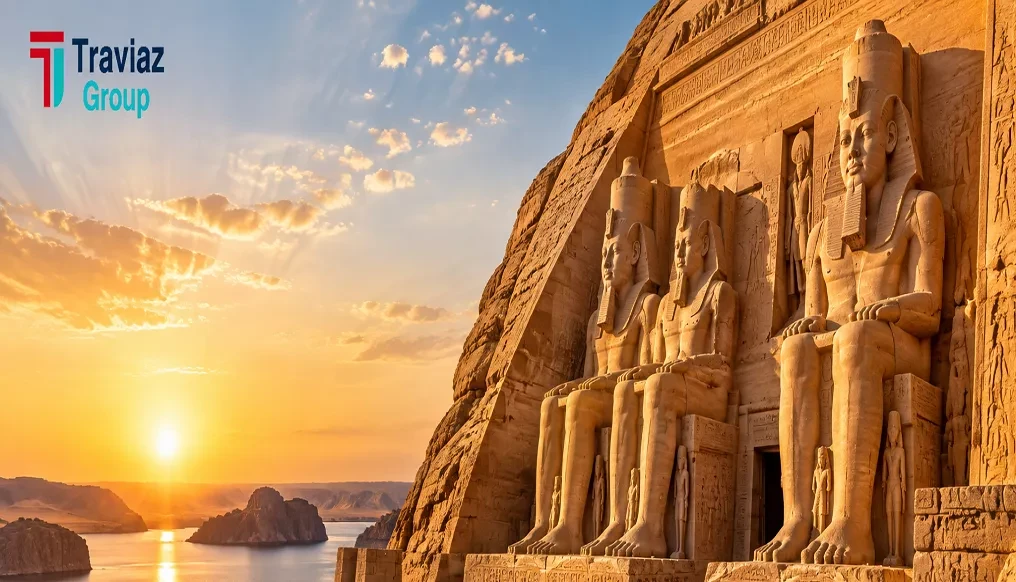
Abu Simbel Temple sits on the shores of Lake Nasser near the Egyptian-Sudanese border in the south. Ramesses II built it in 1260 BC with a design carved directly into the natural rock of the mountain. Four colossal statues of Ramesses II decorate its front facade, each reaching twenty meters in height.
In the 1960s, when the Aswan High Dam project threatened to submerge the temple, UNESCO led a massive relocation operation that cut the temple into thousands of stone blocks. It was reassembled two hundred meters higher than its original location in a project that took four full years.
The best time to arrive is between eleven in the morning and twelve noon to avoid the crowds coming from the early morning trips. Getting there from Aswan is possible by a domestic flight taking forty-five minutes or by road in a journey of three to four hours.
Hatshepsut Temple: The Most Architecturally Distinctive
Hatshepsut Temple differs from other Egyptian temples in a clearly visible way. Three terraces stacked on top of each other and carved into the heart of the rock mountain form its main facade. Queen Hatshepsut built it in 1473 BC and she is one of the few women who ruled Egypt as a full pharaoh.
Hatshepsut depicted herself in the temple's reliefs with masculine features and a false beard to conform to the prevailing pharaonic traditions of the time. The surviving reliefs depict a trading expedition to the Land of Punt with precise details about the ships, goods, and peoples.
An early morning visit is essential because the temple faces direct sunlight from midday onward with virtually no shade. The electric cart available at the entrance saves you a long distance under the sun before reaching the temple.
Philae Temple: Reached by Boat
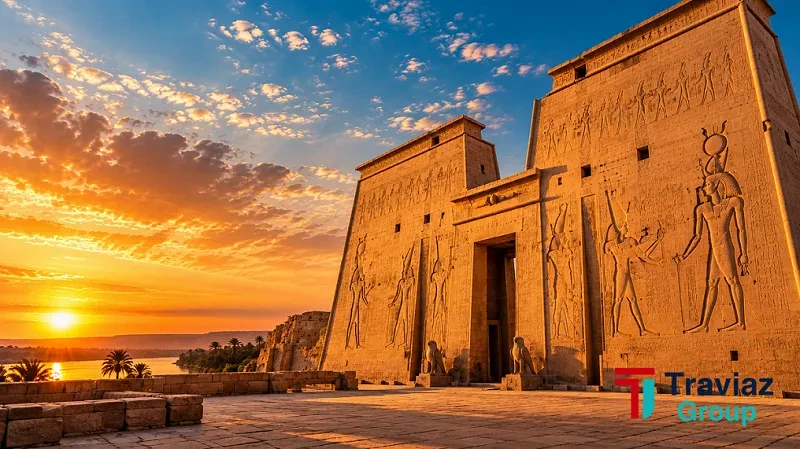
Philae Temple sits on a separate island in the Nile near Aswan and can only be reached by small boats. The boat ride is short but gives you a different visual perspective on the temple from the water. In the 1960s, the entire temple was relocated stone by stone to the neighboring island of Agilkia to save it from the waters of the High Dam. Sitting on the island's edges overlooking the Nile after finishing your visit is a calm experience worth the time.
The left side of the boat as you approach gives you the best angle to photograph the temple from the water. Trajan's Kiosk on the edge of the island is one of the most sought-after angles photographers look for at this site.
Edfu Temple: The Most Complete in Egypt
Edfu Temple was buried under sand for long centuries before its discovery in the nineteenth century, and this is what kept its reliefs exceptionally intact. It ranks among the most complete Egyptian temples ever discovered in terms of its architectural structure and wall reliefs. It was built during the Ptolemaic period between 237 and 57 BC with a clearly classical architectural design.
The massive main gateway carries reliefs depicting scenes from pharaonic mythology in very fine detail. Two black granite statues guard the entrance to the second hall and are among the most photographed features at this site.
The ceiling still bears traces of ancient soot from the period when the temple was used as a stable during the Middle Ages. Most Nile cruise ships stop at Edfu, but it is best to avoid the period between eight and eleven in the morning due to heavy crowds.
Kom Ombo Temple: The Double Temple on the Nile
Kom Ombo Temple stands on a sharp bend in the Nile between Edfu and Aswan in a visually striking location. What architecturally sets it apart from other temples is its unique double design with two perfectly parallel axes, two halls, two entrances, and two separate sanctuaries.
All its reliefs and architectural details are mirrored symmetrically on both sides with remarkable geometric precision. The site includes a small museum displaying dozens of mummified crocodiles discovered around the temple, which is genuinely interesting.
The artificial lighting after sunset brings out the details of the reliefs more clearly than anything visible during the day. Most cruise ships arrive at roughly the same time, so it is worth waiting a little for the groups to spread out before entering.
Dendera Temple: The Original Colors Are Still There
Dendera Temple sits an hour north of Luxor by car and outside the traditional cruise route. What makes it different from others is that it retains original colors on the ceiling and upper walls that have not completely faded.
Recent restoration work revealed vivid blues, reds, and yellows that had been hidden under layers of dust and soot. The astronomical ceiling in the front hall carries pictorial scenes of the zodiac signs, stars, and the Rosette circle.
A network of secret underground chambers runs beneath the temple with carved walls that sometimes require crawling to enter. The relief on the outer rear wall depicts Queen Cleopatra VII with her son Caesarion and is one of the rarest known depictions of her.
Esna Temple: The Most Rewarding Surprise
Esna Temple sits inside the modern city several meters below street level, making entering it an unexpected visual experience. This temple retains the most vivid and saturated original colors of all Egyptian temples discovered so far.
Recent restoration work removed centuries of dust and soot to reveal vibrant colors no one had seen for thousands of years. The single surviving hall contains twenty-four columns with capitals decorated in different plant patterns, no two of which repeat.
Crowds at this site are far lower than at the famous temples, giving you freedom of movement and photography. Most cruise ships pass Esna without stopping, so reaching it requires separate arrangement from Luxor.
Medinet Habu: The Most Complete Colors on the West Bank
Medinet Habu sits on the west bank of Luxor away from the usual tourist crowds. Ramesses III built it around 1180 BC and it is one of the most spacious sites on the west bank. Its walls retain more traces of color than most Luxor sites, giving you a clearer picture of what the temples originally looked like.
The massive front gateway is covered with detailed reliefs of the battles and military victories of Ramesses III. The rare Migdol tower in this temple drew its design from Syrian military architecture and is uncommon in pharaonic construction.
Visiting one to two hours before sunset gives you side lighting that brings out the relief details more clearly than anything you see at midday. You can reach it on foot from Malkata House Hotel if you are staying on the west bank.
Seti I Temple at Abydos: The Finest Reliefs in Egypt
Abydos Temple sits north of Luxor and entirely outside the traditional tourist route, making it one of the least crowded temples. Seti I built it and Ramesses II later completed it, and it stands out for the exceptional quality of its reliefs among all Egyptian temples.
The colors surviving on its walls are among the purest preserved anywhere in Egypt due to its distance from erosion factors. The site includes the famous Abydos King List, a stone tablet listing the names of the pharaohs in chronological order and considered one of the most important historical documents ever discovered.
Getting there requires a dedicated trip from Luxor or from Sohag and it does not appear on any standard cruise itinerary.
Should You Choose a Nile Cruise or Land Tour for Temples?
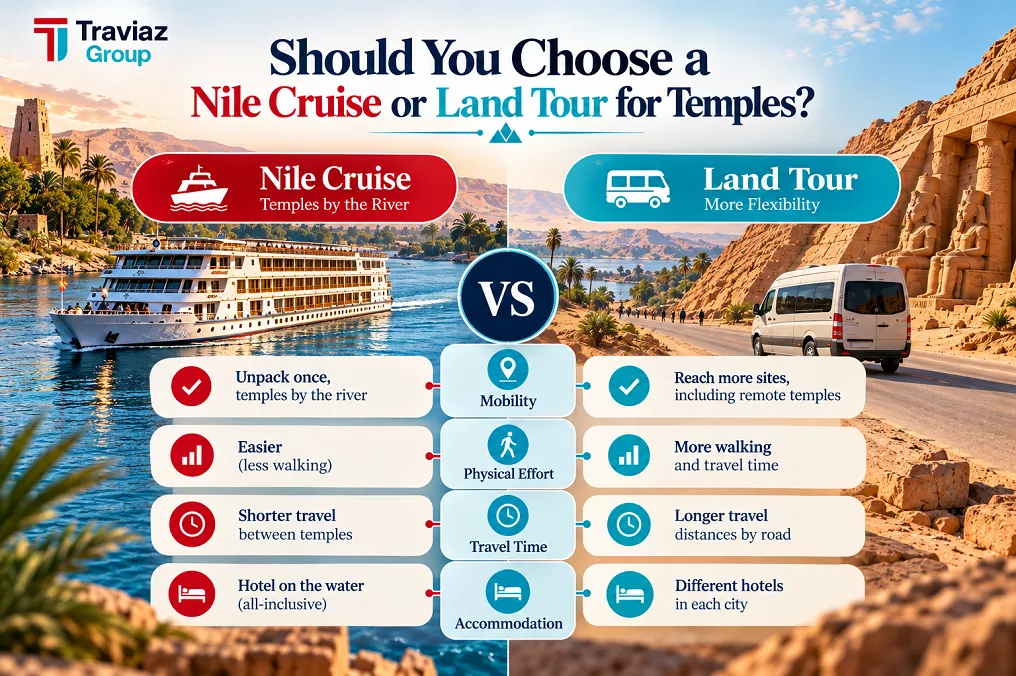
Both options cover the major temples between Luxor and Aswan, but the experience and logistics differ significantly. A Nile cruise works as a floating hotel that moves between sites overnight, minimizing daily packing and unpacking and keeping physical strain low. A land tour gives you more flexibility over timing and allows access to sites outside the standard cruise route including Dendera, Abydos, and Medinet Habu.
Most cruise itineraries cover Edfu, Kom Ombo, Philae, and sometimes Esna as standard stops. Sites like Dendera, Abydos, Abu Simbel, and Medinet Habu require additional days outside the cruise program. Combining a cruise with extra days in Luxor and Aswan gives you broader coverage of the most prominent sites. With Traviaz, you can design a program that combines the cruise and land trips according to your interests and budget.
How Many Days Do You Need to Visit Egypt's Temples?
Three days in Luxor are enough to visit the main temples on both banks at a comfortable and unhurried pace. Two days in Aswan cover Philae and Abu Simbel if you choose to fly there and back in one day. A Nile cruise from Luxor to Aswan typically runs between three and seven days and covers the stops in between. A full week is the comfortable minimum for anyone wanting comprehensive coverage without rushing.
Top Tips for Visiting Egypt's Temples
This section covers the three most common concerns for first-time visitors:
Best Time of Year to Visit the Temples
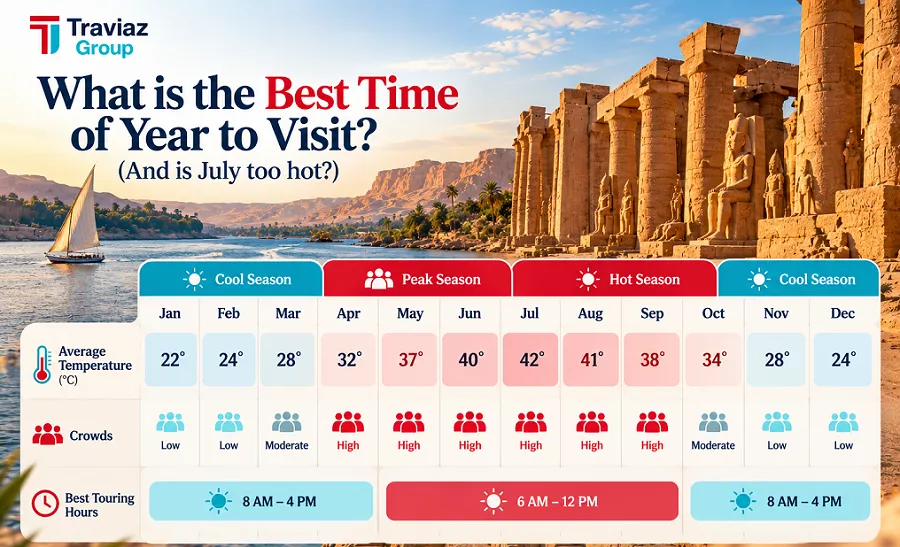
October through April is the most suitable season for visiting in terms of moderate temperatures. January and February are the most crowded tourist months, especially in Luxor and Aswan.
In July and August, temperatures in Upper Egypt climb to 45 degrees Celsius and above, making visits grueling. Visiting the temples in summer is possible but requires limiting yourself to early morning hours and carrying large amounts of water.
Safety at Egyptian Temples
Visiting the temples in Upper Egypt is safe for tourists including solo female travelers according to current reports. Security presence at major archaeological sites is heavy and visible throughout visiting hours. Solo female travelers generally find a comfortable environment at archaeological sites compared to crowded popular markets.
Families with children will find temples like Karnak, Medinet Habu, and Kom Ombo relatively suitable in terms of space to move around. Visitors with special needs will find the Nile cruise more comfortable than land trips, keeping in mind the difficulty of some interior paths.
Accessibility, Walking Distances, and Facilities
Wheelchair access at Egyptian temples is limited and inconsistent. Karnak and Luxor Temple have relatively flat main paths that are manageable for travelers with limited mobility, but the uneven stone floors and distances between structures make a wheelchair or walking aid essential rather than optional. Abu Simbel involves a short but uneven walk from the parking area to the temple entrance. Hatshepsut Temple requires either a walk of several hundred meters in direct sun or an electric cart available at the entrance.
Walking distances vary significantly between sites. Karnak covers two hundred and forty-seven acres and a thorough visit on foot covers several kilometers. Abu Simbel is compact and a full visit takes between one and two hours without excessive walking. Philae is reached by boat and the temple itself is walkable in under an hour.
Restrooms are available at the entrances of all major temples but cleanliness varies considerably. Carrying tissues and hand sanitizer is recommended at every site. Safe bottled water is available for purchase at most major temples but not always at smaller or more remote sites. Carrying at least one liter per person per hour in summer is the minimum recommended amount.
Temple Etiquette: Dress Codes and Inside Access
Visiting an Egyptian temple requires almost no special preparation in terms of dress or behavior, but knowing what is and is not permitted saves you from confusion at the entrance and inside the site.
What Is the Dress Code for Egyptian Temples?
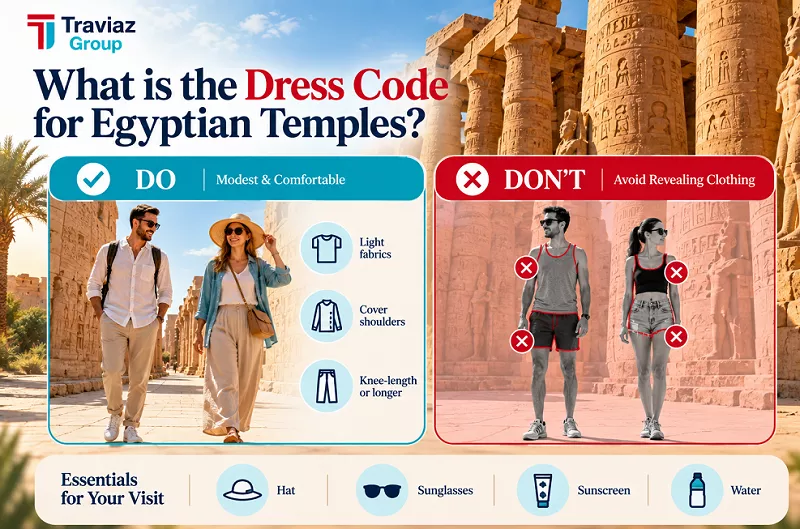
Egyptian temples are archaeological sites and not active places of worship, so there is no religious dress code enforced at the entrance. The practical priority is sun protection rather than modesty coverage. Lightweight long-sleeved tops and long trousers or skirts protect against both sun exposure and the cool interior of covered temple spaces. Women do not need to cover their hair at any Egyptian temple site.
For women visiting Karnak, Luxor, Abu Simbel, or any other major site: shorts are permitted and widely worn by tourists. Covering the knees is not required. In the heat of summer, loose linen trousers are more comfortable than shorts because they protect against sun on the skin while remaining cool. Closed or well-secured shoes are more important than any clothing choice, as temple floors are uneven stone and sand throughout.
Can You Go Inside Ancient Egyptian Temples?
Most major temples allow access to their main halls, courtyards, and hypostyle halls. Inner sanctuaries and restricted chambers vary by site. At Karnak, the main processional route, the Great Hypostyle Hall, and the sacred lake area are all fully accessible. At Abu Simbel, the interior chambers including the sanctuary with the four seated statues are open to visitors. At Hatshepsut, the main terraces and several decorated chapels are accessible while some inner rooms remain restricted.
Photography is permitted throughout accessible areas. Flash photography is prohibited in all decorated interior spaces to protect the pigments on the walls and ceilings.
Photography Rules Inside Egyptian Temples
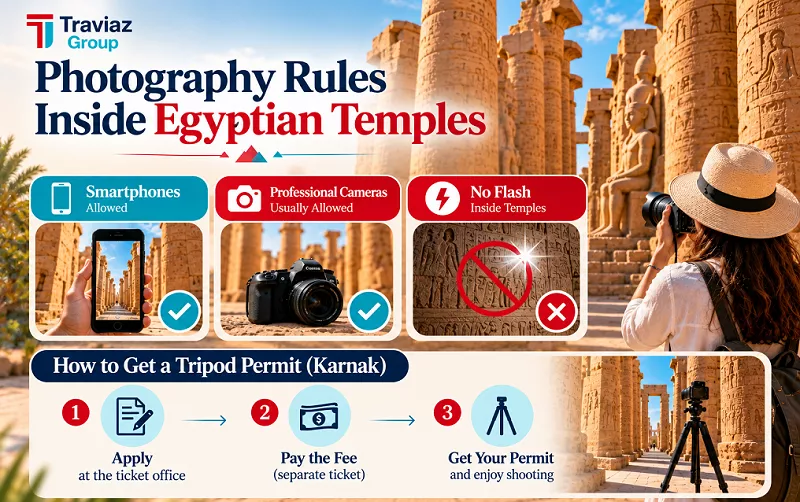
Photography with cameras and phones is completely free at all Egyptian temples as of 2026. The Egyptian government abolished photography fees and any request for payment at the gate is unofficial and should be declined. Flash photography is strictly prohibited in all interior spaces with decorated walls, ceilings, or painted reliefs.
The prohibition applies to all devices including phones. Enforcement is active at sites with well-preserved color such as Dendera, Esna, and the interior chambers of Abu Simbel. Tripods are officially prohibited at most sites, though enforcement is inconsistent at larger sites like Karnak. At smaller or less-visited sites, a tripod is more likely to attract attention from site guards.
How to Obtain a Tripod Permit for Karnak
Official tripod permits for professional photography at Karnak are issued by the Supreme Council of Antiquities through the official Egyptian Ministry of Tourism and Antiquities website at egymonuments.gov.eg. The process requires submitting a written request in advance specifying the date, purpose, and equipment.
Approval is not guaranteed and processing times vary. Arriving at the site with an unpermitted tripod and attempting to use it risks confiscation by site security. For commercial shoots or film production, a separate film permit application is required through the same authority.
Ticketing, Luxor Passes, and Transportation
Understanding how tickets work, what passes are available, and how to get between sites saves you time and money and eliminates the two most common frustrations at Egyptian temples: arriving without the right payment method and not knowing how to reach remote sites independently.
How Much Does It Cost to Visit in 2026?
All Egyptian temple tickets are paid electronically as of 2026, with no cash accepted at official ticket windows. International credit and debit cards are accepted directly at site entrances. Tickets can also be purchased in advance through the official egymonuments.gov.eg website.
Individual ticket prices vary by site and change periodically. Karnak Temple is one of the higher-priced individual tickets among Luxor sites. Abu Simbel carries a separate ticket that reflects its remote location and the additional infrastructure required to maintain it.
Verifying current prices through the official website or through your travel agency before your visit is strongly recommended, as prices are updated regularly.
Luxor Pass vs Single Tickets
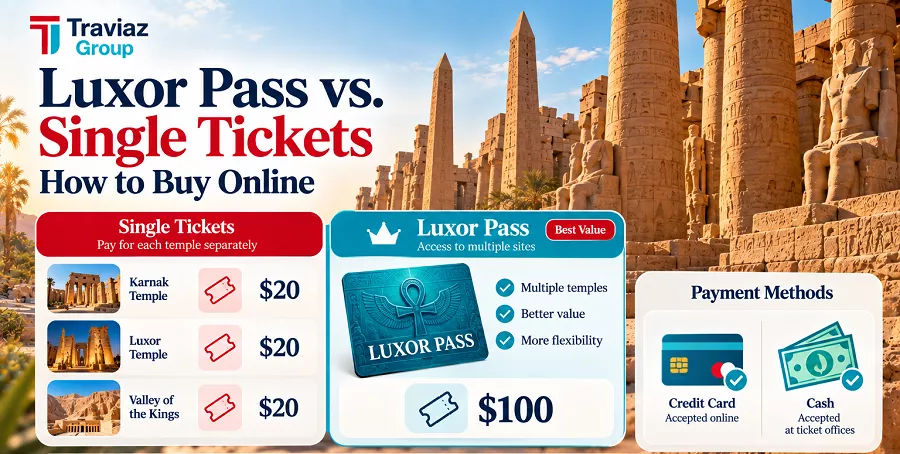
The Luxor Pass covers all archaeological sites in Luxor and is available in two versions: one covering Luxor sites only and one covering both Luxor and Aswan sites including Abu Simbel. For travelers visiting more than four or five sites, the pass typically represents better value than purchasing individual tickets. The pass is purchased at the Luxor governorate ticketing office and requires a passport.
If you lose your Luxor Pass, it cannot be replaced or refunded. Keeping a photograph of the pass on your phone as a backup record is advisable, though site staff will require the physical card for entry.
Do Temples in Egypt Take Credit Cards or Cash?
As of 2026, all major temple sites accept bank cards exclusively at official ticket windows. Cash is no longer accepted at the official counters. Some smaller vendors and services within or around temple sites may still operate on cash only, so carrying a moderate amount of Egyptian pounds for water, tips, and incidental purchases remains practical.
Getting to the Temples
From Cairo, flying to Luxor or Aswan takes approximately one hour and is the fastest option. The express overnight train from Cairo to Luxor takes around ten hours and is a comfortable choice for travelers who prefer not to fly. From Hurghada, Luxor is accessible by road in approximately three to four hours through the desert. Private car hire with a driver is the most flexible option for reaching sites outside the standard cruise or tour route, including Dendera, Abydos, and Esna.
How to Book the Best Egypt Temple Tours with Traviaz
Most tourists leave Egypt having seen the surface of these temples. A Traviaz Egyptologist guide takes you past the crowds and into the stories carved into every wall, reading the hieroglyphs in place, identifying the specific pharaohs depicted in each scene, and pointing out the details that most visitors walk straight past.
Traviaz handles the logistics so you focus on the experience. Airport pickup, hotel transfers, skip-the-line ticket arrangements, and a flexible itinerary built around your pace and interests are all included. The Sound and Light Show at Karnak and Philae can be added to any itinerary and booked in advance through Traviaz to guarantee seats at your preferred language showing.
Whether you want three focused days in Luxor, a full Nile cruise from Luxor to Aswan, a private day trip to Abu Simbel, or a week-long itinerary combining all of the above, Traviaz builds the program around what you want to see and how you want to travel.
FAQs
What gods were worshipped in ancient Egyptian temples?
Each temple was dedicated to a specific deity or group of deities. Karnak was primarily dedicated to Amun-Ra, the king of the gods. Philae was dedicated to Isis, goddess of magic and motherhood. Edfu was dedicated to Horus, god of the sky and kingship. Kom Ombo was uniquely dedicated to two gods simultaneously: Sobek the crocodile god and Haroeris a form of Horus. Hatshepsut's temple at Deir el-Bahari honored Amun and served as her own mortuary temple.
What is the oldest temple in Egypt?
The Temple of Seti I at Abydos, built around 1280 BC, is among the oldest surviving temples in good condition, but earlier structures predate it significantly. The temple complex at Karnak began construction around 2000 BC, making sections of it among the oldest surviving religious architecture in Egypt. Structures at Abydos associated with the earliest dynasties date to around 3000 BC, though little survives above ground level.
Which Egyptian temple is known for its unique astronomical alignment?
Abu Simbel is the most famous for its astronomical precision. The temple was designed so that twice a year, on February 22 and October 22, the rising sun penetrates the full length of the temple and illuminates the statues of Ramesses II and the gods in the inner sanctuary. The relocation in the 1960s preserved this alignment exactly. Dendera Temple also features an astronomical ceiling with zodiac representations and star charts used for religious calendar calculations.
Are ancient Egyptian temples kid-friendly?
Karnak, Luxor Temple, Kom Ombo, and Medinet Habu are the most suitable for families with children, offering open spaces, wide paths, and manageable walking distances. The Sound and Light Show at Karnak is particularly engaging for older children. Abu Simbel and Hatshepsut Temple are also accessible but require more planning around heat and walking. Carrying water, snacks, and sun protection is essential at all sites regardless of age.
What are the three most famous temples in Egypt?
Karnak, Luxor, and Abu Simbel are the three most visited and recognized among tourists. Karnak is the largest, Luxor the most accessible, and Abu Simbel the most geographically remote and the most fascinating in terms of its relocation story