
Every year, thousands of travelers pass through Edfu Temple without realizing that the carvings on its walls tell the complete story behind one of the most recognized symbols in human history. The Eye of Horus, known in ancient Egyptian as the Wadjet, is a symbol of protection, healing, and the restoration of what was lost. This guide explains the myth, decodes the meaning, and shows you exactly where to find it still carved in stone today.
The God Horus and the Origins of the Symbol
Horus was the god of the sky in Egyptian mythology, depicted as a falcon or a human with a falcon's head, and associated with kingship and divine justice. The ancient Egyptians believed his right eye represented the sun and his left eye represented the moon, which established the distinction between the left eye of Horus meaning, linked to the moon, healing, and renewal, and the right eye of Horus meaning, linked to the sun, strength, and authority.
The name Wadjet, or the Wadjet eye, is the term the ancient Egyptians used for this symbol from the New Kingdom onward, meaning "the whole eye" or "the sound eye," a reference to the eye restored in the myth after being lost. Horus was worshipped principally at Edfu and Kom Ombo, and Edfu Temple remains the most complete of his temples and the best-preserved temple in all of Egypt today.
The Mythological Origins of the Eye of Horus
The roots of the symbol go back to an ancient Egyptian myth built around two central storylines:
The Myth of Osiris, Horus, and Set
The myth tells of the killing of King Osiris, god of resurrection and renewal, at the hands of his brother Set, god of chaos and the desert, who seized the throne of Egypt, dismembered Osiris, and scattered his remains across the earth. Isis, the wife of Osiris, gathered the pieces and restored him to life long enough to conceive Horus, after which Osiris became ruler of the underworld and god of eternal life. Horus grew up under his mother's care and trained to reclaim his father's throne.
The Conflict, the Loss, and the Restoration
Horus fought long battles against his uncle Set, and in the course of this conflict he lost his left eye according to Egyptian mythology. The accounts vary in their details. Some texts say Set tore out the eye and cut it into six pieces, while the Contendings of Horus and Set states that Set tore out both eyes and buried them, causing them to grow as lilies, before the goddess Hathor restored Horus's sight by anointing his eyes with gazelle milk.
In most texts it was Thoth, god of wisdom and the moon, who reassembled the eye and returned it whole, and the ancient Egyptians likened this restoration to the full moon completing itself in the middle of the month after waning.
After his victory, Horus offered the eye to the spirit of his father Osiris in the underworld, and the ancient Egyptians believed its regenerative power helped sustain Osiris in the afterlife. This is where the symbol's association with funerary offerings and temple rituals originated.
The Meaning of the Eye of Horus and Its Dimensions
The symbol carries multiple meanings in ancient Egyptian belief organized around two main dimensions:
Spiritual and Symbolic Significance
Eye of Horus meaning rests on three foundations: protection, healing, and restoration. The ancient Egyptians saw in the symbol an embodiment of the triumph of order over chaos and the return of wholeness after fracture, which explains its use across contexts as varied as medicine, funerary practice, and seafaring.
Eye of Horus significance and power is reflected in its unbroken use across more than two thousand years. The spiritual meaning of Eye of Horus connects in Egyptian mythology to the idea that what is lost through sacrifice returns whole, which led the ancient Egyptians to use it in healing rituals and protective amulets.
Traditional colors of the Eye of Horus center on green and blue. Green symbolizes health, renewal, and life, while blue symbolizes the sky, water, and protection. Black was sometimes used to signify resurrection and transformation. Modern Egyptian culture representation of the symbol remains widespread in jewelry, art, and contemporary design.
Egyptian Eye Protection Symbol and Everyday Use
Ancient Egyptian physicians invoked the symbol in healing rituals and drew it on linen or papyrus as a temporary amulet in cases of illness and childbirth. Warding off the evil eye was among its most prominent functions, and some scholars suggest the blue bead widely known today across the Mediterranean may have its origins in ancient Egyptian eye amulets.
Protection, Healing, and Divine Order
The Eye of Horus was not a decorative motif. In ancient Egyptian belief, it served as a functional symbol across three distinct domains: protecting the living, healing the sick, and guiding the dead through the afterlife. Sailors painted it on the prows of their boats. Physicians drew it on linen during healing rituals, and embalmers placed it over mummy incisions to preserve the body for what came next. Its power, in the Egyptian worldview, came directly from the myth of its loss and restoration, the idea that what is broken can return whole.
The Wadjet: Its Six Components
The Wadjet symbol is composed of six distinct parts, each carrying its own independent meaning:
The Geometry of Myth: Mathematics and the Six Parts
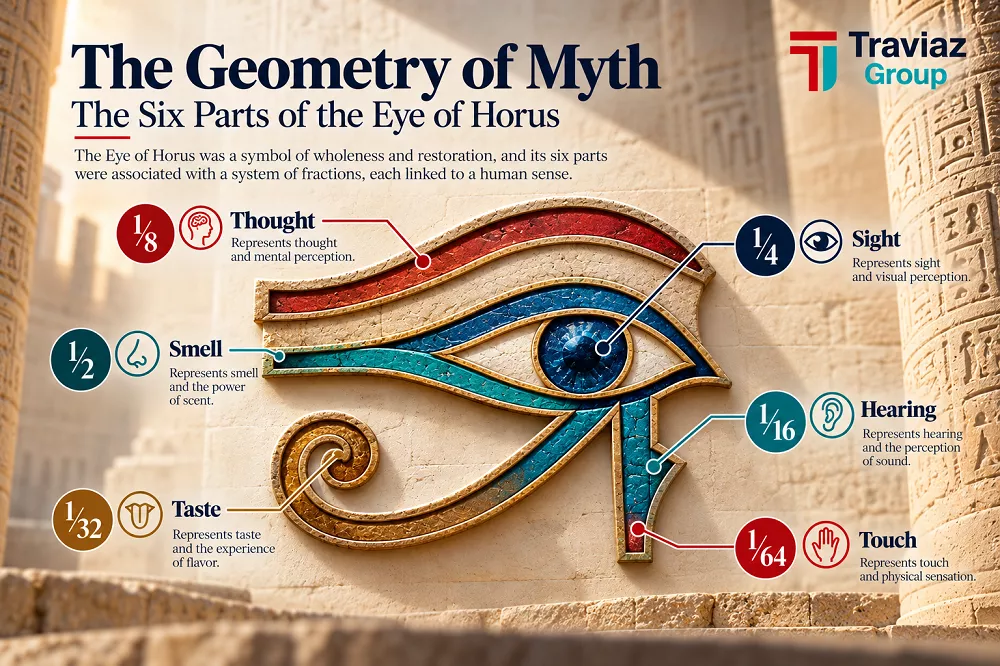
The Wadjet is a composite symbol combining the features of a human eye with the distinctive markings of a falcon. The six parts of the Eye of Horus each carry a sensory meaning in Egyptian mythology:
- The pupil: Associated with protection, healing, and sight.
- The eyebrow: A symbol of thought and mental focus.
- The right side: Linked to the sense of smell due to its proximity to the nose.
- The left side: Linked to the sense of hearing due to its orientation toward the ear.
- The spiral tail: Linked to the sense of taste. The teardrop shape in some archaeological interpretations points to sacrifice and resurrection.
- The cheek mark: Inspired by the distinctive marking on a falcon's face.
Eye of Horus Fractions Explained
Each of the six parts represents a fraction of the ancient Egyptian unit of volume known as the heqat: the right side ½, the pupil ¼, the eyebrow ⅛, the left side 1/16, the spiral tail 1/32, and the cheek mark 1/64. The sum of these fractions is 63/64 rather than a whole, and the ancient Egyptians believed the missing portion represented the magical power of Thoth, or embodied the idea that absolute perfection does not exist. It should be noted that some contemporary scholars have questioned this mathematical interpretation, arguing that the hieratic fractions developed independently of the eye symbol.
Eye of Horus vs Eye of Ra
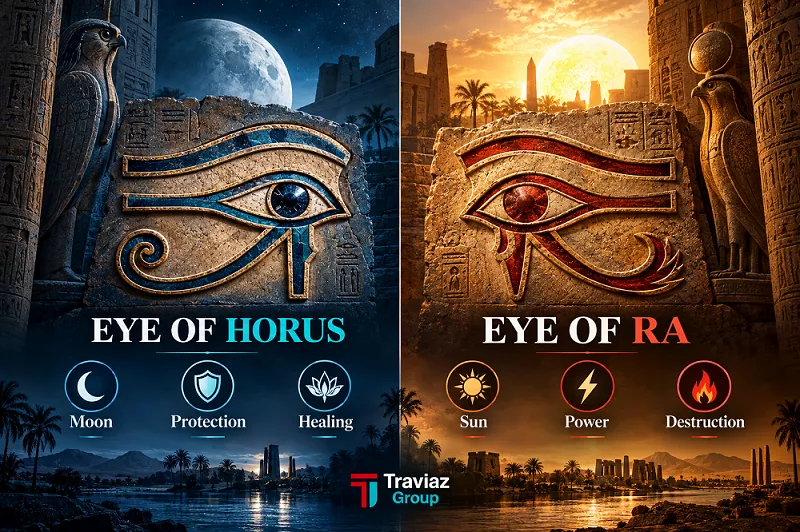
Many people confuse the two symbols, even though ancient Egyptian belief distinguished between them clearly:
|
Dimension |
Eye of Horus |
Eye of Ra |
|
Cosmic association |
The moon — the left eye |
The sun — the right eye |
|
Primary character |
Healing, protection, and restoration |
Power, wrath, and dominion |
|
Founding myth |
The loss and recovery of the eye in the conflict between Horus and Set |
The goddess sent to punish humanity, who returned as Hathor |
|
Common use |
Protective amulets and funerary rituals |
Symbol of royal authority and protection of the cosmic order |
Eye of Horus vs Eye of Ra comes down to a fundamental difference in character. The former embodies mercy and renewal in Egyptian mythology, while the latter embodies a deterrent force that can turn destructive before being brought back under control.
The Eye of Horus in Ancient Egyptian Art and Religion
The ancient Egyptians used the symbol in two distinct religious contexts:
Amulets and Tombs
The ancient Egyptians believed Eye of Horus amulets possessed protective power and crafted them from gold, glass, lapis lazuli, and semi-precious stones, remaining in continuous use from the Old Kingdom through the Roman period. Eye of Horus in funerary rites was among its most prominent applications.
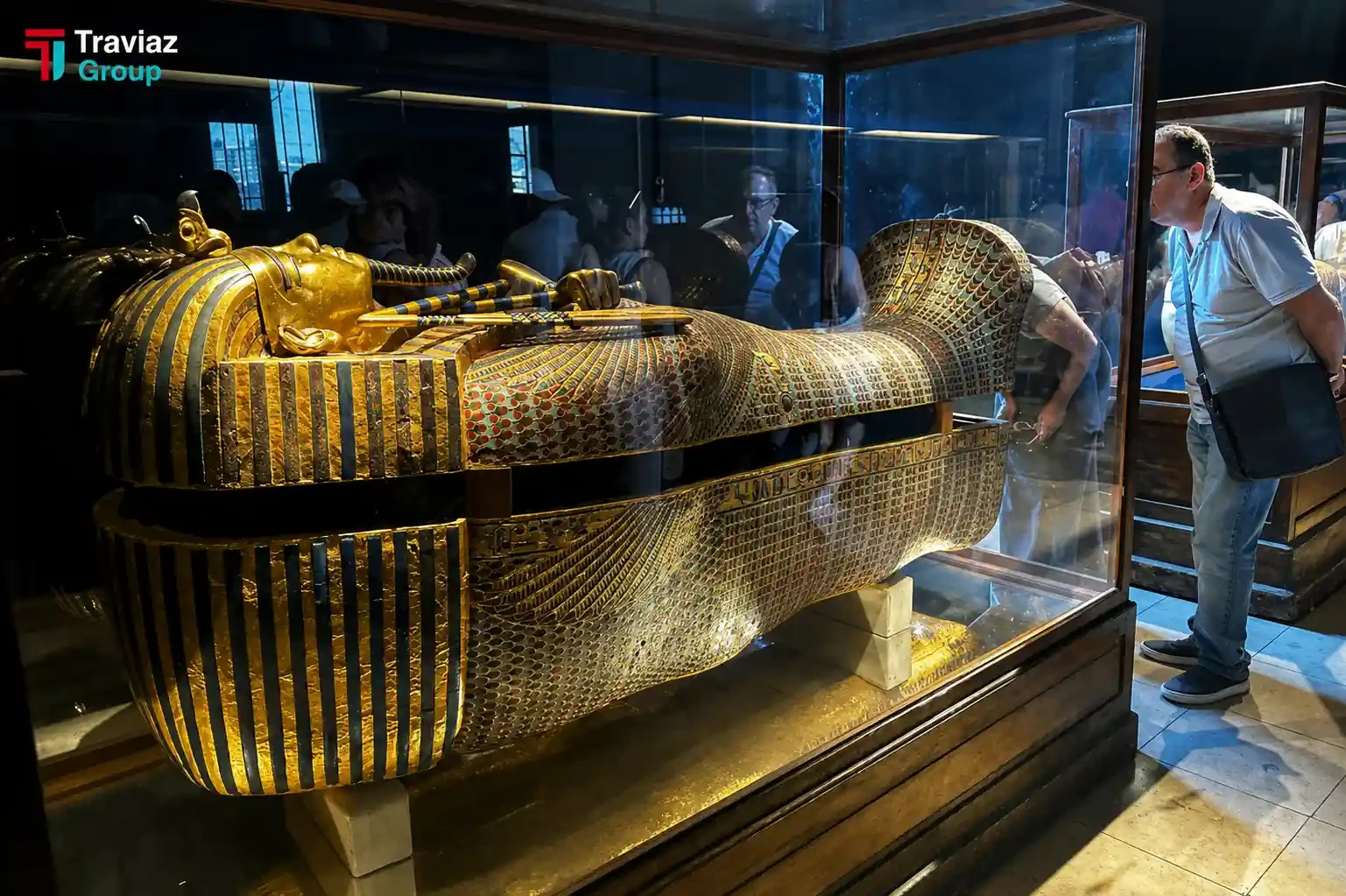
Wadjet eyes were painted on coffins during the First Intermediate Period and the Middle Kingdom, and the ancient Egyptians oriented the mummified body to face left so that the painted eyes could, in their belief, see outward from the coffin. Use of the eye on pharaohs' amulets was widespread, and the gold and lapis lazuli piece recovered from Tutankhamun's tomb and preserved in the Cairo Museum is one of the most celebrated examples.
Offerings and Temples
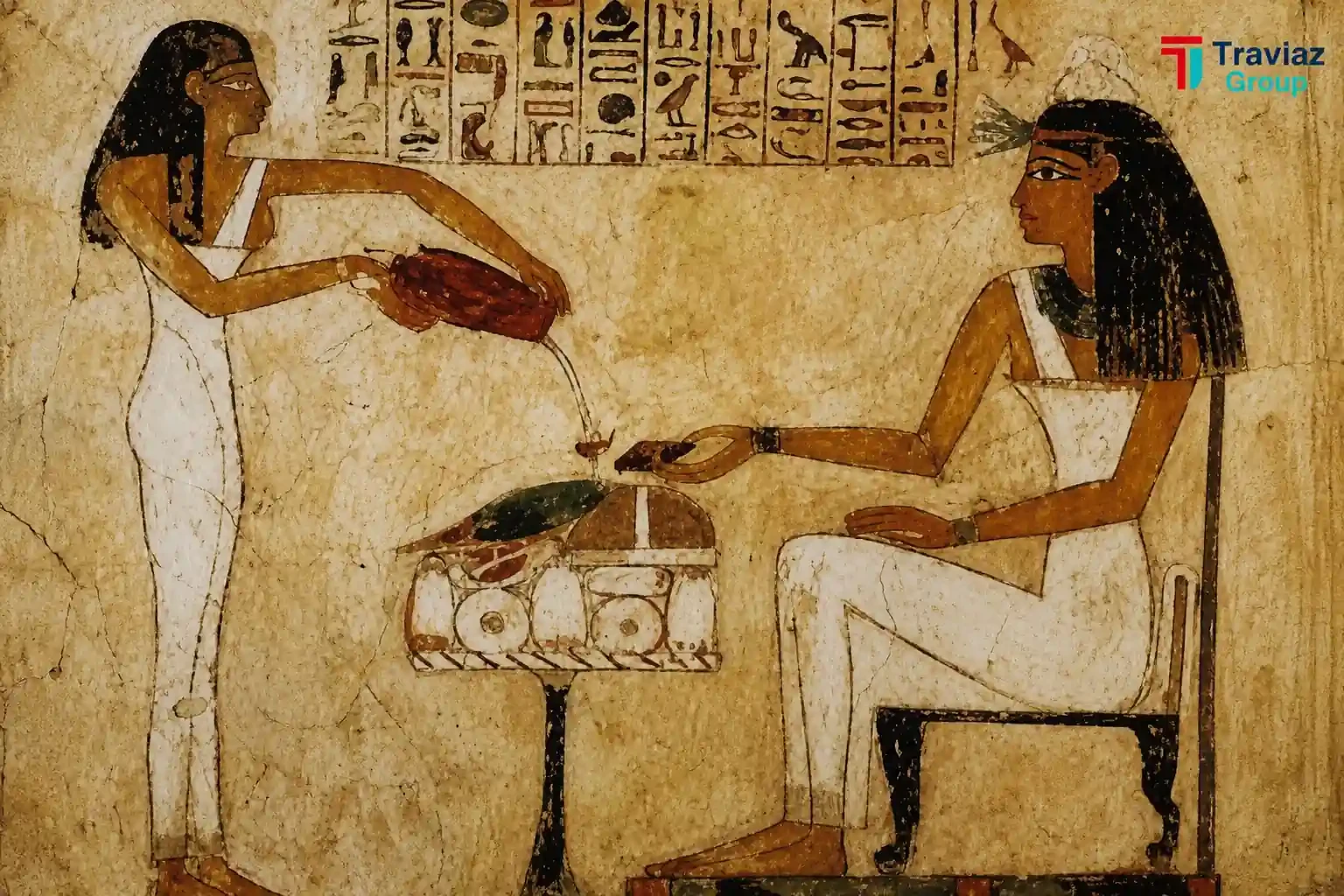
In Egyptian mythology, offerings presented to the gods in temples were symbolically represented as eyes. Eye of Horus in ancient Egyptian art also appeared on the prows of boats and on carved stone tablets, and in certain periods it was painted above figures of ordinary people in funerary paintings for protection in the afterlife.
Where to Find the Eye of Horus in Egypt Today
Egypt holds numerous sites where the symbol still survives on stone, the most significant of which are:
Edfu Temple
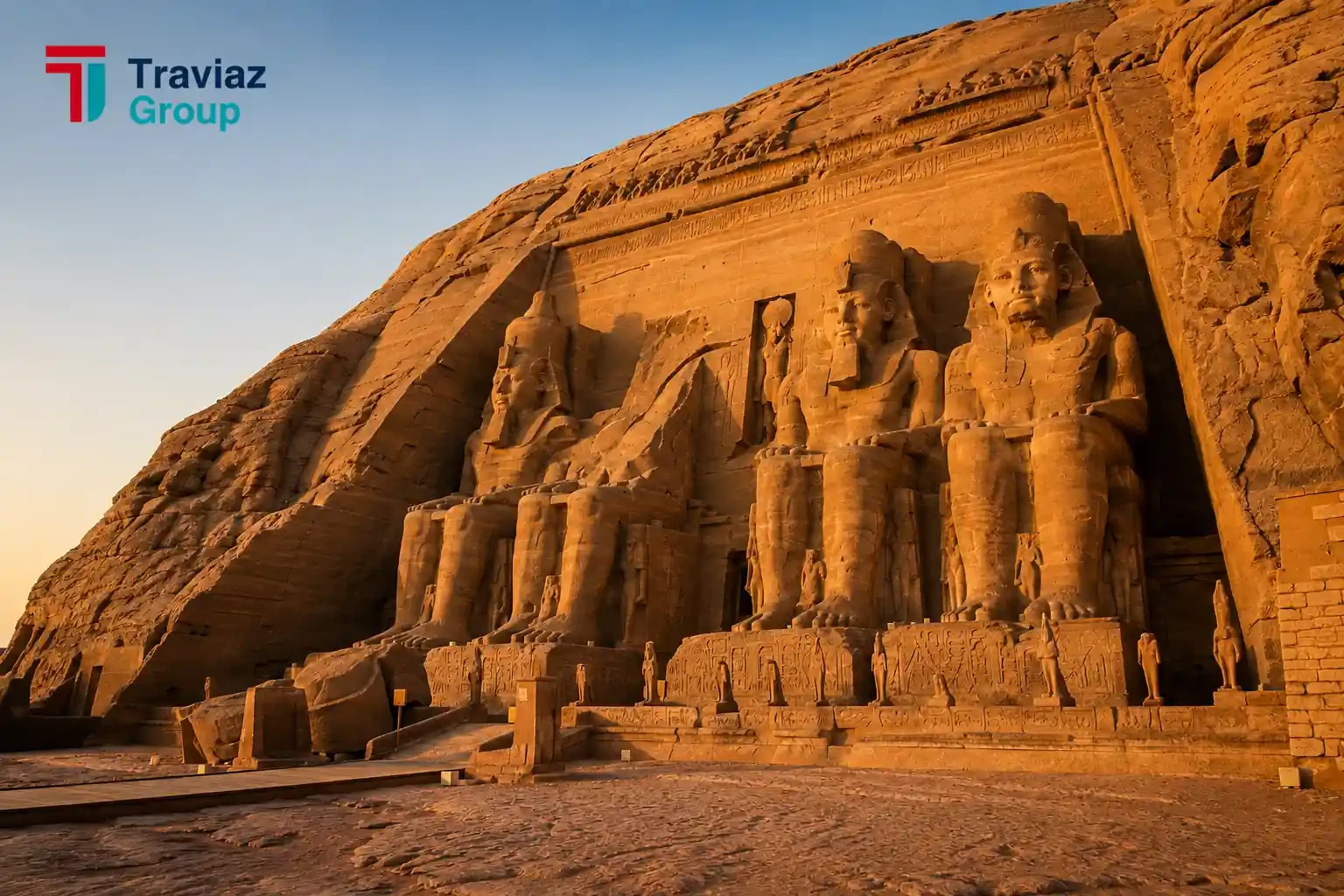
Edfu Temple is the site most closely associated with the Eye of Horus in all of Egypt. It sits on the west bank of the Nile in Aswan Governorate, around 105 kilometers north of Aswan and 225 kilometers south of Luxor, and was built during the Ptolemaic period between 237 and 57 BC.

Why Edfu Is the Best Place to Witness the Legend
Most Egyptian temples contain references to Horus. Edfu is different. It is the only temple in Egypt where the complete myth of the conflict between Horus and Set is told from beginning to end on the walls themselves. The interior walls retain their color and detail in a way that makes the imagery immediate rather than academic, and unlike Karnak or Luxor, where centuries of damage have erased large sections of the original decoration, Edfu gives you the myth intact.
Inside the Sanctuary: What to See
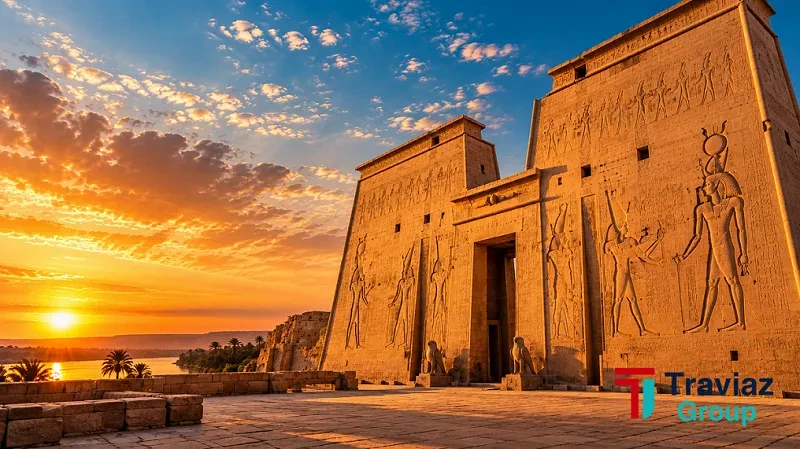
The entrance pylon stands 36 meters tall and its outer face carries carved scenes of Horus defeating Set, the largest and most complete version of this imagery anywhere in Egypt. Past the pylon, the great hypostyle hall opens into a sequence of smaller halls that lead to the granite sanctuary at the center of the temple, which still houses the black granite falcon statue of Horus, one of the few cult statues to survive intact from the Ptolemaic period.
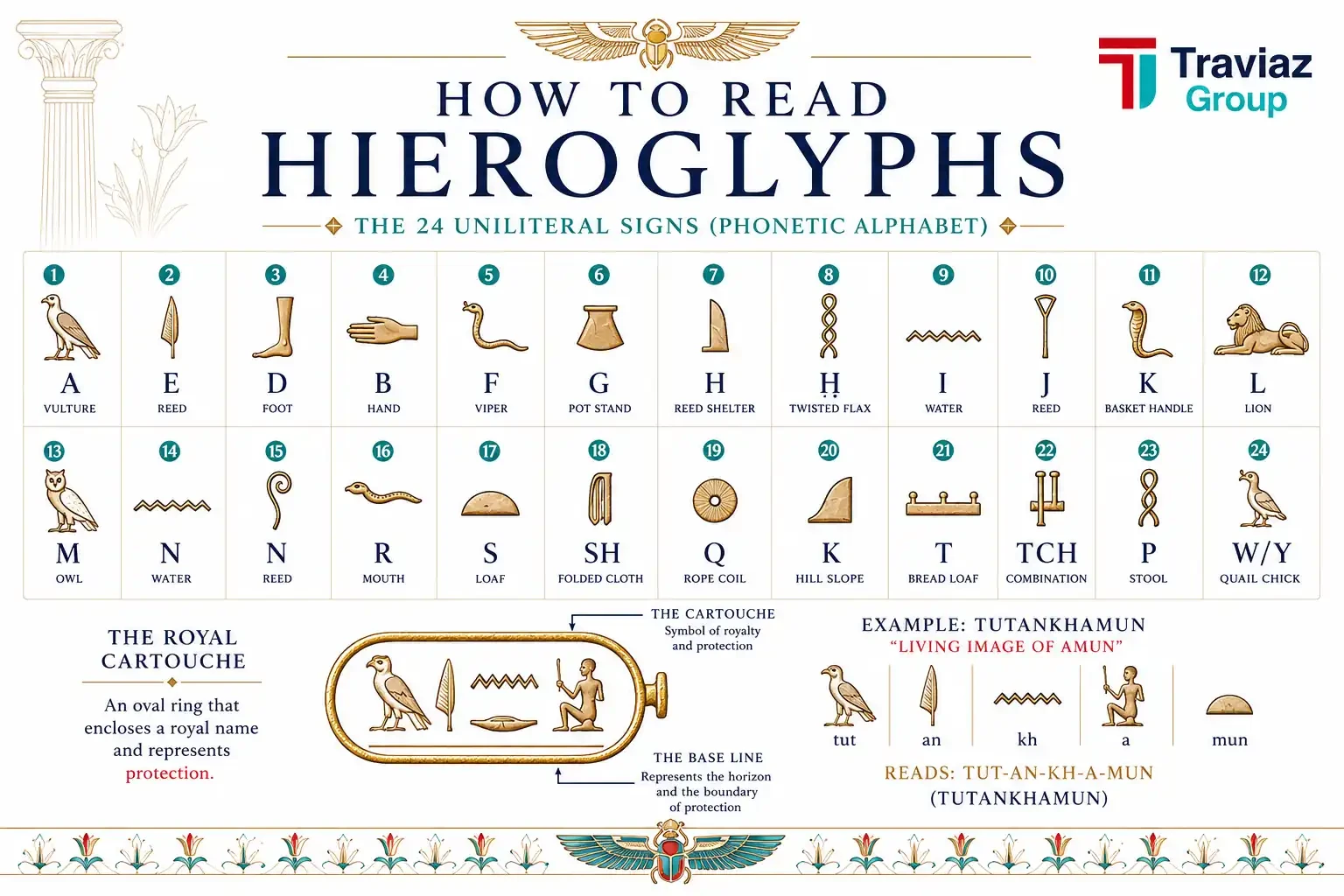
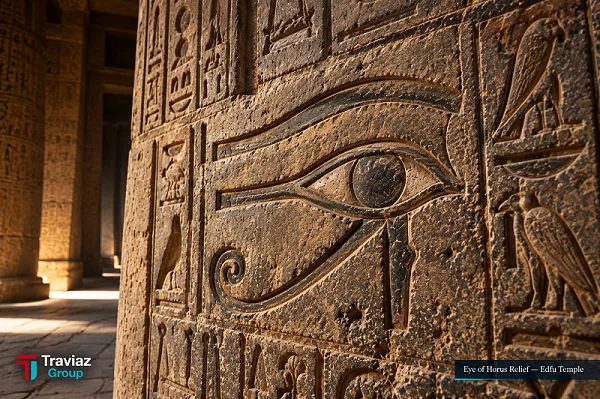
The Eye of Horus appears throughout the sanctuary walls in the offering texts, depicted as a ritual gift presented to the god, positioned at reading height in its hieroglyphic form rather than the stylized version most visitors recognize.
How to Reach Edfu: Cruises vs. Private Tours
Most Nile cruises traveling the Luxor to Aswan route stop at Edfu automatically, making it the most convenient option for travelers already planning a cruise. A private car from Luxor takes approximately two and a half hours and allows more flexibility over arrival time. Horse-drawn carriages are available outside the cruise dock for the short ride to the temple entrance, and agreeing on the fare before getting in is essential.
2026 Visitor Guide: Opening Hours and Entrance Etiquette
The temple is open daily from 7:00 AM to 4:00 PM in winter and 7:00 AM to 5:00 PM in summer. Entrance fees are subject to change and worth verifying with your travel agency or the official Egyptian Ministry of Tourism website before visiting. Photography is permitted inside and outside at no additional charge. Arriving within the first hour of opening gives you the best light on the exterior carvings and the quietest conditions inside before the cruise groups arrive.
The Cairo Egyptian Museum
Egyptian Museum Eye of Horus artifacts include an exceptional collection of amulets, jewelry, and funerary objects decorated with the symbol. The most prominent piece is the eye crafted from gold and lapis lazuli recovered from Tutankhamun's tomb.
Valley of the Kings Eye of Horus appears in numerous inscriptions on the walls of the royal tombs on the West Bank of Luxor, and visiting them reveals clearly how the ancient Egyptians used the symbol in the context of the afterlife.
Contemporary Markets and Jewelry
Authentic Eye of Horus jewelry in Egypt can be found in the gold shops of Khan El-Khalili in Cairo and in the markets of Luxor and Aswan. Modern Egyptian culture representation of the symbol is widespread on gold and silver pieces and handcrafted souvenirs. If you want an authentic piece, go to an established gold shop in Khan El-Khalili and ask for the metal certificate. That single step separates a genuine piece from everything else on the market.
Experiencing Edfu with Traviaz
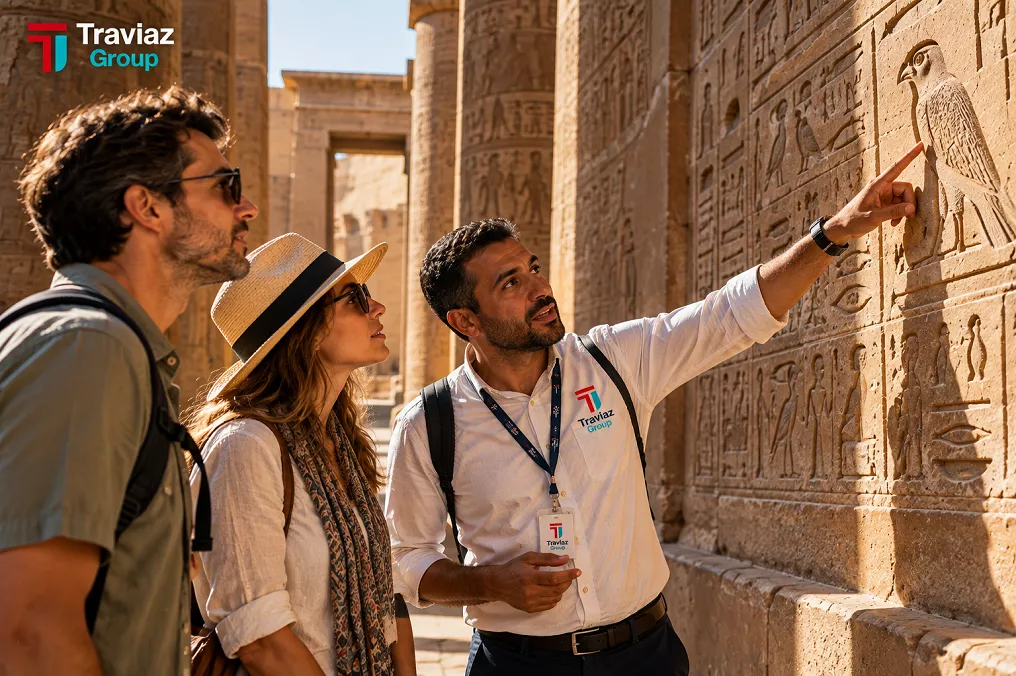
The difference between visiting Edfu alone and visiting it with a specialist guide is not a matter of comfort. It is a matter of what you actually see. The outer walls of the temple carry a continuous narrative of the conflict between Horus and Set, inscribed in hieroglyphics that most visitors pass without a second glance. A certified Egyptologist reads those inscriptions in place, connects them to the myth, and identifies the specific representations of the Eye of Horus that appear throughout the sanctuary.
Traviaz provides private, Egyptologist-led tours of Edfu as part of its Luxor and Aswan itineraries. Groups are kept small, timing is planned around the cruise crowds, and the pace allows for a proper reading of the inscription details rather than a rushed walk through the hypostyle hall. If you want the temple to make sense rather than simply be seen, this is the difference a vetted specialist makes.
Souvenirs and Authenticity: What to Look For
The Eye of Horus is one of the most mass-produced symbols in Egyptian souvenir markets, which makes finding a piece of genuine quality more difficult than it should be. Most of what is sold near temple entrances and in tourist bazaars is factory-produced resin or low-grade metal with no connection to traditional Egyptian craftsmanship.
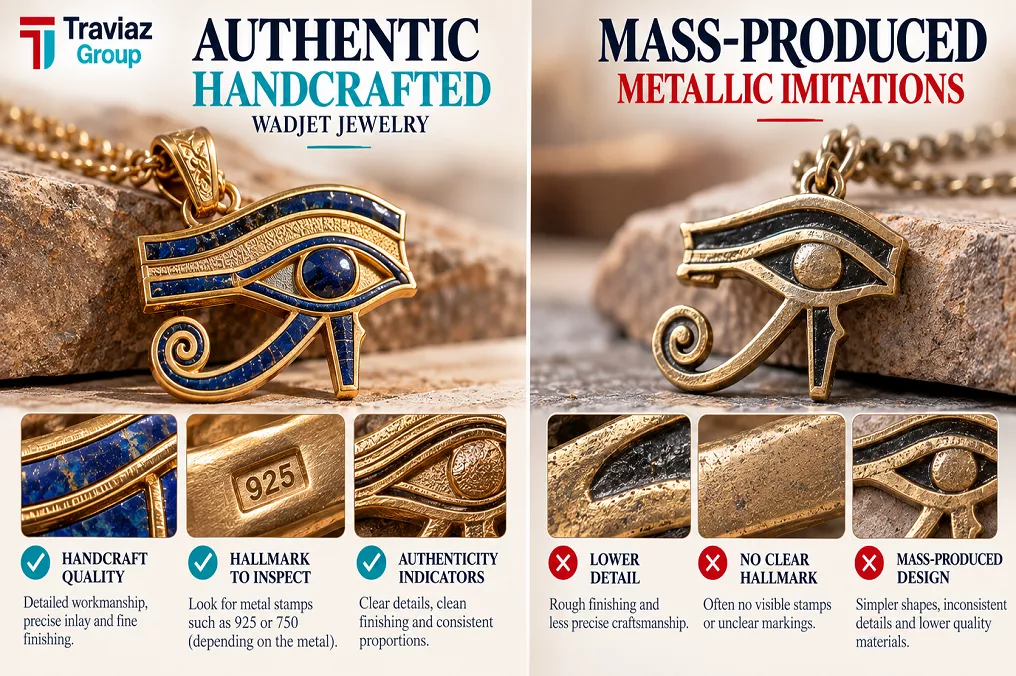
For gold and silver pieces, Khan El-Khalili in Cairo remains the most reliable destination. Established gold shops there are required to issue a metal certificate with each piece, which confirms the purity of the material. In Luxor and Aswan, the better shops are found inside the city rather than at the dock markets. Asking for the certificate is the single most reliable way to separate a genuine piece from a tourist trinket, and a guide who knows the market can take you directly to the right shops and negotiate on your behalf.
Conclusion
Ancient Egypt left no symbol more traveled than the Eye of Horus. It crossed three thousand years of history, moved from temple walls to gold amulets to the prows of fishing boats, and still appears today in the markets of Cairo and the jewelry shops of Luxor. Edfu is where the story behind it is still legible on stone. Traviaz's Egyptologist-led tours cover the temple in full, at a pace that lets the walls speak for themselves.
FAQs
Is Edfu Temple worth visiting?
For anyone interested in Egyptian mythology or the Eye of Horus specifically, Edfu is essential rather than optional. It is the best-preserved temple in Egypt and the only site where the complete story of Horus and Set is told on the walls in its original context. Dendera and Edfu together form a natural pair, and visiting both in a single itinerary gives a broader picture of Ptolemaic religious architecture.
How do I hire a certified guide for Edfu?
Book directly through the Traviaz website, where you can browse Luxor and Aswan itineraries that include Edfu, review your guide's qualifications before confirming, and arrange a private tour that fits your schedule. Booking at least four to six weeks in advance is recommended between October and March.
Is the Eye of Horus considered good luck?
In ancient Egyptian belief, yes. The symbol was used to ward off evil, protect the living and the dead, and restore what was lost or damaged. Sailors carried it for safe passage, physicians used it in healing rituals, and the dead were buried with it to ensure protection in the afterlife. Whether it qualifies as a luck symbol depends on how you define luck, but its original function was protective rather than decorative.
What is the difference between the Eye of Horus and the Eye of Ra?
Eye of Horus vs Eye of Ra comes down to character. The former is linked in Egyptian mythology to the moon, healing, and renewal, while the latter is linked to the sun, power, and divine wrath.
What does the Wadjet mean?
The Wadjet is the ancient Egyptian name for the Eye of Horus symbol, meaning "the whole eye" or "the sound eye," a reference to the eye restored in the myth.