
Queen Nefertari: Who Was Egypt's Spectacular Queen & How to Visit Her Tomb
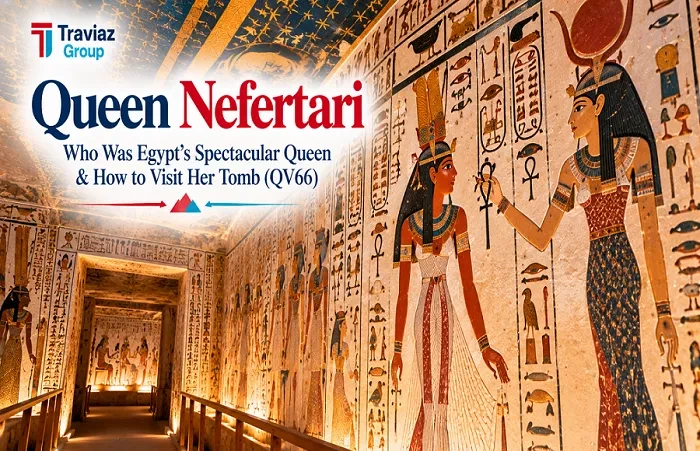
Queen Nefertari tomb is the most exciting destination in the Valley of the Queens, as its walls hold more than 5,200 square feet of colored paintings preserved for more than 3,300 years. Nefertari was the Great Royal Wife of Ramesses II in the Nineteenth Dynasty, and her tomb QV66 in the Valley of the Queens deserves a trip to Luxor on its own. Precise planning for the visit is necessary given the strict entry restrictions, and this is what Traviaz specializes in for travelers looking for a historical and artistic experience that has no equal.
Who Was Queen Nefertari? Uncovering Her History and Legacy
Nefertari is an exceptional historical figure who left her mark on diplomacy, art, and architecture over decades of Ramesses II's reign. Knowing her story makes visiting queen Nefertari tomb an experience that goes beyond seeing the wall paintings to a deep understanding of what every scene on the walls means.
What is the Meaning of the Name Nefertari and Her Royal Lineage?
The name Nefertari means "the most beautiful among them" or "the beautiful companion, beloved of Mut," and her full name is Nefertari Meritmut. She was not from a direct royal family but from a noble family, and some archaeological evidence points to the possibility of her belonging to the Eighteenth Dynasty on the side of Pharaoh Ay. She held many royal titles, the most prominent of which are:
- Great Royal Wife: the highest title held by a pharaoh's wife in ancient Egypt.
- Lady of the Two Lands, Upper and Lower: it refers to her authority extending over all of Egypt.
- She for Whom the Sun Shines: the title that Ramesses II gave her specifically as an expression of his exceptional love for her.
Nefertari and Ramses II: A 19th Dynasty Love Story
Nefertari was more than a wife, as she was a seasoned diplomat who was proficient in reading and writing hieroglyphics, which was a very rare skill in her era. She corresponded with Hittite queens in official diplomatic letters that are still preserved to this day. Ramesses II built for her the Temple of Hathor at Abu Simbel and made her statues the same size as his statues, which happened only twice in the entire history of pharaonic Egypt.
What Did Queen Nefertari Look Like, and Has Her Mummy Been Found?
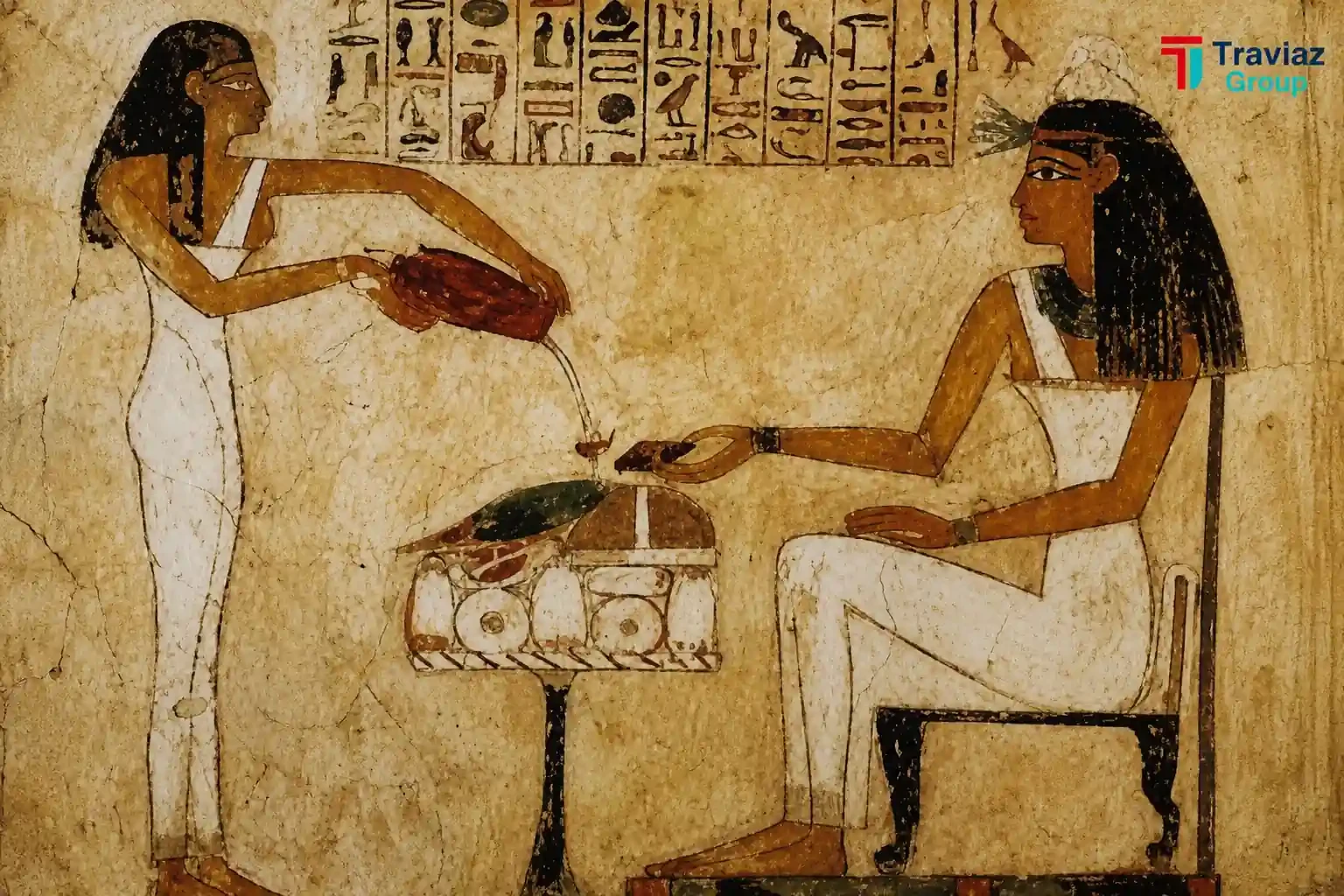
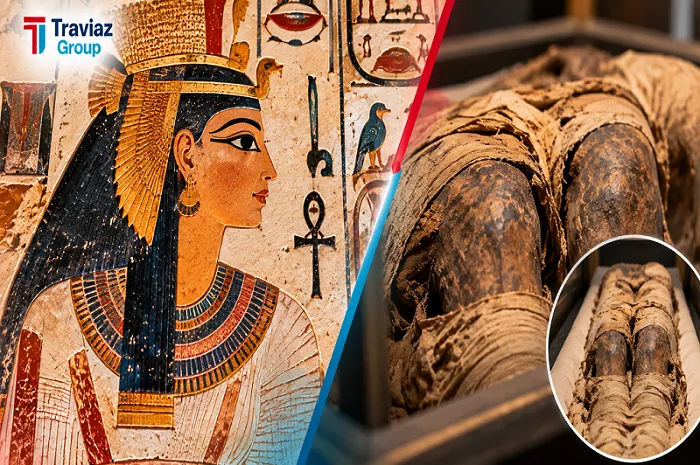
The paintings of queen Nefertari tomb depict her repeatedly in a pure white linen dress, a golden vulture crown, and eyes elongated with kohl. No complete mummy of hers has been found to this day, as thieves looted her tomb in ancient times. What Ernesto Schiaparelli found when he discovered the tomb in 1904 was limited to her mummified knees, now preserved in the Museo Egizio in Turin, Italy.
The "House of Eternity": Exploring the Queen Nefertari Tomb (QV66)
Queen Nefertari tomb extends over an area of 520 square meters and is divided into an antechamber, a side room, and a main burial chamber held by four massive columns. The path inside the tomb tells the story of Nefertari's journey from death to resurrection according to ancient Egyptian belief, and it visually embodies every stage of this spiritual journey.
How Did Ernesto Schiaparelli Discover the Nefertari Tomb in 1904?
The Italian archaeologist Ernesto Schiaparelli discovered the tomb in 1904 during his second campaign in the Valley of the Queens, after he obtained in 1903 an exclusive concession to excavate the site. The excavation workers first found steps carved into the rock, then revealed a corridor 1.65 meters wide ending with a door on which the queen's name was inscribed. Schiaparelli found the tomb open and completely looted before his arrival, but the wall paintings were still in an exceptional state of preservation that stunned the entire archaeological world.
Why is the Interior Art Considered the Sistine Chapel of Ancient Egypt?
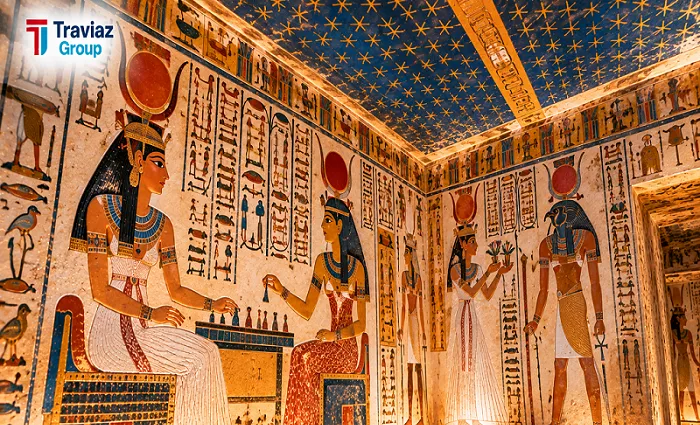
Two teams of painters together used natural metallic oxides of blue, red, yellow, and green that still retain their brilliance after more than three thousand years. The style combines raised relief and meticulous coloring in one integrated image that cannot be found in any other Egyptian tomb. The most prominent visual scenes that greet you inside queen Nefertari tomb are:
- Nefertari in her white linen dress offering sacrifices to the gods with striking royal elegance.
- The goddess Hathor taking her by the hand in a scene that embodies divine protection of the queen on her journey.
- Nefertari playing Senet, a board game associated with crossing to the afterlife.
Why is the Ceiling of Nefertari's Tomb Famous and What Do the Stars Represent?
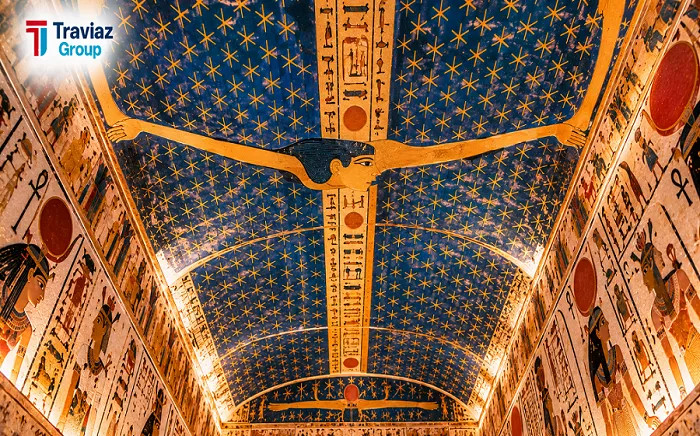
The ceiling is painted in dark blue and covered with five-pointed golden stars that represent the dome of the sky in Egyptian belief. The goddess Nut is painted on the ceiling with her body stretched out to protect the queen with her outstretched arms. This design gives the visitor a sense of infinite space despite the actual limited dimensions of the room.
How Do the Scenes from the Book of the Dead Help Nefertari Reach the Afterlife?
The walls of queen Nefertari tomb contain passages from chapters 17, 94, 144, 146, and 148 of the Book of the Dead. Chapter 17 gives her the ability to transform into a Ba bird to fly freely during the day and return to the tomb at night. Chapter 144 trains her on the names of the guardians of the gates of Osiris's kingdom to pass through them safely. In the final scene on the door of the burial chamber, Nefertari appears being reborn as a solar disk, transformed from death to immortality forever.
Clearing the Confusion: Historical Comparisons
Many visitors confuse Nefertari with Nefertiti and with Cleopatra, and this confusion causes the traveler to miss a correct understanding of what they see inside queen Nefertari tomb. The precise comparison between these figures enriches the experience significantly.
Are Nefertiti and Nefertari the Same Person?
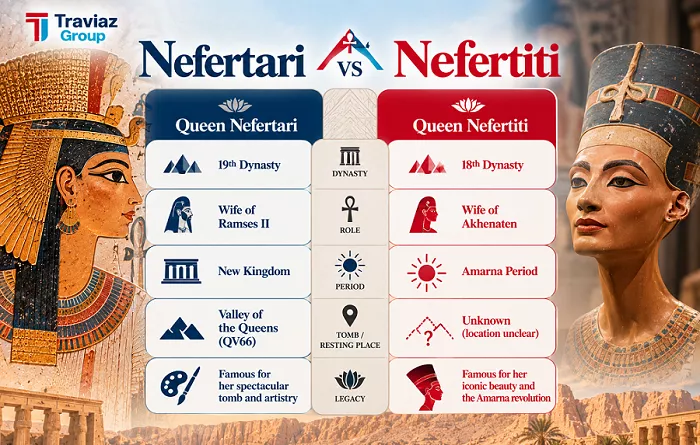
No, they are two completely different queens separated by approximately a century. The full comparison between the two is:
|
Criterion |
Nefertari |
Nefertiti |
|
Dynasty |
Nineteenth |
Eighteenth |
|
Husband |
Ramesses II |
Akhenaten |
|
Era |
Around 1295-1255 BC |
Around 1370-1330 BC |
|
Most Notable Legacy |
Tomb QV66 and Abu Simbel Temple |
Bust preserved in Berlin |
|
Religious Role |
Protector of traditional Egyptian religion |
Advocate of the Atenist religious revolution |
How Does Her Political Power Compare to Cleopatra or King Tut?
Nefertari exercised her diplomatic power through official correspondence with Hittite queens, which made her a true political partner of Ramesses and not merely a royal wife. Cleopatra ruled with complete independence as a pharaoh, while Nefertari exercised her influence from within the royal system. Tutankhamun is famous for the material treasures of his tomb, while queen Nefertari tomb is famous for its artistic value that is beyond price.
Planning Your 2026 Visit: Logistics, Rules, and Timings
Visiting queen Nefertari tomb requires more precise advance planning than any other archaeological site in Egypt, given the strict restrictions imposed by the Ministry of Tourism to protect the sensitive paintings from deterioration.
What Are the Exact Logistics, Opening Hours, and Humidity Rules for Visiting in 2026?
The tomb opens daily from 6:00 AM to 5:00 PM in summer and until 4:00 PM in winter. The Ministry of Tourism imposes restrictions on the daily number of visitors because the humidity from visitors' breath causes direct deterioration in the plaster layers and pigments that are 3,300 years old. The tomb was closed from March 2024 until October 2024 for urgent restoration work, and it closes sometimes without sufficient prior notice, so it is recommended to verify its status directly before the visit through egymonuments.com.
How Long Are Visitors Allowed to Stay Inside the Tomb?
The time allowed inside queen Nefertari tomb is only 10 to 15 minutes for each group of visitors. To achieve maximum benefit from this short time, the following order is recommended:
- First: go immediately to the antechamber and focus on the scene of Nefertari with the god Horus on the northern wall.
- Second: move to the burial chamber and start by looking at the blue ceiling studded with golden stars.
- Third: dedicate the final minutes to the four columns and the details of the god Osiris's inscriptions on them.
What Are the Strict Photography Rules?
Photography inside queen Nefertari tomb is subject to the most strictly enforced rules among all Egyptian archaeological sites. The current rules in 2026 are:
- Flash: absolutely prohibited because light accelerates the deterioration of the metallic pigments.
- Tripod: completely prohibited inside all Egyptian tombs without exception.
- Mobile phone: photography without flash is permitted for personal use.
- Professional camera: it sometimes requires additional fees, and it is recommended to inquire at the ticket booth.
Photography tip inside the tomb: set the ISO between 800 and 1600 with a lens aperture of f/1.8 or f/2.8 to get a clear image in very dim lighting without flash.
Is the Queen Nefertari Tomb Wheelchair Accessible and How Many Stairs Are Inside?
Reaching the burial chamber requires descending on steeply inclined wooden steps carved into the rock. The tomb is not equipped with ramps or elevators and cannot be accessed by wheelchair. Travelers with mobility difficulties find in Karnak Temple and Luxor Temple a suitable alternative at an accessible ground level.
Tickets, Pricing, and Value: Is the Nefertari Tomb Worth the Money?
Queen Nefertari tomb is among the most expensive archaeological sites in all of Egypt, and this high price is part of the official protection strategy that aims to reduce the number of visitors and preserve the paintings.
How Much Does It Cost to Enter the Nefertari Tomb in 2026?
The Valley of the Queens entry ticket is around 220 Egyptian pounds, and to that is added the separate queen Nefertari tomb ticket that ranges between 1,400 and 2,500 Egyptian pounds, which is approximately $28 to $50. The price changes frequently, and the precise and updated figures are always available on egymonuments.com. Tickets are purchased mostly in cash at the Valley of the Queens ticket booth, so it is always recommended to bring sufficient Egyptian pounds.
Is the Luxor Premium Pass the Best Way to Visit?
The Luxor Premium Pass at $130 for adults includes all archaeological sites on both the east and west banks of Luxor including queen Nefertari tomb and the tomb of Seti I. Those who plan to visit both premium tombs in addition to the Valley of the Kings, Karnak, and Luxor achieve real savings. Obtaining the card requires an original passport and a personal photo, and it is issued at specific offices in Luxor.
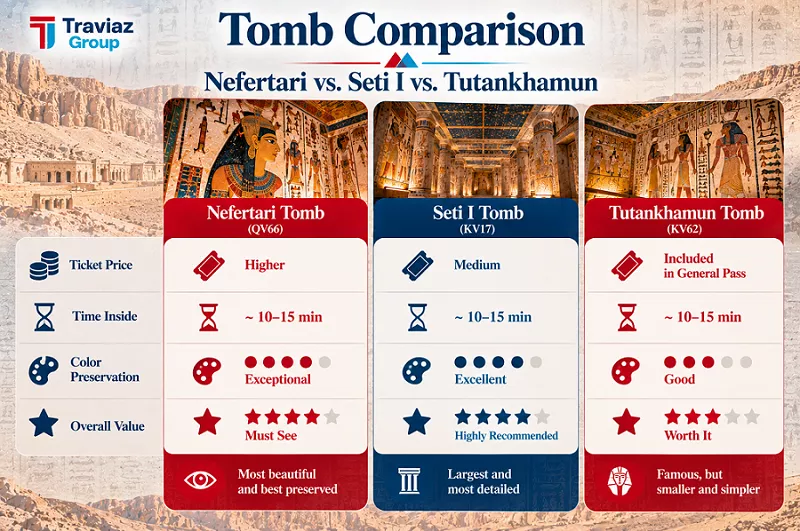
Tomb Comparisons: Nefertari vs. Seti I vs. Tutankhamun
|
Criterion |
Nefertari QV66 |
Seti I KV17 |
Tutankhamun KV62 |
|
Art Quality |
Best preserved and most detailed |
Magnificent but very large in size |
Modest artistically |
|
Reason for Fame |
Exceptionally colored paintings |
Largest tomb in the Valley of the Kings |
Golden treasures |
|
Price |
1,400-2,500 pounds |
2,000 pounds |
700 pounds |
|
Visit Duration |
10-15 minutes only |
No time limit |
No time limit |
|
Best For |
Lovers of art and fine details |
Lovers of scale and variety |
Lovers of history and treasures |
Beyond Luxor: The Magnificent Abu Simbel Temples
To fully understand the story of Nefertari, visiting queen Nefertari tomb alone is not enough, as the Abu Simbel temple represents the most dramatic chapter in her love story with Ramesses II.
Why Did Ramesses II Build a Temple for Nefertari at Abu Simbel?
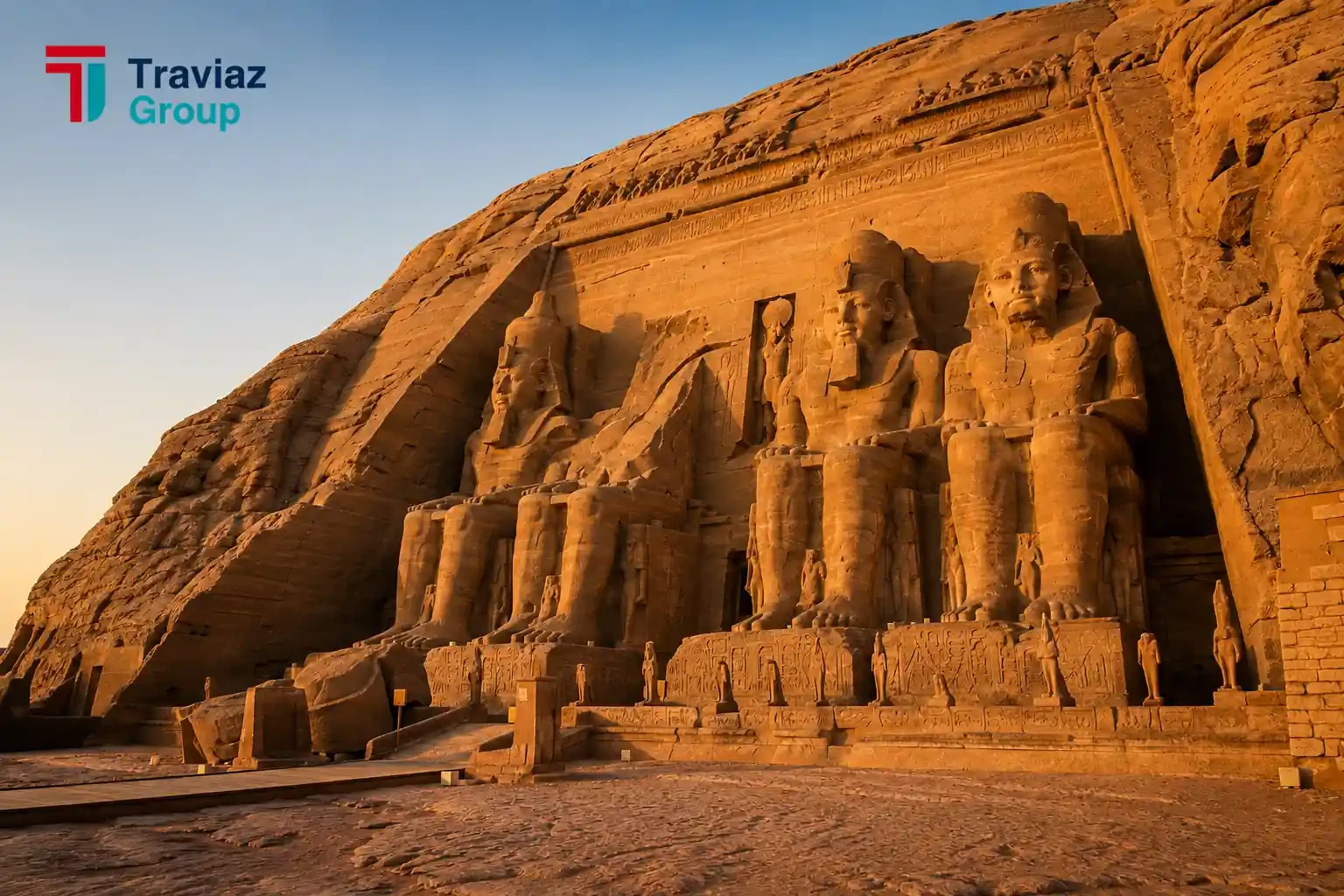
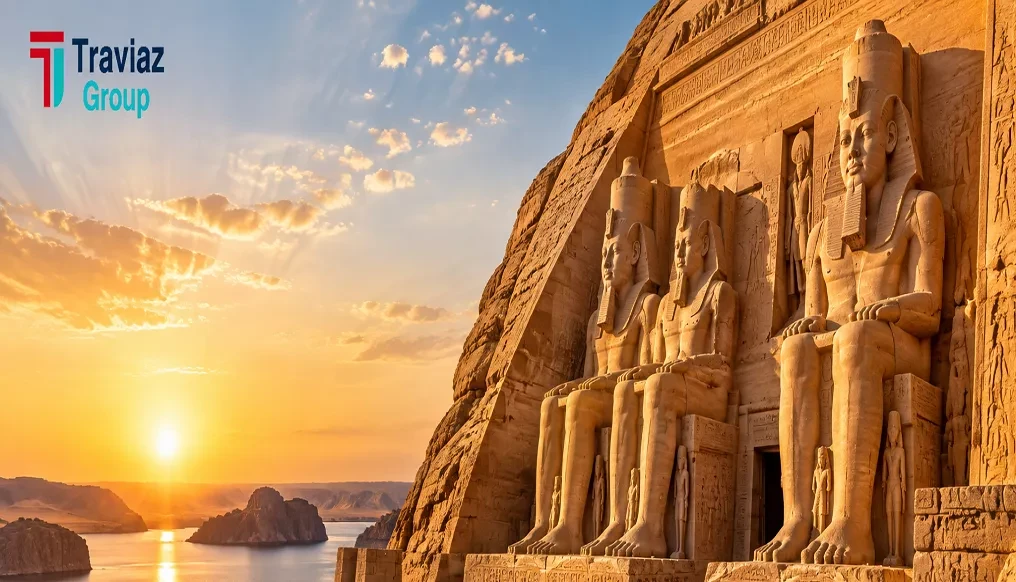
The Temple of Hathor and Nefertari is the small temple at Abu Simbel, and it was built around 1264 BC. Its facade features six towering statues each 10 meters tall, four of Ramesses II and two of Nefertari. The notable paradox is that Nefertari's statues are the same size as Ramesses's statues, which happened only twice in all of pharaonic history and embodies her exceptional status. The interior contains Hathor-headed columns and wall inscriptions showing Nefertari offering sacrifices to the gods.
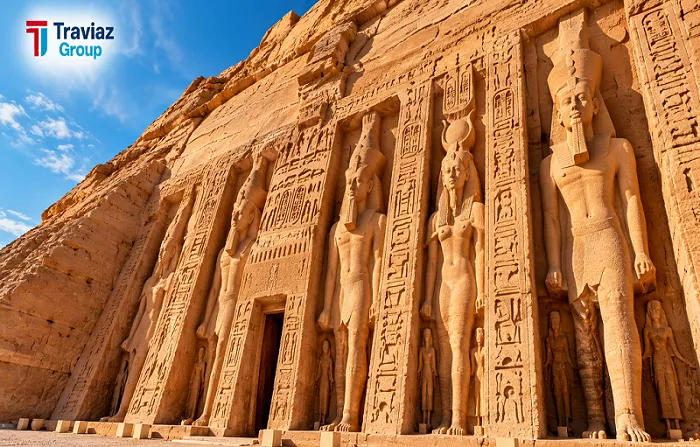
Is the Visit to the Abu Simbel Nefertari Temple Worth the Journey?
The trip from Aswan to Abu Simbel takes 3.5 to 4 hours by car or 45 minutes by plane. The entry ticket is around 750 Egyptian pounds and includes both temples. The vast majority of visitors describe Abu Simbel as among the top three sites in all of Egypt and worth every minute of travel. The best timing for arrival is early morning before the peak heat and the crowding of tourist buses.
How Traviaz Facilitates Your Queen Nefertari Experience
Visiting queen Nefertari tomb independently means facing multiple challenges all at once, from buying tickets in cash to daily verification of the tomb's opening status to making optimal use of the available 10 minutes. Traviaz removes all of these challenges before your arrival:
- Advance ticket booking: Traviaz handles the booking and payment mechanism before the visit date to guarantee ticket availability.
- Private archaeological guide: delivers a detailed briefing before entering the tomb to know the most prominent scenes and the order of viewing.
- Coordination with the Luxor Premium Pass: Traviaz directs you to the more affordable option according to your full Luxor itinerary.
- Private transportation to Abu Simbel: organizing the trip by air or by road with a specialized guide who explains the Nefertari temple in depth.
Contact Traviaz through the official website to book your customized itinerary for visiting queen Nefertari tomb and Abu Simbel.
FAQs
Why Is the Nefertari Tomb So Expensive?
The high price is a deliberate protection tool that aims to reduce the daily number of visitors and maintain the humidity inside the tomb at safe levels, because every visitor adds humidity that accelerates the deterioration of the pigments that are 3,300 years old.
When Did Queen Nefertari Live?
Nefertari lived in the period between around 1295 and 1255 BC during the reign of the Nineteenth Dynasty in the New Kingdom era, and she died around the twenty-fifth year of Ramesses II's reign.
Was Queen Nefertari Related to King Tut?
There is no documented blood relation between Nefertari and Tutankhamun, but some archaeological evidence points to the possibility of her belonging to the family of Pharaoh Ay who ruled at the end of the Eighteenth Dynasty to which Tutankhamun belongs.
Where Is Queen Nefertari Buried?
Nefertari was buried in tomb QV66 in the Valley of the Queens on the west bank of Luxor, but her body was looted in ancient times and only her mummified knees were found, currently preserved in the Museo Egizio in Turin, Italy.