
Cairo Attractions: The Best Things to Do in Cairo and Giza
Cairo needs at least two days to cover its most important landmarks, three days if you want to add Saqqara, Dahshur, and Coptic Cairo, and four days if you are the kind of traveler who likes to go deep into the details.
This guide covers 13 main destinations arranged by geographic area rather than by fame, so you can build a clear and logical daily plan.
Before you start, there is one piece of information that many sources have gotten wrong until now: the complete treasures of Tutankhamun, including the golden mask, moved to the Grand Egyptian Museum GEM in Giza in November 2025 and are no longer in the Tahrir building.
You will find the details of that in the museums section below, while the following table gives a quick comparison of all the sites.
Cairo Attractions at a Glance
For a quick picture before getting into the details, the following table shows the location of each landmark, the area it is in, the expected visit time, the entry price for foreigners, the best time to go, and an estimate of the experience's value:
|
Site |
Area |
Time Needed |
Foreign Entry |
Best Time |
Value |
|
Giza Pyramids and the Sphinx |
Giza |
3 to 4 hours |
700 pounds |
7 to 9 AM |
Essential |
|
Grand Egyptian Museum GEM |
Giza |
3 to 5 hours |
25 dollars |
At opening |
Essential |
|
Egyptian Museum |
Tahrir |
2 to 3 hours |
450 pounds |
Midday |
Essential |
|
Saqqara and the Step Pyramid |
30 km south |
2 to 3 hours |
600 pounds |
Morning |
Essential |
|
Khan el-Khalili |
Islamic Cairo |
1.5 to 2 hours |
Free |
Evening |
Essential |
|
Cairo Citadel |
Islamic Cairo |
2 hours |
300 pounds |
Late afternoon |
High |
|
National Museum of Egyptian Civilization NMEC |
Fustat |
2 hours |
450 pounds |
Any time |
High |
|
Coptic Cairo |
Old Cairo |
1.5 hours |
Mostly free |
Morning |
High |
|
Dahshur |
40 km south |
1.5 hours |
60 pounds |
Morning |
Moderate |
|
Cairo Tower |
Zamalek |
1 hour |
250 pounds |
At sunset |
Moderate |
|
Al-Azhar Park |
Darb Al-Ahmar |
1 to 2 hours |
50 pounds |
At sunset |
Moderate |
|
Abdeen Palace |
Downtown |
1.5 hours |
100 pounds |
Any time |
Moderate |
|
Manial Palace |
Rhoda |
1 hour |
100 pounds |
Any time |
Specialized |
Prices documented in September 2026; ticket prices in Egypt change frequently and we recommend checking the official website egymonuments.gov.eg before visiting.
The Giza Plateau: Pyramids, the Sphinx and the Grand Egyptian Museum
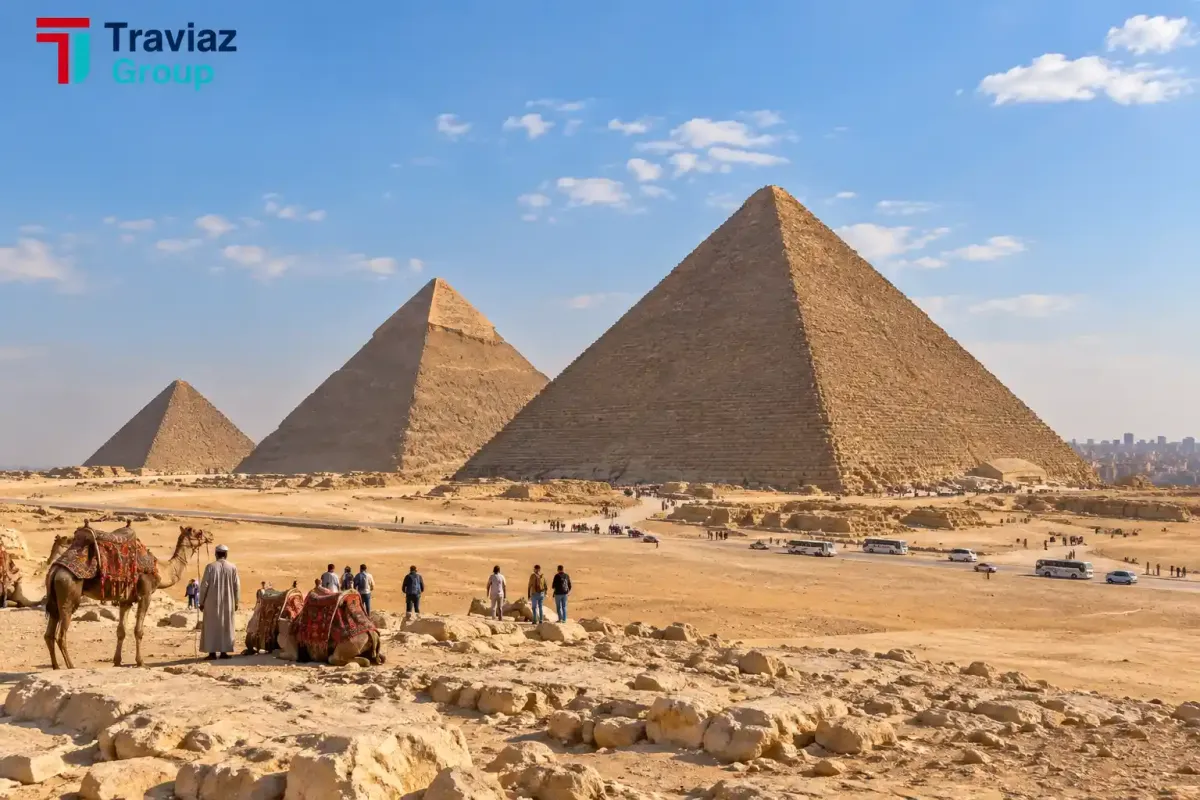
The Giza Plateau is the stop that most visitors associate with Cairo's tourist identity, and it deserves a full half-day of good planning.
Within a single area you will find three pyramid complexes and the Sphinx, in addition to the new Grand Egyptian Museum which is just a few minutes away.
The Pyramids of Giza
The story of the Giza Pyramids began with Khufu, who built the largest of the three pyramids around 2560 BC, followed by his son Khafre and grandson Menkaure with their successive constructions.
The image you see from a distance does not fully reflect their actual size: getting close reveals a scale that goes beyond what photographs suggest.
The basic plateau ticket at 700 pounds includes walking around the three pyramids and visiting the Sphinx, while entering inside the pyramids requires additional tickets.
The Great Pyramid of Khufu costs an additional 900 pounds, and the experience inside is narrow, hot, and free of carvings, so it does not suit everyone.
Entry to the Pyramid of Khafre costs an additional 100 pounds, while Menkaure's Pyramid costs 200 pounds and is the least crowded of the three.
Arriving at seven in the morning gives you at least an hour before the volume of tourist buses rises, while the panorama point behind the plateau is the only place that allows photographing all three pyramids in a single frame.
Camel and quad rides are also available, but agreeing on the price before getting on is better than entering a negotiation after the tour ends.
The Great Sphinx
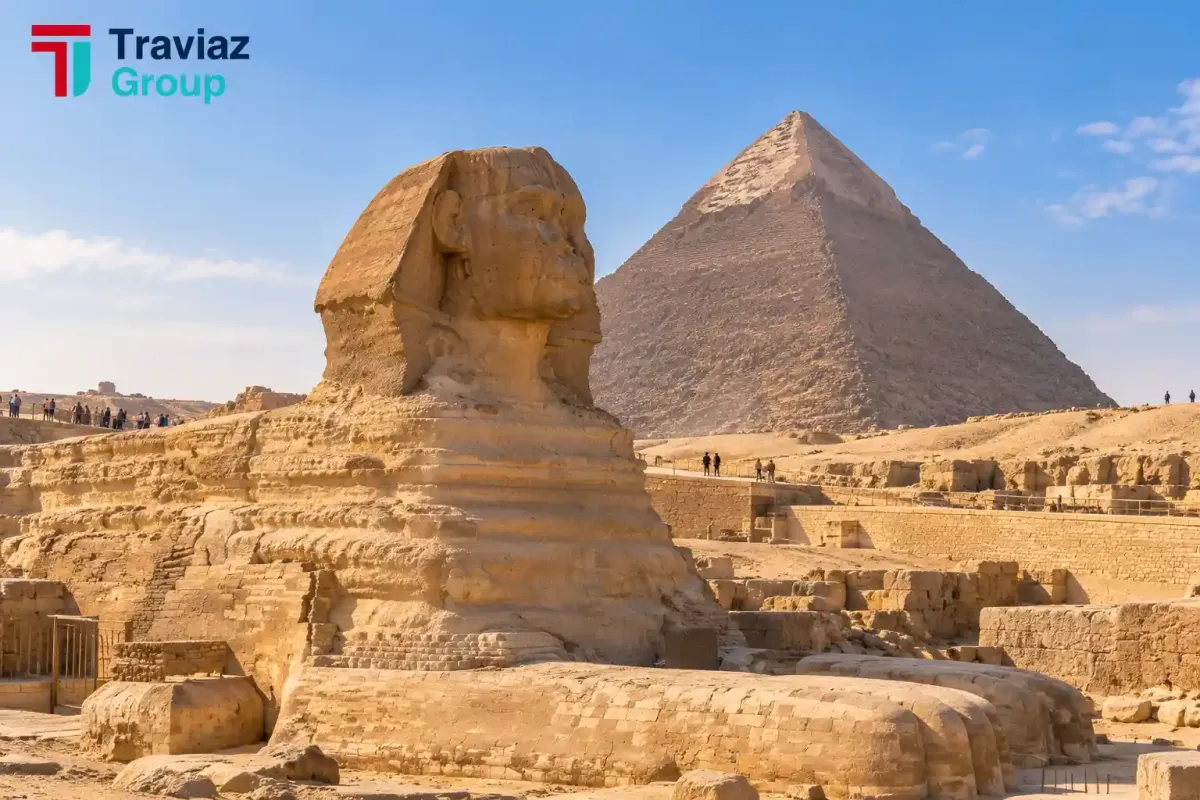
Directly below Khafre's plateau, the Sphinx appears as part of the funerary complex of the second pyramid. Entry is included within the basic plateau ticket without additional fees, and about 30 minutes is enough for a careful visit.
From the northeast near the entrance gate you get the best angle for photography, where its face appears fully with the pyramid in the background.
The Grand Egyptian Museum
Since the Grand Egyptian Museum GEM officially opened on November 1, 2025, the complete Tutankhamun collection, exceeding 5,000 pieces including the golden mask, has been displayed together for the first time in history since Howard Carter discovered the tomb in 1922.
The experience does not stop at this collection: the main atrium holds the massive statue of Ramesses II, and the museum also displays Khufu's solar boat across 12 sequential chronological exhibition halls.
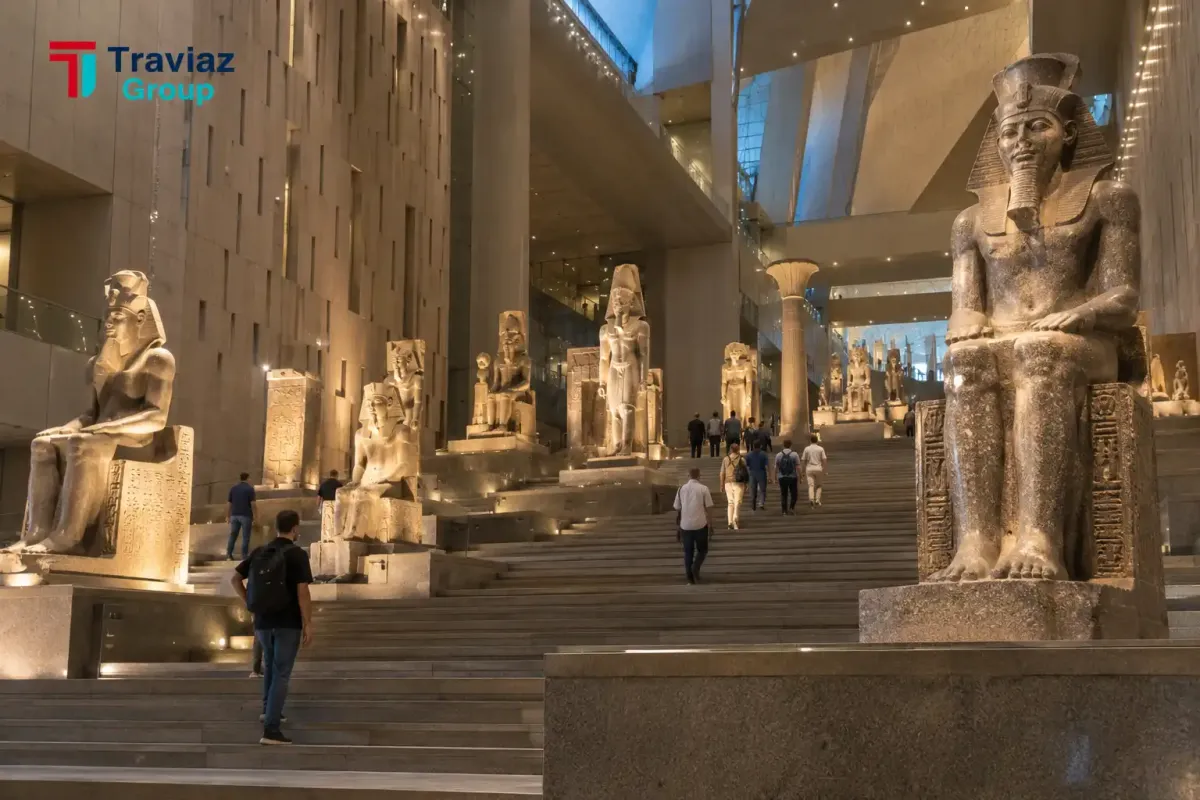
Set aside three to five hours for the museum and do not try to squeeze the plateau and the museum into just the first half of the day.
Its close proximity to the pyramid gate, whether on foot or by car, makes combining both sites in one day a practical arrangement. For more details, read our comprehensive Grand Egyptian Museum guide.
The Egyptian Museum in Tahrir Square
Before anything else, there is an important correction: the treasures of Tutankhamun moved to GEM in November 2025 and are not in the Tahrir building.
So anyone who goes to Tahrir looking for the golden mask will leave without finding it there.
That said, the Egyptian Museum in Tahrir remains an independent destination that deserves a full half-day.
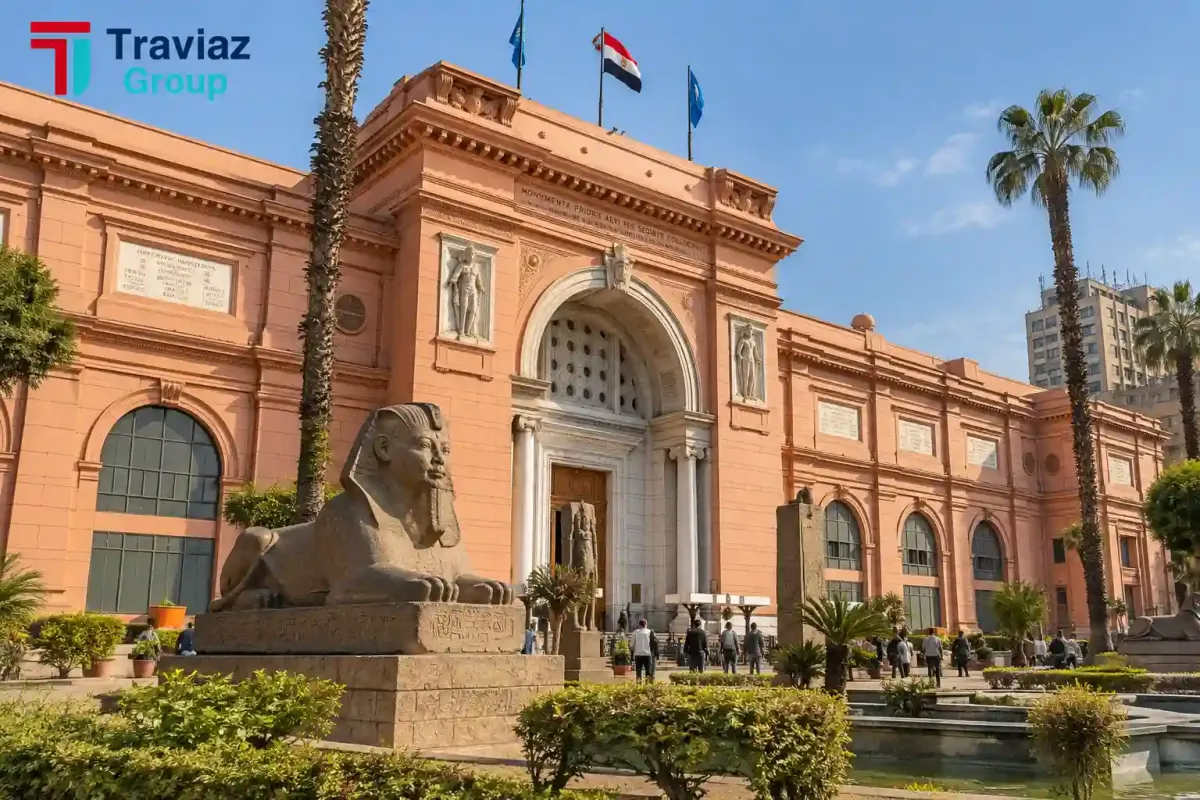
The Old and Middle Kingdom collections, the Amarna material from the era of Akhenaten, and the Royal Mummies Hall offer historical layers that GEM's experience does not condense.
Even the building itself, dating to 1902, is worth contemplating with its high ceilings, dim lighting, and the density of its displayed collections in a style resembling a Victorian cabinet of curiosities.
GEM offers a modern, organized, and comfortable museum experience, while the Tahrir building gives a sense of free exploration amid the density of the collections and historic architecture.
The museum opens from nine in the morning until five in the evening, and the ticket costs 450 pounds for foreigners and 230 pounds for foreign students.
The Royal Mummies Hall requires a separate additional ticket, while visiting after ten-thirty and before twelve gives you relative calm before the large tour groups arrive. For more, visit the Egyptian Museum page in our guide.
The National Museum of Egyptian Civilization (NMEC)
In Fustat, NMEC adds a different chapter to the picture that GEM and the Tahrir building present. It reopened on a large scale in 2021, coinciding with the transfer of 22 royal mummies to it in an exceptional procession known as the "Pharaohs' Golden Parade" that was broadcast live around the world.
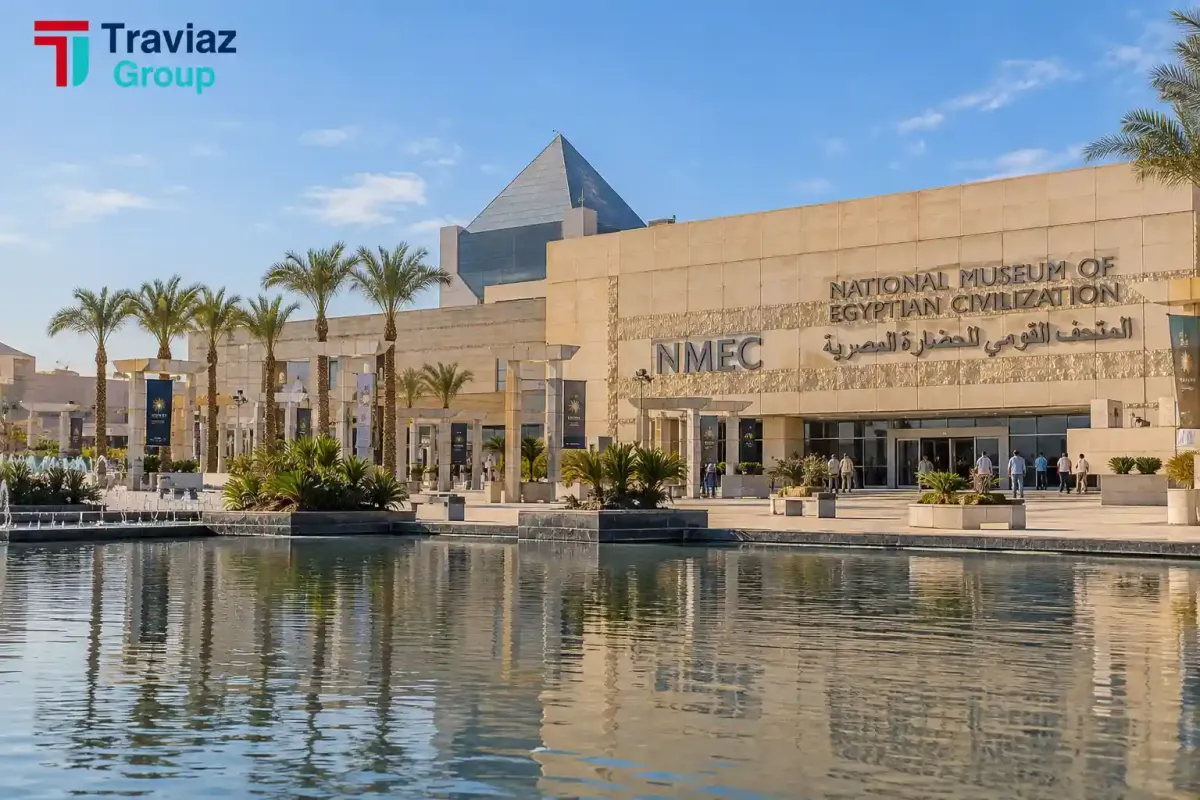
These mummies, displayed in a specially and carefully designed hall, are the heart of the museum experience and one of the main reasons to visit.
NMEC's halls are not limited to the mummies: the museum presents a journey through 7,000 years of Egyptian civilization, from prehistoric times to the modern era, in a contemporary interactive display.
This specific point distinguishes it from the other two museums, as it places Egyptian history in a continuous context rather than focusing on a single era. It opens from nine in the morning until five in the evening, with a Friday evening session from six until nine.
The foreign ticket costs 450 pounds and the average visit takes about two hours. Its proximity to Coptic Cairo makes combining both destinations suitable for a single half-day.
Saqqara and the Step Pyramid of Djoser
For those who want to see an archaeological site away from the usual tourist crowds, Saqqara offers a strong reason to leave the traditional Giza route.
Most Cairo visitors do not add it to their plan, and this is a point that can work in favor of those who decide to visit.
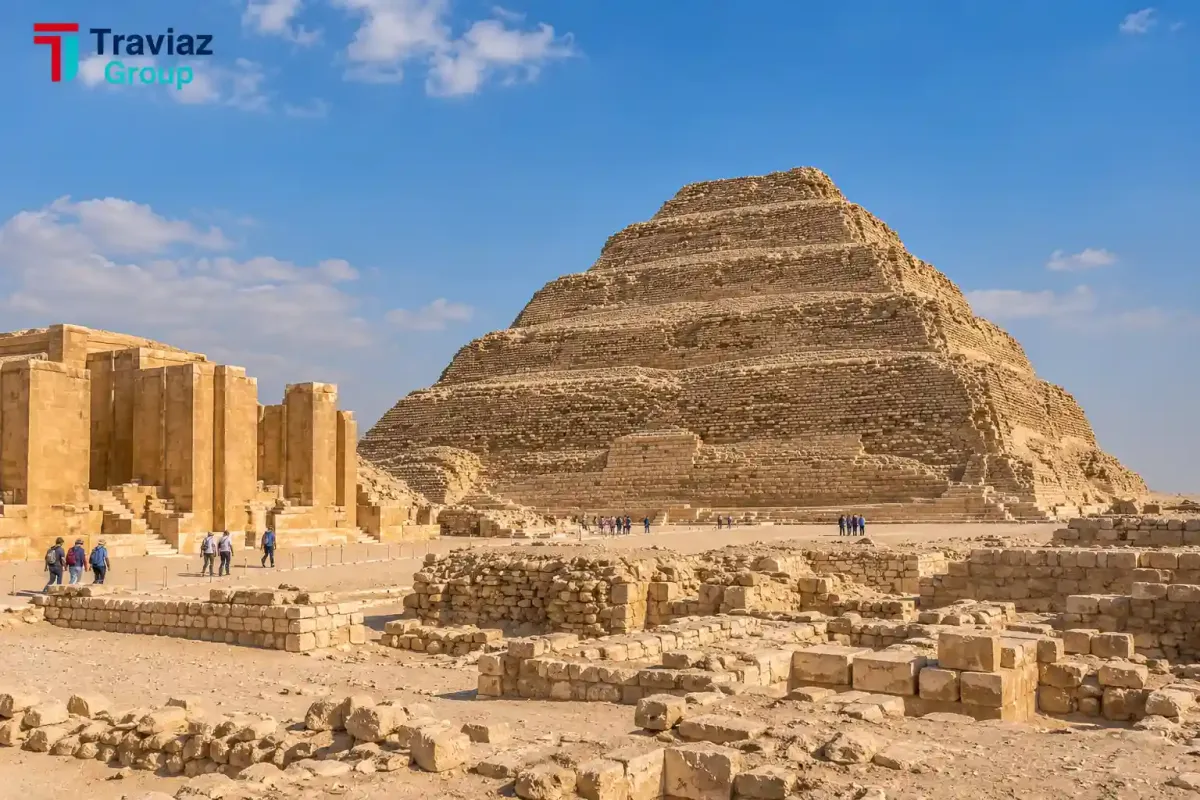
The Step Pyramid is associated with Pharaoh Djoser and the architect Imhotep, built around 2650 BC to become the oldest massive stone construction in human history and about a full century older than the Giza Pyramids.
Standing before the Step Pyramid, you see an early stage of the thinking that later led to the classic pyramid form: six mastabas stacked on top of each other reveal the engineering evolution step by step.
Around the pyramid lie the mastaba tombs, some of which contain remarkably preserved colored carvings that give a more intimate experience than many Giza scenes.
In the same area appears the Serapeum, the massive vault where the sacred Apis bulls were buried inside granite sarcophagi, some weighing up to 70 tons.
Saqqara is about 30 kilometers from Cairo and the trip takes about 45 minutes in normal traffic. The basic ticket is 600 pounds for foreigners and includes the main pyramid and the museum, while the ticket to enter inside Djoser's pyramid costs an additional 280 pounds.
The comprehensive package at 1,000 pounds includes most additional sites, making it suitable for those who want to explore the area fully.
Dahshur: The Bent and Red Pyramids
At Dahshur, the experience of entering a pharaonic pyramid becomes easier and less crowded than the usual scene at Giza, and this is one of the details that does not always get enough attention when planning a Cairo visit.
The Bent Pyramid of Sneferu presents a living engineering document: the lower section was built at a 54-degree angle, then the angle shifted in the upper half to 43 degrees when the engineers were forced to modify the design after cracks appeared under the weight of the construction.
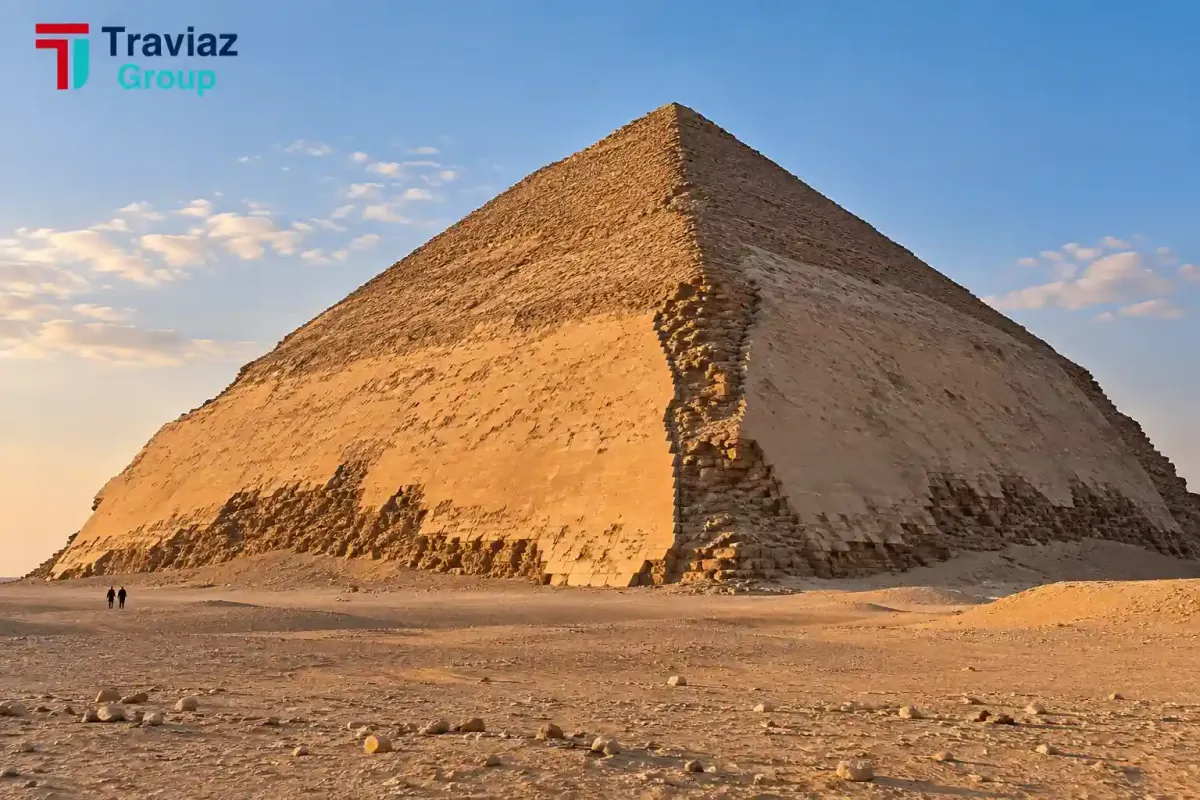
The result reveals a real phase of trial and error that preceded the arrival at the stable pyramid form.
The adjacent Red Pyramid represents the first successful pyramid in the classic sharp form, and entering its interior is generally available without a queue, giving you a genuine interior experience with less pressure and fewer crowds than the Giza Pyramids.
The ticket is just 60 pounds for foreigners, the cheapest among the pyramid sites mentioned here, and the site needs about an hour and a half.
For this reason, combining Saqqara and Dahshur in one day is a practical arrangement for anyone who wants to cover southern archaeological Cairo.
Islamic Cairo: Mosques, Minarets and Al-Muizz Street
Islamic Cairo is one of the most prominent preserved urban heritage areas in the world, and UNESCO listed it as a World Heritage Site within Historic Cairo in 1979.
The Fatimids, Ayyubids, Mamluks, and Ottomans all left their marks here in a continuous system of mosques, fountains, khans, and palaces whose buildings span from the tenth to the eighteenth century. Here are the most prominent stops within this area.
Al-Muizz Street
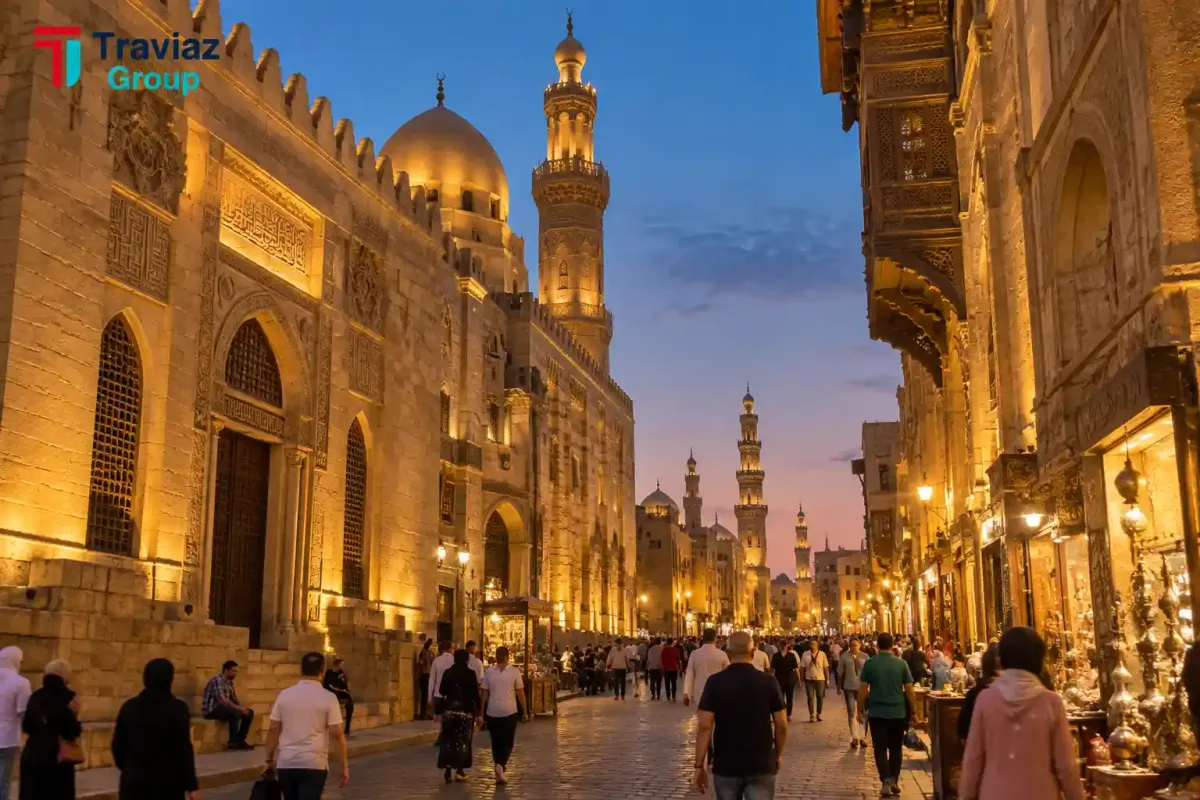
Al-Muizz Street extends between Bab al-Futuh and Bab Zuweila and forms the backbone of Islamic Cairo. Walking through it resembles passing through an open museum, with monuments from multiple Islamic eras lining both sides.
In the late evening, the tour becomes more comfortable as traffic decreases and night lighting appears on the mosque minarets.
Sultan Hassan and Al-Rifa'i Mosques
In the Citadel Square, the Mosque of Sultan Hassan and the Al-Rifa'i Mosque stand facing each other, and the two sites bring together two different models of Egyptian Islamic architecture.
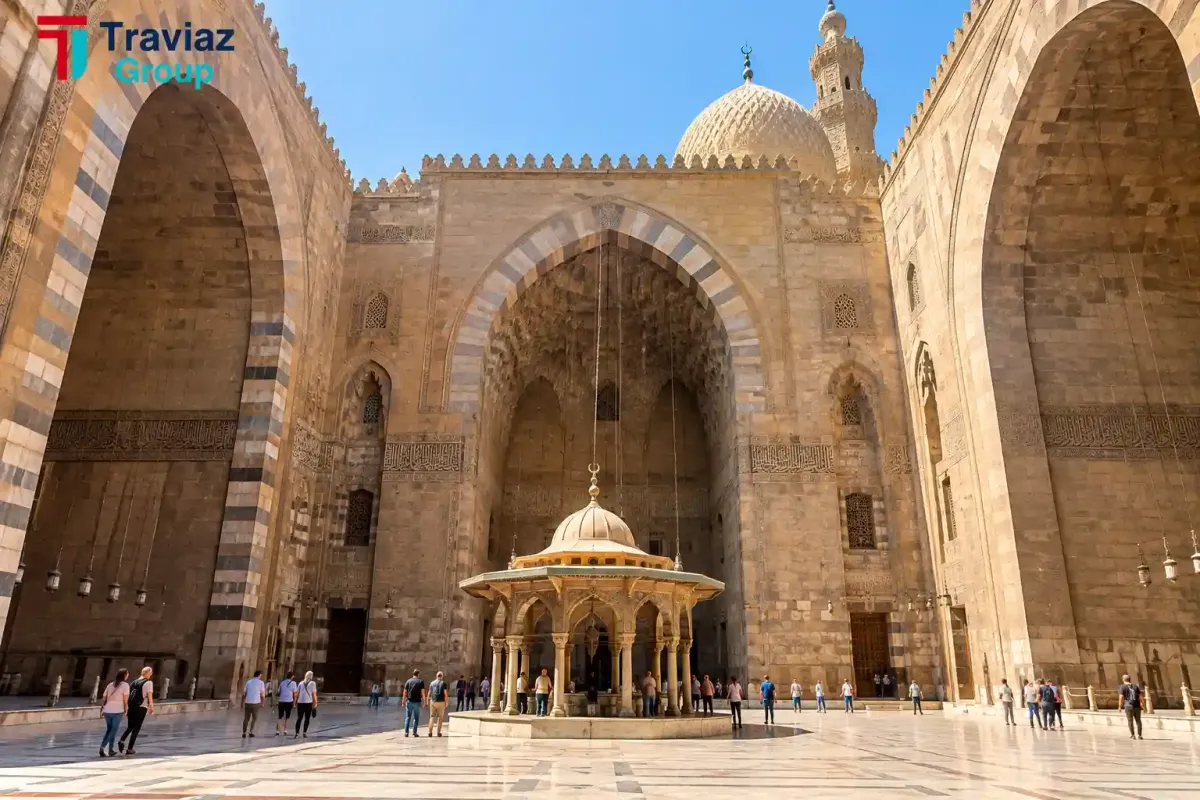
Sultan Hassan dates to the fourteenth century and is distinguished by its Mamluk grandeur, while Al-Rifa'i belongs to the nineteenth century and carries a more clearly Ottoman influence.
Entry is available to non-Muslims outside prayer times, with the necessity of covering shoulders and knees, while a head covering is generally available for women at the entrance.
Al-Azhar Mosque and Al-Azhar Park
Al-Azhar Mosque was founded in 970 AD and is one of the oldest congregational mosques in the Islamic world. Nearby lies Al-Azhar Park, with its 50-pound entry ticket, and its hills provide a view that combines the minarets of Islamic Cairo with the Giza skyline.
Sunset gives the park its best visual scene, especially for those who want to photograph the different layers of Cairo in a single shot.
The Cairo Citadel and Muhammad Ali Mosque
Above the Muqattam plateau, Saladin built the Citadel in 1176 AD to be a fortress protecting Cairo from the Crusaders.
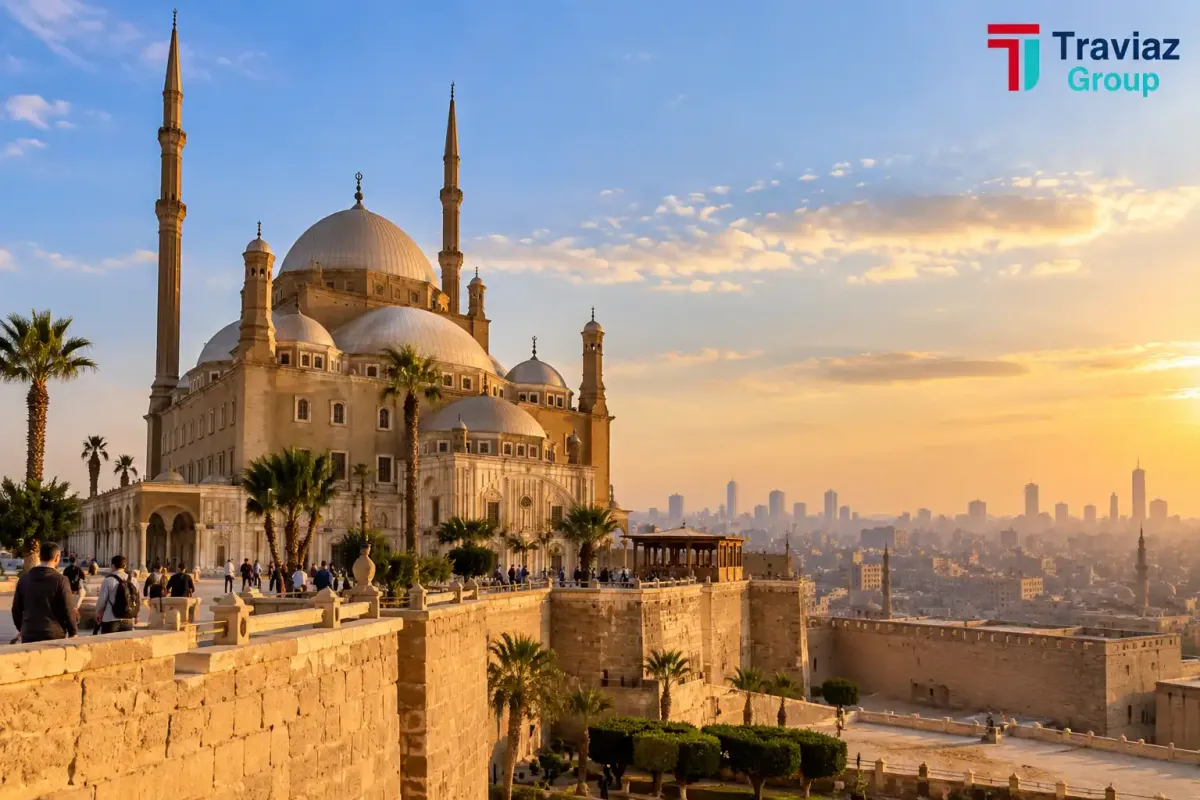
The Citadel remained the center of governance in Egypt for more than seven centuries, until the late nineteenth century, and it holds today a collection of the city's most prominent architectural landmarks.
The most famous of its buildings is the Mosque of Muhammad Ali, also known as the Alabaster Mosque, which was completed in 1848 in the Ottoman style with its domes and towers rising above Cairo.
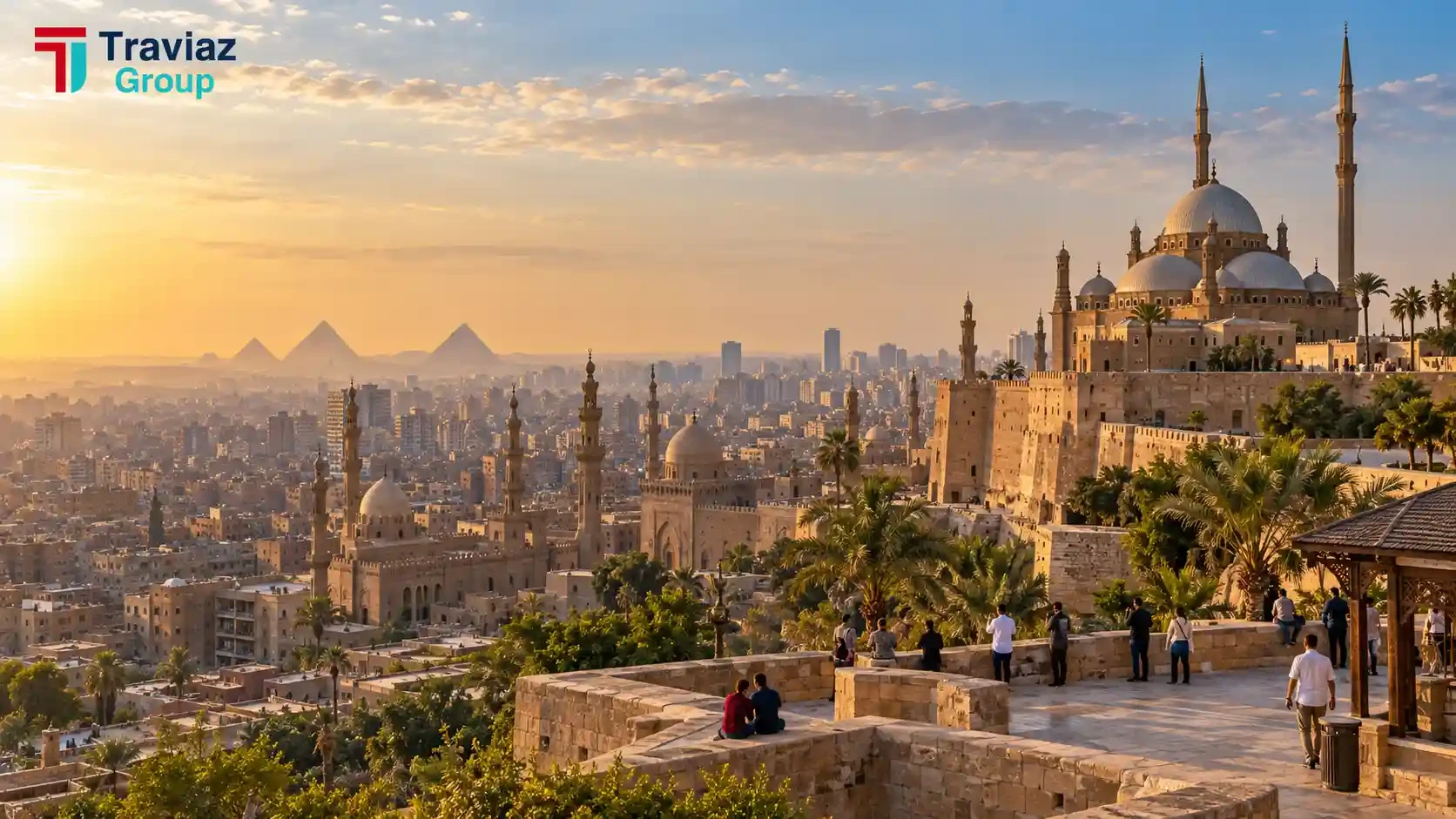
From the Citadel's terrace, on clear days the Giza Pyramids can be seen on the western horizon, bringing Islamic and Pharaonic Cairo together in a single scene.
The ticket costs 300 pounds for foreigners, while a late-afternoon visit provides suitable light for photography with a relative drop in crowds. Combining the Citadel with the Islamic Cairo area in one day is the practical arrangement.
Coptic Cairo and Old Cairo
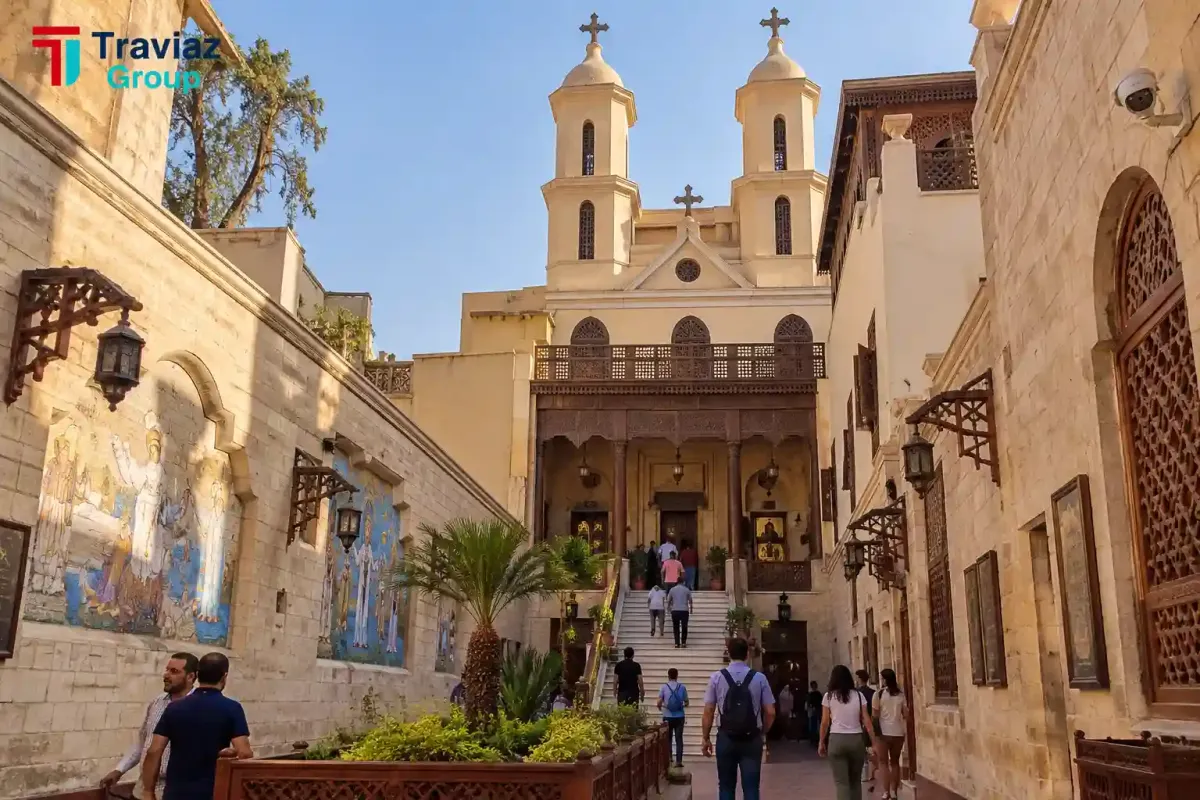
Among the easiest areas of old Cairo to reach, Coptic Cairo comes directly at the Mar Girgis station on Metro Line 1, which eliminates the need for a taxi or Uber to reach the heart of the area.
Within a walkable space, the Hanging Church appears, built in the seventh century AD and named because it rises above two towers of the Roman Babylon Fortress.
Nearby is the Church of Saints Sergius and Bacchus from the eleventh century, with columns dating to the fourth century.
Ben Ezra Synagogue also appears within the area, where an important collection of Jewish documents was found, known as the "Cairo Geniza."
The Coptic Museum holds 16,000 pieces that narrate the history of Christianity in Egypt, and its ticket costs 230 pounds for foreigners.
Most churches are free to enter, while a morning visit before ten gives calmer atmospheres and beautiful light through the interior windows.
Khan el-Khalili and Cairo's Markets
Khan el-Khalili's founding dates to 1382 during the reign of the Mamluk prince al-Khalili, and by the end of the fifteenth century it had become a center for regional trade in the Islamic world.
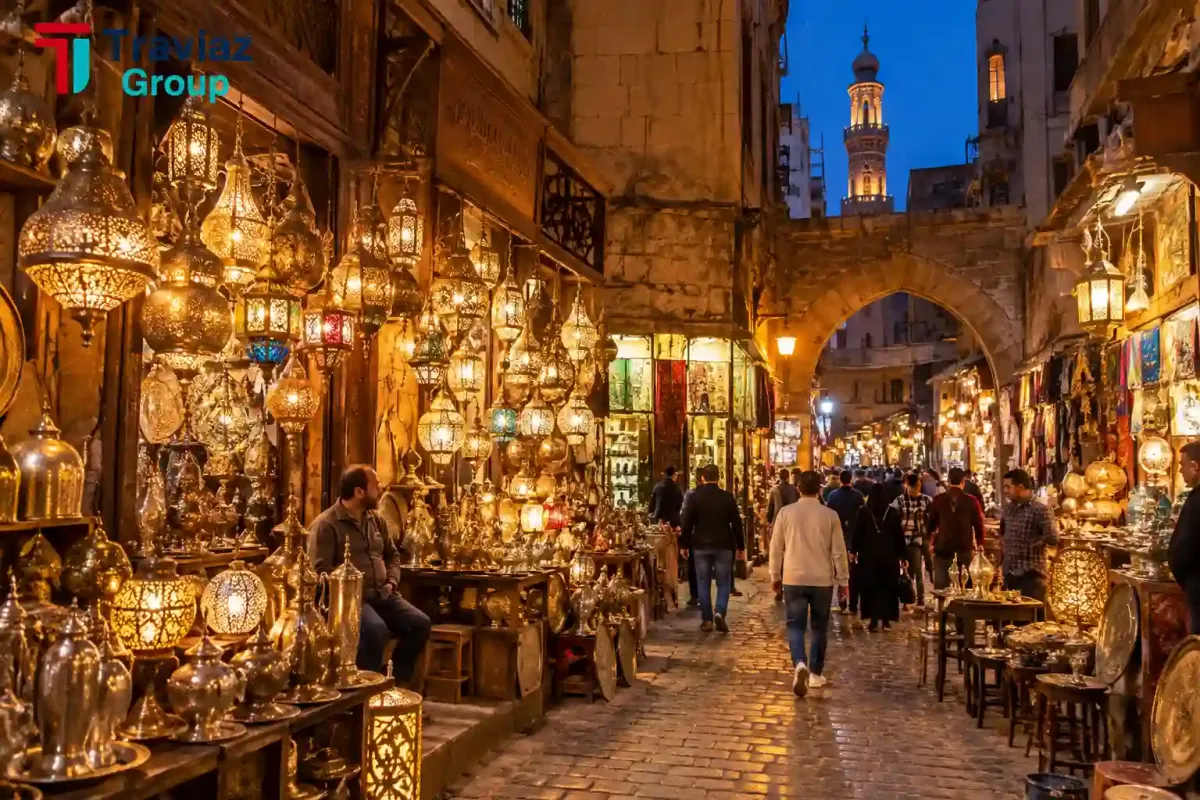
Today, the Khan forms a vast network of alleys and interior squares that accumulated over six centuries of commercial and urban activity.
If you are looking for local products, the inner gold district is the area associated with gold and silver workshops, while the inner alley shops provide whole unground spices.
Brass lanterns carry more of a local craft connection when you buy them from the craftsmen themselves rather than the tourist-facing storefronts.
Much of what is displayed on the main fronts is imported, and selling it as Egyptian craftsmanship is one of the common commercial tricks in the area.
In negotiation, the first price is not necessarily the final price: the seller generally starts higher than the price he is targeting.
Starting at half the amount you want to pay and then reaching a middle ground is a common approach, and smiling and walking away calmly may lead to a better offer.
The evening is the most beautiful time to visit, and the historic El-Fishawy Cafe, which has been operating since 1773, is worth stopping at for a cup of mint tea.
Cairo Tower and the City Views
Cairo Tower rises 187 meters above Zamalek and was built in 1961 with the design of architect Naoum Shebib, inspired by the lotus flower and using Aswan granite.
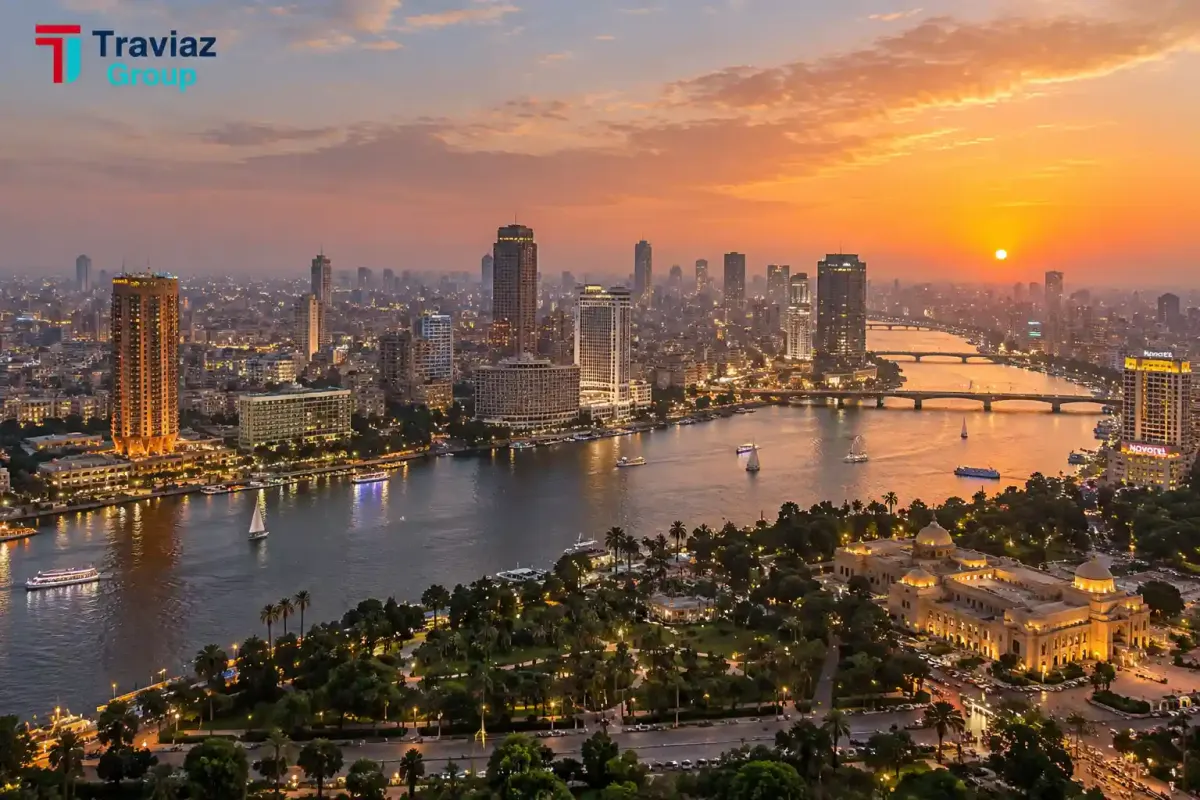
Its height exceeds the Pyramid of Khufu by 43 meters, and the observation platform at the top reveals historic Cairo and the Citadel to the east, while Giza and the Pyramids appear to the west when visibility is good.
The ticket costs 250 pounds and the tower opens from nine in the morning until midnight.
Sunset is the most attractive timing for photography, but also the most crowded. Air pollution is an important factor to keep in mind, as it may block visibility on a large number of summer days.
For a cheaper view, Al-Azhar Park for 50 pounds offers a scene combining Cairo's minarets with the Giza skyline, while the Citadel's terrace provides a view toward the Pyramids within the Citadel's own entry ticket.
Cairo's Palace Museums and Lesser-Known Attractions
Away from the more famous tourist routes, Cairo holds a collection of palaces and museums that give the visitor a different picture of the city's history and art.
These destinations do not always appear in traditional English-language tourist guides, but they deserve dedicated independent time.
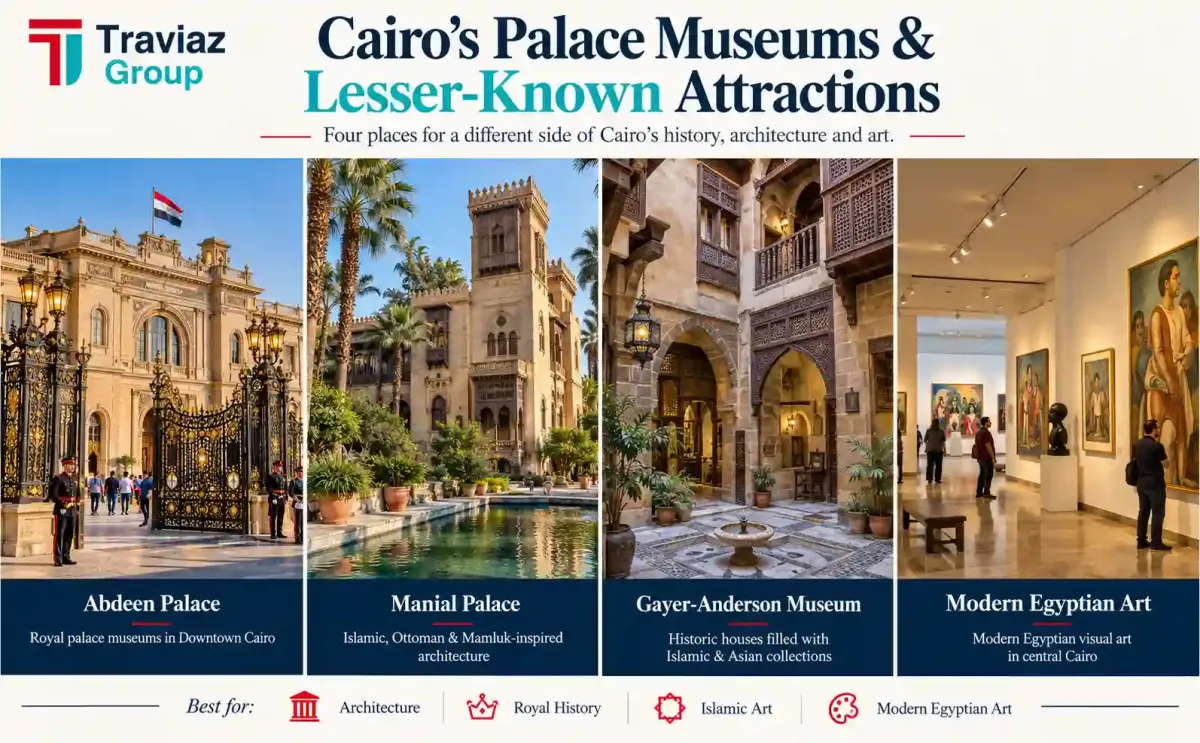
In Downtown, Abdeen Palace was the seat of governance for Khedive Ismail and later the royal family, and it holds today the Museum of Arms, Decorations, Gold, and Royal Watches across multiple wings. Its ticket costs 100 pounds and a visit takes about an hour and a half.
On Rhoda Island, Manial Palace represents a distinctive architectural model built between 1901 and 1929, blending the Mamluk and Ottoman styles. Its ticket costs 100 pounds and it is a specialized destination for lovers of historic architecture.
In the Khalifa neighborhood, the Gayer-Anderson Museum is located inside two seventeenth-century Ayyubid houses and displays a collection assembled by a British officer in the 1930s, a rare blend of Islamic and Eastern antiques.
As for the Museum of Modern Egyptian Art in the Opera House gardens, it holds an important collection of modern Egyptian visual art and is often absent from visit plans despite offering a direct entry point into understanding aspects of contemporary Egypt.
Historic Cairo as a UNESCO-listed system was described by the organization as "the most historically rich Islamic city in the world" and listed in 1979.
Cairo Attractions by Neighbourhood
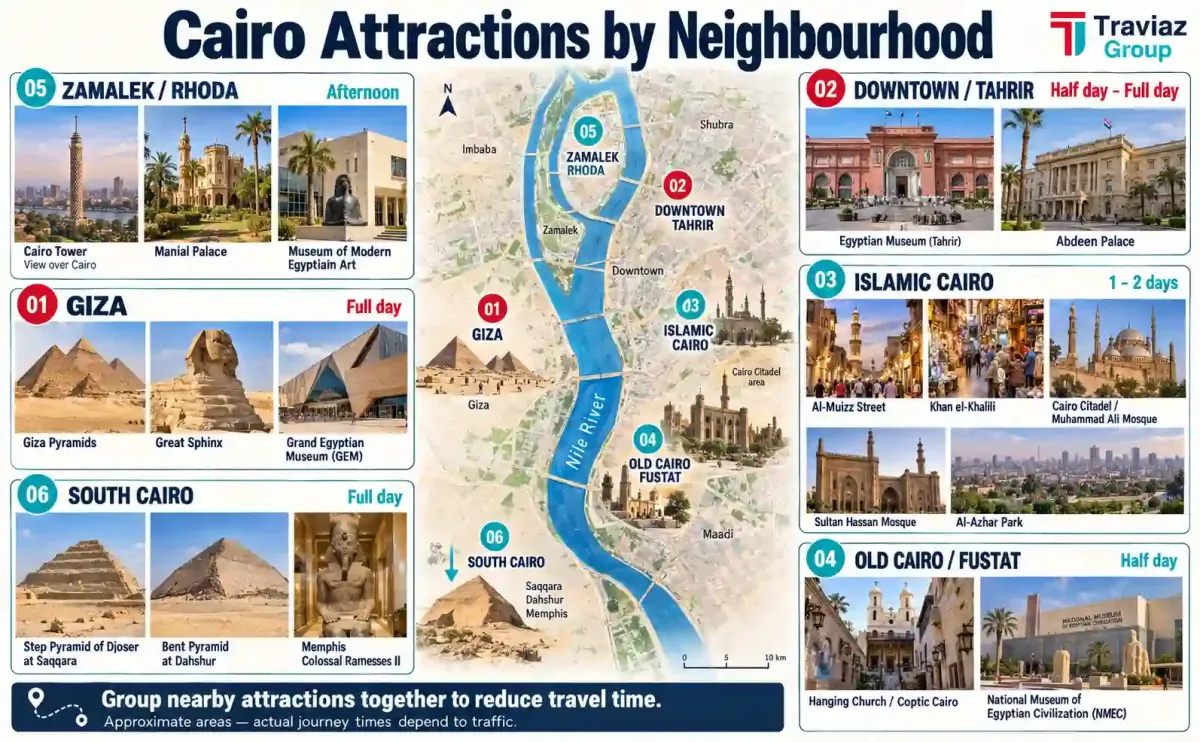
Distributing landmarks according to geographic areas reduces travel time within Cairo, and the following classification can be used as a basis for building a more cohesive daily program:
- Giza: the Giza Pyramids, the Sphinx, and the Grand Egyptian Museum GEM, a full day.
- Downtown and Tahrir: the Egyptian Museum and Abdeen Palace, half a day to a full day.
- Islamic Cairo: Al-Muizz Street, Khan el-Khalili, the Citadel, Sultan Hassan Mosque, and Al-Azhar Park, a full day or two consecutive days.
- Old Cairo and Fustat: Coptic Cairo and the National Museum of Egyptian Civilization NMEC, half a day.
- Zamalek and Rhoda: Cairo Tower, Manial Palace, and the Museum of Modern Art, an afternoon.
- South of the city: Saqqara, Dahshur, and Memphis, a full day.
How Many Days Do You Need in Cairo?
Two days cover the basics, three days give a balanced experience, while four days provide more space for depth. The following plans maintain realistic timings and combine nearby sites as much as possible.
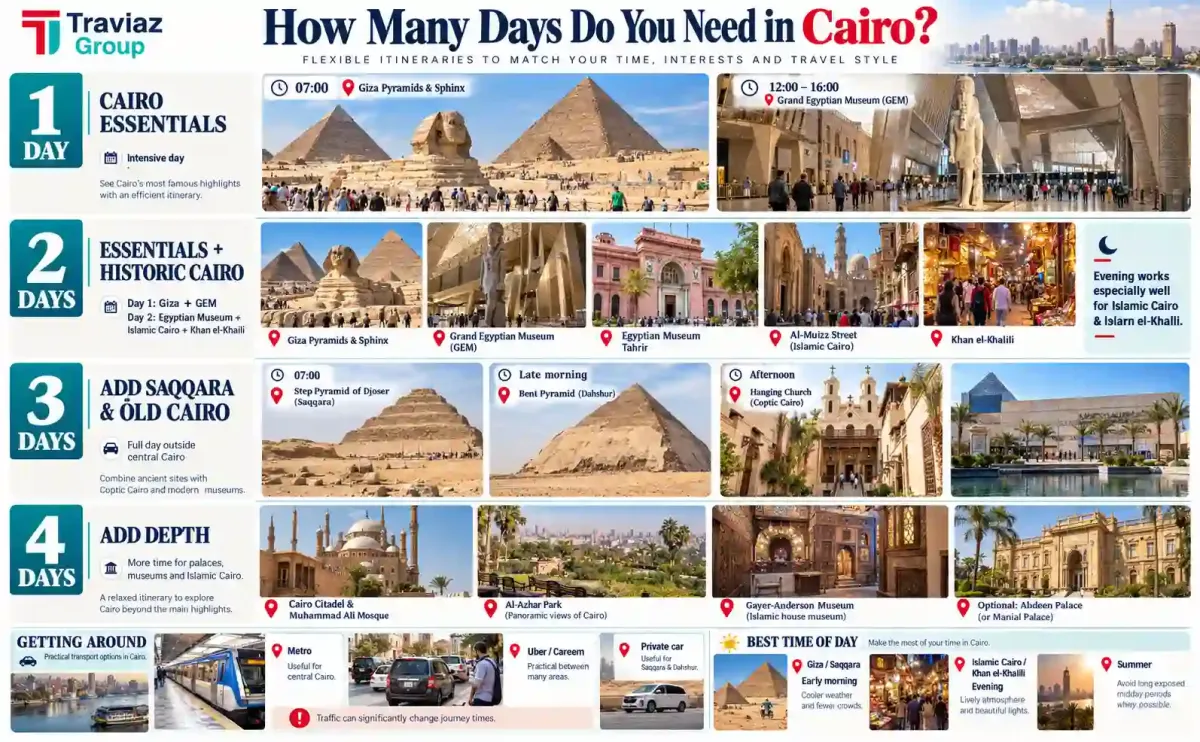
One-day plan
Seven in the morning: Giza and the Sphinx to avoid midday heat and crowds, with the basic plateau ticket booked electronically in advance.
An hour and a half is enough for the Sphinx and walking around the three pyramids, and you need an extra hour if you decide to enter one of the pyramids.
After that, the transfer from Giza to GEM takes about 10 minutes by car. From twelve until four: visiting GEM, with the ticket booked in advance because the entry queue can reach 45 minutes.
The most important thing to book in advance is the GEM electronic ticket, while keeping in mind that combining Giza and GEM in one day is very intensive and you may not be able to absorb all the details of both sites.
Two-day plan
Day one: Giza and GEM as above. Day two: the Egyptian Museum in Tahrir from ten until one, then Islamic Cairo at sunset and Khan el-Khalili in the evening.
The transfer between Tahrir and Islamic Cairo takes about 20 minutes by Uber in suitable traffic conditions. The Royal Mummies Hall ticket at the Egyptian Museum is something that should be booked separately in advance.
Two hours at Tahrir may not be enough for those who want to go deep, so the Mummies Hall can be dropped if time is tight and the two hours dedicated to the main collections.
Three-day plan
Days one and two as above. Day three starts by setting off at seven in the morning to Saqqara, then spending two and a half hours there, followed by Dahshur for an hour and a half, then Coptic Cairo and NMEC on the way back in the afternoon.
The transfer between Saqqara and Dahshur takes about 15 minutes, and between Dahshur and Coptic Cairo about 45 minutes.
Arranging a private car in advance for Saqqara and Dahshur is important as the metro does not reach them.
Combining four sites on day three is intensive, so those who prefer a quieter pace can drop NMEC and limit the day to Coptic Cairo.
Four-day plan
The first three days as above, while day four remains flexible. It can start with the Citadel from nine until eleven, then Al-Azhar Park at midday, then the Gayer-Anderson Museum in the afternoon.
Another option is a palace tour covering Abdeen and Manial, or a trip to Alexandria for a change in the trip's nature.
Combining the Citadel, Al-Azhar, and Gayer-Anderson in one day is possible as the sites are located in approximately the same area.
Visiting Cairo: Tickets, Hours and Practical Advice
Before the first tour begins, there is a set of practical details that save waiting time and help in choosing the right transport and timing for each area.
Tickets and Passes
There is no comprehensive Cairo Pass covering all sites at the time of writing this guide. Each site has its own independent ticket, sold on-site, while a large portion is also available electronically through egymonuments.gov.eg.
Advance booking saves waiting time, especially at GEM and Giza. University students get a 50% discount at most sites with the international ISIC card, and phone photography is permitted for free at most sites, while professional cameras may require additional fees at some. Most sites accept bank cards and cash.
Getting Between Attractions
The metro is useful at three main points: Mar Girgis station for Coptic Cairo, Sadat station for Tahrir and the Egyptian Museum, and Attaba station for Islamic Cairo with about 15 minutes of walking.
Beyond these stations, Uber and Careem become more practical and safer than a random taxi. A private car is necessary for Giza, Saqqara, and Dahshur, while traffic between twelve noon and eight in the evening can double journey time.
Grouping sites in the same area can save at least an hour a day of travel time.
Best Time of Day and Year
Giza and Saqqara need an early start between seven and nine in the morning before the heat and crowds rise.
Khan el-Khalili takes on a different character in the evening, while large tourist groups arrive at many sites between ten and twelve, making the period between seven and nine-thirty noticeably calmer. In terms of weather, the months of October, April, and March are among the suitable periods for a visit.
Cairo's summer may exceed 40 degrees, which is tolerable inside enclosed sites but becomes harsh at the exposed Giza plateau. During Ramadan, many sites change their hours and some may close early.
What to Wear and Cultural Notes
At religious sites such as the Citadel, Al-Azhar Mosque, and churches, covering shoulders and knees is the required standard for both genders.
A head covering is usually available for women at mosque entrances, while a closed and comfortable shoe remains important at Giza and Saqqara because of the sand and uneven surfaces. Sunscreen is necessary at all exposed sites, even during winter.
Book your Cairo tour with Traviaz now and explore Cairo's landmarks with a specialist Egyptologist guide who saves you ticket time and turns your visit from a list of sites into a connected story: [/day-tours/cairo-day-tours/]
FAQ
Where Are Tutankhamun's Treasures in Cairo?
Since November 2025, the complete Tutankhamun collection, including the golden mask and more than 5,000 pieces, moved to the Grand Egyptian Museum GEM in Giza. The Egyptian Museum in Tahrir still holds exceptional collections from the Old and Middle Kingdoms, but Tutankhamun's treasures are not among them.
What Is the Difference Between the Grand Egyptian Museum GEM and the Egyptian Museum?
GEM in Giza is a modern museum that opened in November 2025, displaying Tutankhamun and the solar boats across 12 chronologically organized halls in a contemporary, comfortable museum experience, with a ticket costing 25 dollars. The Egyptian Museum in Tahrir is a building dating to 1902 that holds 170,000 pieces from the Old and Middle Kingdoms in an intensive Victorian style, with a ticket costing 450 pounds. Each museum has its own character, and visiting each one deserves independent time.
How Many Days Are Enough to Visit Cairo?
Two days are enough for the basics, three days give you the balanced experience, while four days provide more space for depth. If you only have one day, the best approach is to build the day around Giza and GEM together or choose the Egyptian Museum in Tahrir within a separate program, as combining all of these sites in one day is not practical.
What Are Cairo's Most Important Landmarks?
The Giza Pyramids, the Sphinx, GEM, Saqqara, the Step Pyramid, Khan el-Khalili, the Egyptian Museum, Islamic Cairo, and Coptic Cairo form nine essential stops in the Cairo experience, and they are the sites that most visitors describe as the heart of the trip.
Can You See the Pyramids and a Museum in One Day?
Yes, if the museum in question is GEM, since it is just minutes from the Giza plateau, making them a suitable centerpiece for a first-day plan. The Egyptian Museum in Tahrir, with its farther location, makes combining it with Giza on the same day more tiring and less comfortable.
How Much Do Cairo Landmark Tickets Cost?
The Giza plateau ticket costs 700 pounds for foreigners, GEM costs 25 dollars, the Egyptian Museum costs 450 pounds, Saqqara costs 600 pounds, Dahshur costs 60 pounds, the Coptic Museum costs 230 pounds, and the Citadel costs 300 pounds. Prices are documented in September 2026 and are subject to change.
Is It Worth Entering the Great Pyramid?
The passages inside the Great Pyramid are narrow, sloping, and hot, and there are no carvings inside, while the entry costs an additional 900 pounds with a daily limit on the number of spots. Those looking for a more comfortable and less crowded interior experience can choose the Red Pyramid at Dahshur, where the entire site ticket costs just 60 pounds.
Can Non-Muslims Enter Cairo's Islamic Mosques?
Yes, non-Muslims can enter most of Islamic Cairo's mosques outside the five prayer times, with shoes removed and shoulders and knees covered. Al-Azhar Mosque, the Mosque of Sultan Hassan, and Al-Rifa'i are among the most prominent mosques that welcome non-Muslim visitors under these rules.
What Should I Wear at Cairo's Landmarks?
Wear clothing covering shoulders and knees when visiting religious sites, choose a closed and comfortable shoe for the plateau and Saqqara, and use sunscreen at all exposed sites even during winter. You may also need a light layer inside the air-conditioned museums during summer.
Is Saqqara Worth Visiting After Giza?
The Step Pyramid at Saqqara is about a full century older than the Giza Pyramids, and the site is far less crowded. The colored tombs contain remarkably preserved carvings, while the Serapeum offers a different experience that has no equivalent at other Egyptian sites. A separate day can be dedicated to Saqqara with Dahshur added to it in one arrangement.
What Is the Best Time to Visit the Pyramids?
Seven in the morning, when the gates open, is the most suitable period to avoid the bulk of the crowds and the heat. The first hour gives you relative calm before the tourist buses arrive between nine and ten, while the period from seven until nine-thirty is particularly suitable for visiting and photography during winter.
How Do I Get Between Cairo's Landmarks?
Uber and Careem are suitable for moving between different neighborhoods and are easier and safer than a random taxi. The metro is useful for reaching Mar Girgis, Sadat, and Attaba stations, while Saqqara, Dahshur, and Giza need a private car in the suggested program. Arranging sites geographically reduces travel time and can save about two hours a day of the journey.