
Edfu Temple Guide: Myths, Scams & Best Way to Visit
The Temple of Edfu, or Temple of Horus, is considered one of the most complete and best-preserved Egyptian temples in the world. It was built between 237 and 57 BC during the Ptolemaic period and dedicated to the falcon god Horus, protector of the pharaohs.
The temple holds second place in size after Karnak, while its facade is famous for the massive gateway reaching 36 meters in height, alongside the "Triumph of Horus" carvings that tell the legendary battle between Horus and Seth.
Why Edfu Temple is a Must-Visit on Your Egyptian Holiday
What makes the Temple of Edfu different from most other Egyptian temples is its striking completeness: the ceilings are still standing, the chambers are defined, the carvings are clear, and the architectural sequence from the gateway to the sanctuary is exceptionally preserved.
This scene does not appear in the same way at Karnak with its missing ceilings, or at Luxor Temple open to the sky.
Behind this rare condition lies an unusual historical story. When the pagan temples were closed in the fourth century AD, sand and dust began to accumulate around Edfu gradually until it was completely covered from its base to the top of its gateway.
On top of this layer, homes were built for residents for more than a thousand years, providing natural protection for the carvings from weathering and theft.
When the French archaeologist Auguste Mariette discovered it in 1860, he found the carvings in a near-complete condition with their original colors, making the discovery one of the most prominent events Egyptian archaeology saw in the nineteenth century.
The temple's importance goes beyond its architectural value, as the walls carry the most extensive complete religious hieroglyphic text to reach us from ancient Egypt, known as the "Edfu Texts."
These texts address the construction of the temple, its mythological interpretation, and its daily rituals, and so they have become an important academic source for understanding Egyptian religion during the Hellenistic period.
With a Traviaz guide, the visit begins more smoothly: the team handles the horse carriages, the entrance vendors, and the tickets, so the visitor can reach the inside of the temple without being distracted by the surrounding details.
Planning Your Visit: Location, Distance, and Best Way to Reach Edfu
The location of the Temple of Edfu on the western bank of the Nile in the city of Edfu in Aswan Governorate makes it a natural stop within trips linking Luxor to Aswan. Its position at roughly the midpoint between the two cities also explains its constant presence in Nile cruise itineraries.
How Far is Edfu Temple from Aswan, Luxor, and Kom Ombo?
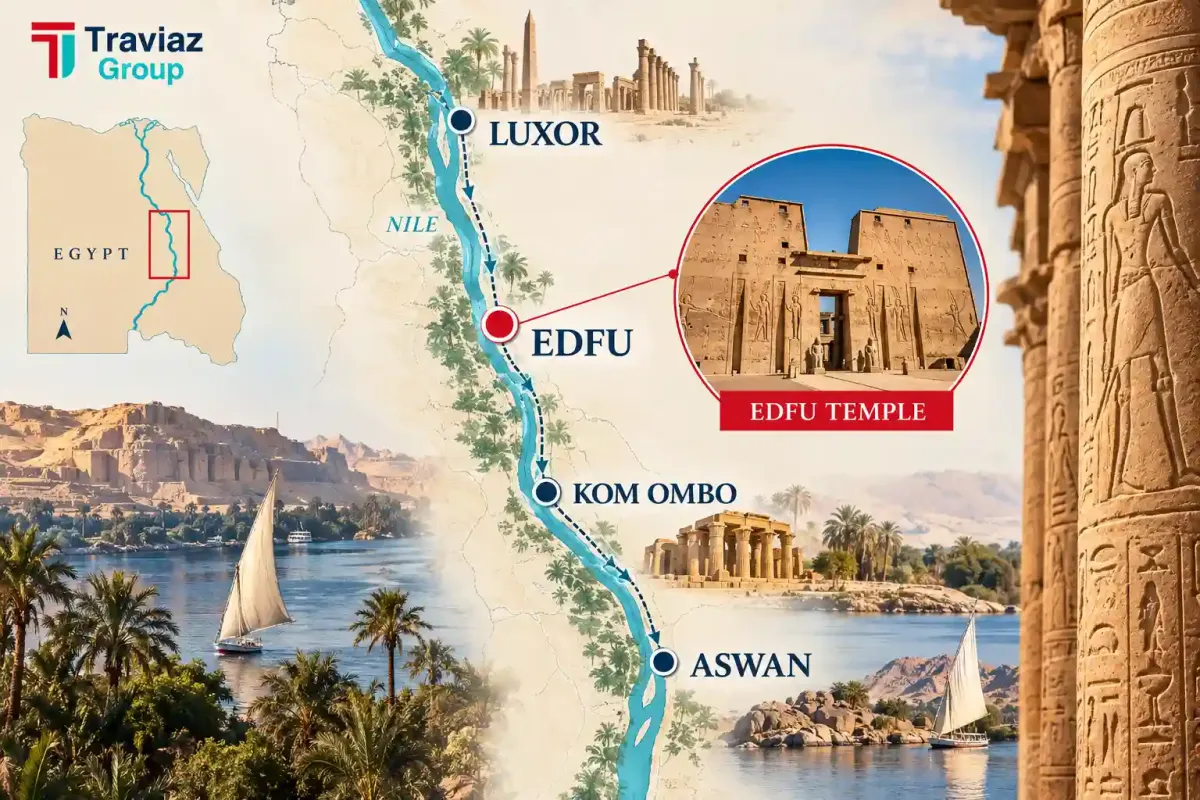
The distance and travel time differ depending on the departure point, and can be arranged as follows:
- From Aswan: 110 kilometers to the north, taking about two hours by car.
- From Kom Ombo Temple: 65 kilometers to the north, taking about one hour by car.
- From Luxor: 115 kilometers to the south, taking about two hours and fifteen minutes by car.
- From Edfu train station to the temple: 5 kilometers taking about 15 minutes by tuk-tuk or horse carriage.
How to Get to Edfu Temple from Luxor or Aswan

A private car with a driver gives the traveler the greatest flexibility, as the arrival time can be controlled and peak-hour crowds avoided. Private transport through Traviaz from Luxor or Aswan also allows timing to be tailored to the itinerary, including arrival at six in the morning before the Nile cruise buses.
The train stops at Edfu station, but the journey does not end there: the temple is 5 kilometers from the station, which requires taking a tuk-tuk or horse carriage. This additional step may need coordination that a first-time visitor to the area would not prefer.
The road bus from Aswan is also available, but it is slower and less flexible in terms of timing, and it does not arrive directly at the temple.
Do Nile Cruises Stop at Edfu Temple?
Yes, most Nile cruise trips between Luxor and Aswan include Edfu as a main stop. The ships usually arrive in the early morning hours, and passengers then move from the dock through a small residential neighborhood and a local market to the temple, with the trip taking 10 to 15 minutes by horse carriage or tuk-tuk.
Many cruise companies provide organized transport directly for their passengers, while those who want to get away from the ship crowds need to arrive before six-thirty in the morning.
Beating the Crowds and Scams: First-Hand Travel Tips
Timing and how to deal with the temple's surroundings are essential elements of the visit. Arriving before the Nile ships helps avoid the crowds, while finishing the tour early avoids the worst of the midday heat.
The 6:00 AM Strategy for Photographers
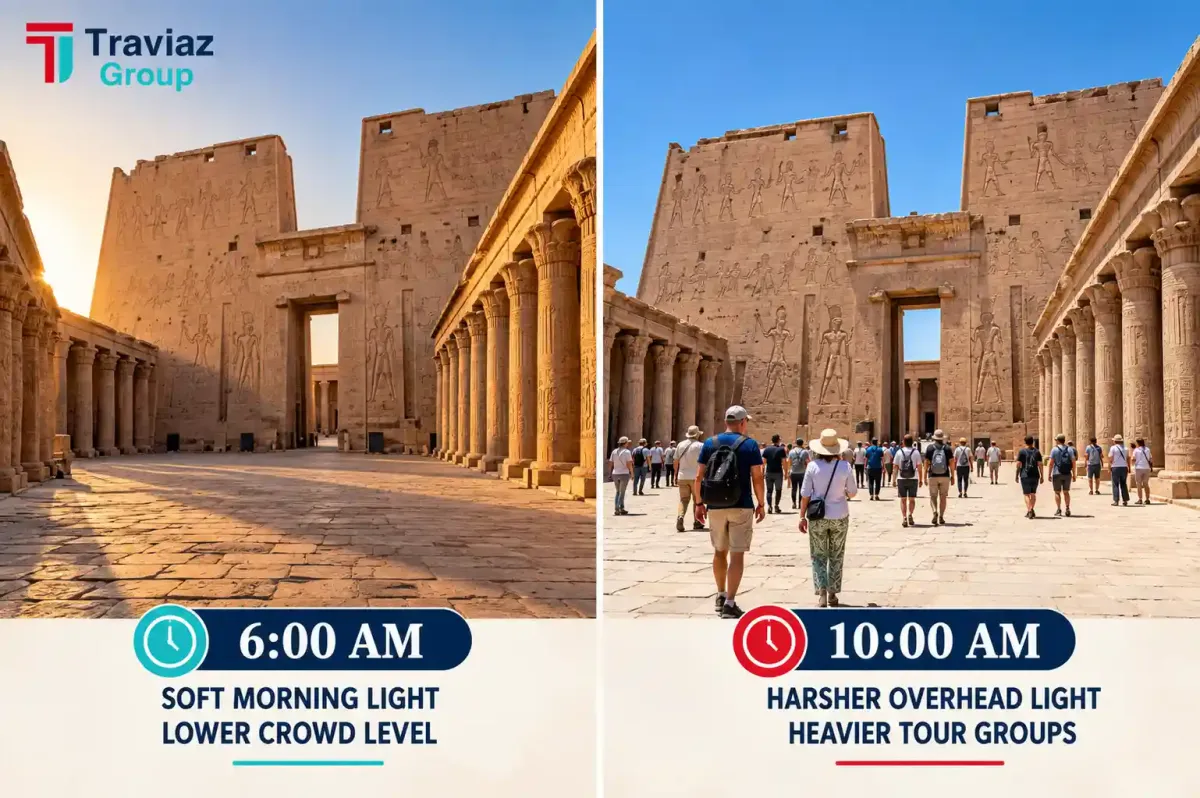
At six in the morning the Temple of Edfu opens its doors, and the first hour is an excellent opportunity for photography before the first Nile cruise passenger buses arrive between seven-thirty and eight.
During this period the massive gateway and the great court appear almost empty, while warm horizontal light falls on the raised carvings at an angle that gives them deep shadows and a three-dimensional feel that does not appear to the same degree in midday light.
For photographers, this timing is particularly suitable for capturing the gateway and the granite statues of Horus without crowds in the frame.
Navigating the Horse Carriage Scam and Local Vendors
Dealing with horse carriages between the ship dock and the temple can be one of the most common friction points for visitors, but a few simple steps make the situation easier.
Agree on the price clearly before getting into the carriage and not after arriving, and the reasonable price in 2026 is around 50 to 80 pounds per person for a round trip.
With the street vendors at the entrance, a firm "no thank you" with a smile while continuing to walk without stopping is enough.
If you want to buy something from the local market, do that after the visit and not before, so your attention stays focused on the temple.
Having a private guide with Traviaz practically reduces most of this friction, as their professional presence creates a natural barrier between the visitor and sources of commercial pressure.
Inside the Temple: Architecture and Layout Highlights
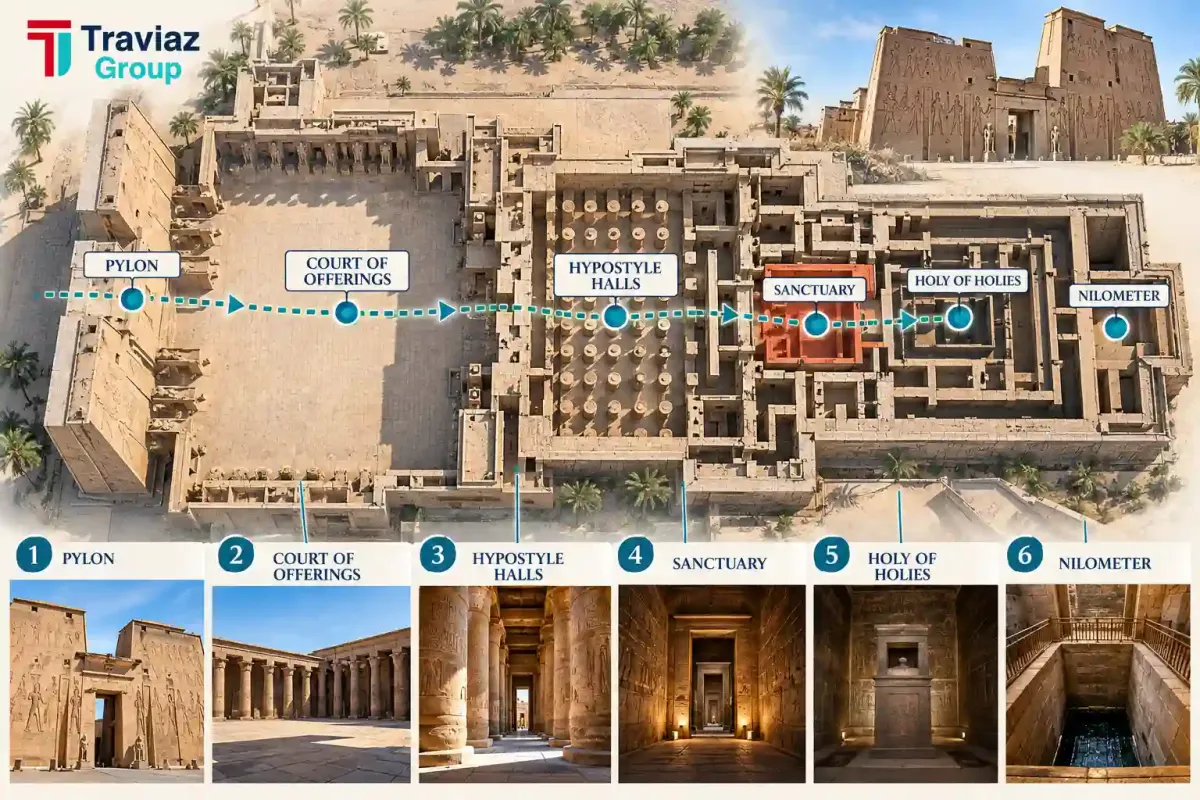
As you move through the Temple of Edfu, the design shifts gradually from open public spaces to more sacred and darker areas.
This gradation was not random: the transition from the gateway to the sanctuary means less light, a lower ceiling, and greater sanctity, within a ritual system that did not allow ordinary people to pass beyond the court of offerings, just as it did not allow ordinary priests to enter the inner chambers.
The Mammoth Gateway: The Pylon
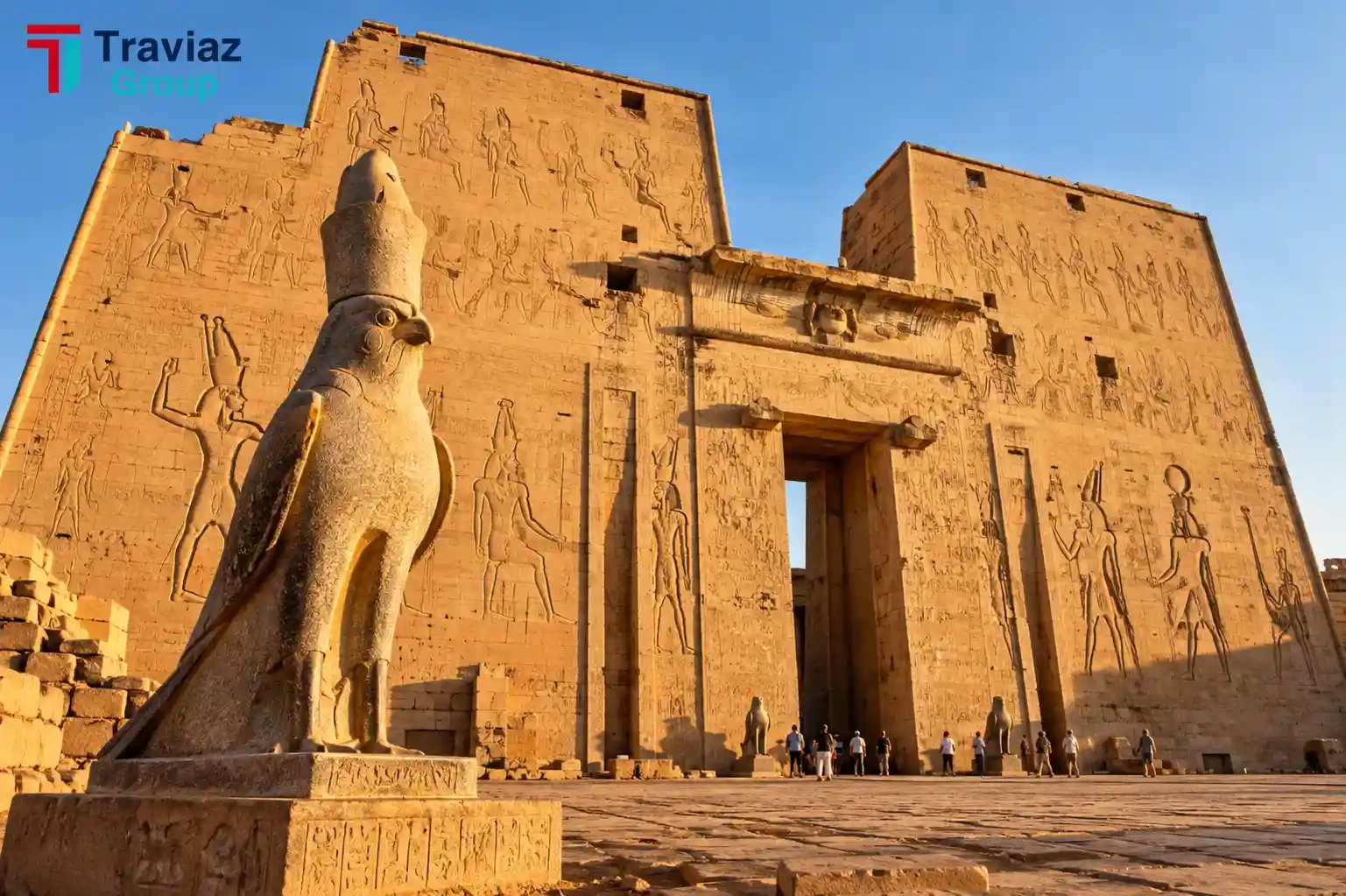
As soon as you approach the Temple of Edfu, the massive Pylon imposes itself on the scene with its enormous size. It stands 36 meters tall, equivalent to a twelve-story building, and is one of the most massive complete temple gateways to survive from ancient Egypt.
On both sides, a large raised relief shows Ptolemy XII striking his enemies before Horus in a "smiting of enemies" scene, a depiction that was associated with establishing royal legitimacy inside Egyptian temples.
As for the vertical slits on the sides of the gateway, they were designed to hold massive wooden poles that raised red flags during religious festivals.
The Court of Offerings and the Famous Horus Falcon Statues
Immediately after the gateway, the Court of Offerings opens up, surrounded by columns with varied plant capitals that do not repeat in their designs.
This variety represents a distinctive Ptolemaic feature, and then at the entrance to the first hall appear two granite statues of Horus in the form of a life-size falcon.
One is preserved in near-complete condition and wears the pharaoh's crown on its head, and the two statues are considered among the most prominent surviving Horus statues in Egypt and the most photographed.
The Hypostyle Halls and The Sanctuary: Holy of Holies
From the outer and inner hypostyle halls, a calculated architectural journey begins from light toward darkness. The first hall contains openings in the ceiling that allow natural light in, while the second appears more enclosed with denser columns.
After that, the inner chambers surrounding the sacred room appear, where the darkness becomes almost total, and where the god's statue carried in festival processions would have been placed.
Inside the Naos or Holy of Holies, the original granite tabernacle still stands, which held the golden statue of Horus and is considered the oldest artifact in the temple, dating to the reign of Nectanebo I, three centuries before the current construction.
The Nilometer: How Ancient Priests Predicted the Future
On the eastern side of the inner corridor sits the Nilometer, a well connected to an underground network of channels that directly reflects the Nile flood level.
Stone lines with hieroglyphic numbers record water levels, and the priests relied on these readings to forecast the scale of the coming flood, which helped them determine agricultural taxes and distribute resources months before the harvest.
This ability to read annual flood data gave the priests significant economic and political power, as the process of "prediction" was fundamentally an accurate reading of water levels.
Mythology and Reliefs: The Battle of Horus and Seth
The carvings on Edfu's walls form a vast mythological record and are not limited to decoration. At the heart of the narrative appears Horus, son of Osiris and Isis, who was born after his father was killed by his uncle Seth, god of chaos.
Horus grew up in hiding until he was able to confront Seth, then fought a series of battles that ended with his victory and his reclaiming of his father's throne.
Since the pharaoh in ancient Egypt was considered a living embodiment of Horus on earth, the myth became part of the political and religious foundation of royal legitimacy.
What Stories are Depicted on the Walls?
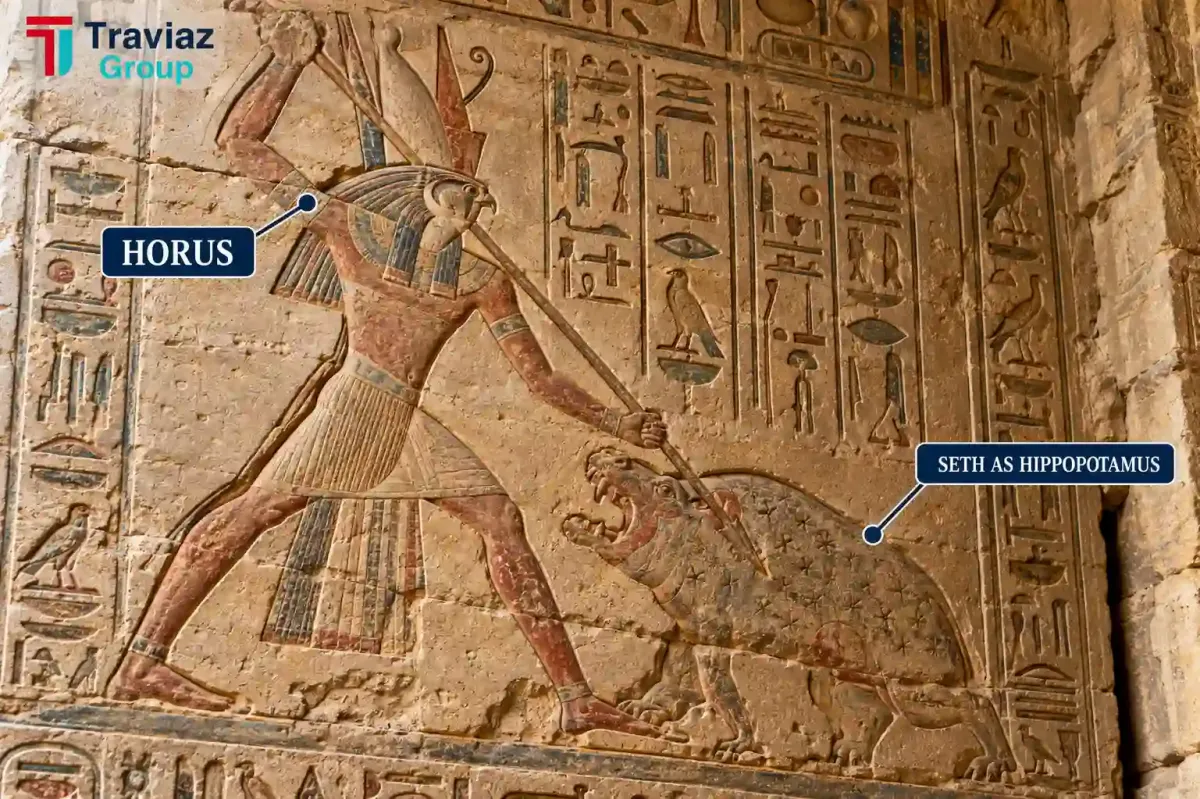
A collection of scenes spread across the walls reveal different aspects of the mythology and daily rituals, and the most notable among them are:
- Triumph of Horus: the most detailed and repeated scene in the temple, depicting Horus spearing Seth transformed into a hippopotamus. The scene repeats across nineteen panels describing the stages of the battle between the two gods in clear detail.
- Feast of the Beautiful Meeting: telling the annual journey of the goddess Hathor's statue from her temple at Dendera to the Temple of Edfu to meet Horus in a major religious celebration in which the entire city participated for fourteen days.
- Daily service rituals: the scenes document the stages of daily religious service, beginning with the priest entering the statue chamber, then washing, dressing, and presenting offerings to it, preserving details of religious practices that disappeared centuries ago.
Who Destroyed the Faces on the Reliefs?
The defacement of the gods' and pharaohs' faces in some of Edfu's carvings did not happen randomly, but was tied to later religious transformations.
After Egypt converted to Christianity in the fourth century AD and Emperor Theodosius I issued his edict in 391 AD closing the pagan temples, early Egyptian Christians defaced the gods' faces in some carvings in the belief that the images carried a spiritual power that needed to be neutralized.
Parts of the temple were also used as a church, and traces of this conversion are still visible in some chambers where Coptic cross drawings appear over the pharaonic carvings.
Visitor Essentials: 2026 Ticket Prices, Dress Code, and Accessibility
According to the information in the source text, the Edfu Temple entry ticket costs 550 Egyptian pounds for foreign adults and 275 Egyptian pounds for foreign students according to the official Egyptian Antiquities Authority website at egymonuments.gov.eg.
Children under six enter for free, while the temple opens from six in the morning until five in the evening daily, including Friday.
Payment is generally in cash at the ticket window, with card payment sometimes available, and online booking through the official website or approved booking platforms reduces waiting time during Nile cruise peak periods.
Is There a Dress Code for Edfu Temple?
Edfu Temple does not impose official dress rules for entry, but modest clothing covering the knees and shoulders remains the appropriate standard out of respect for the site and the surrounding local community.
Practically speaking, loose and light clothing is more comfortable in the heat of Upper Egypt, while a closed and comfortable shoe remains important for walking over the uneven stone floors inside the temple.
Accessibility and Facilities
Access to some parts of the Temple of Edfu presents a real challenge for wheelchair users.
The high stone thresholds at the entrances to the inner chambers range between 20 and 40 centimeters, with no ramp alternative, and the ancient stone floors are uneven in some places.
The outer section and the court of offerings are reasonably accessible, while the deep inner chambers are practically difficult to reach.
Restroom facilities are located near the visitor center at the entrance, alongside a water and drinks station in the same area.
Comparison: Edfu vs. Kom Ombo vs. Philae
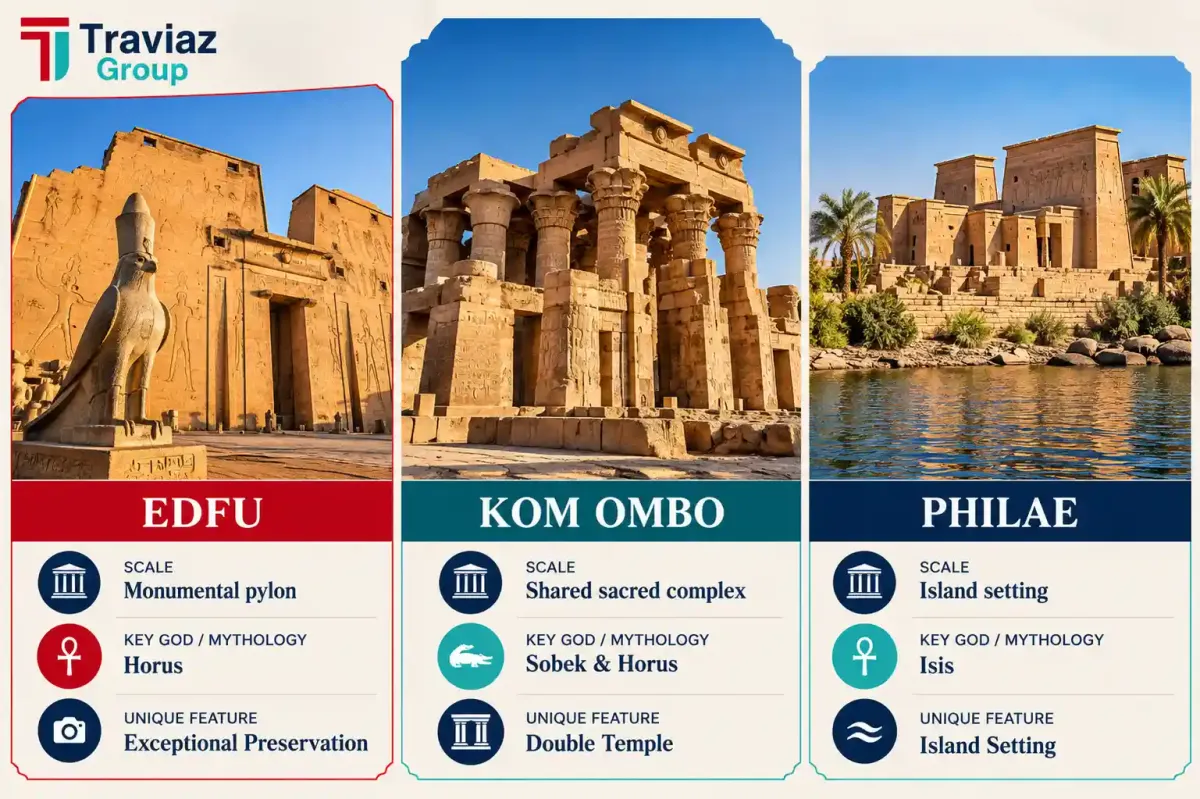
When time is limited during the trip between Luxor and Aswan, the need arises to know the basic differences between the three temples. The following comparison clarifies the nature of each site and its special distinction:
|
Criterion |
Edfu |
Kom Ombo |
Philae |
|
Size |
The largest and most complete |
Medium |
Small to medium |
|
Preservation |
The best, without competition |
Good |
Good |
|
Unique distinction |
The most complete Egyptian temple |
A double temple for two gods |
An island site on the Nile |
|
Dedicated deity |
Horus |
Sobek and Haroeris |
Isis |
|
Special atmosphere |
Grandeur and drama |
Dual strangeness |
Romance and isolation |
|
Recommendation |
Essential for every visitor |
Add it with Edfu in one day |
An independent Aswan day |
Edfu is the largest and most deserving of time, Kom Ombo completes an Edfu trip since it is on the road between Edfu and Aswan and visiting it takes only one additional hour, while Philae on its island in Lake Nasser is a different experience in spirit and atmosphere that completes an Aswan day and does not compare directly with the others.
Edfu Temple Sound and Light Show
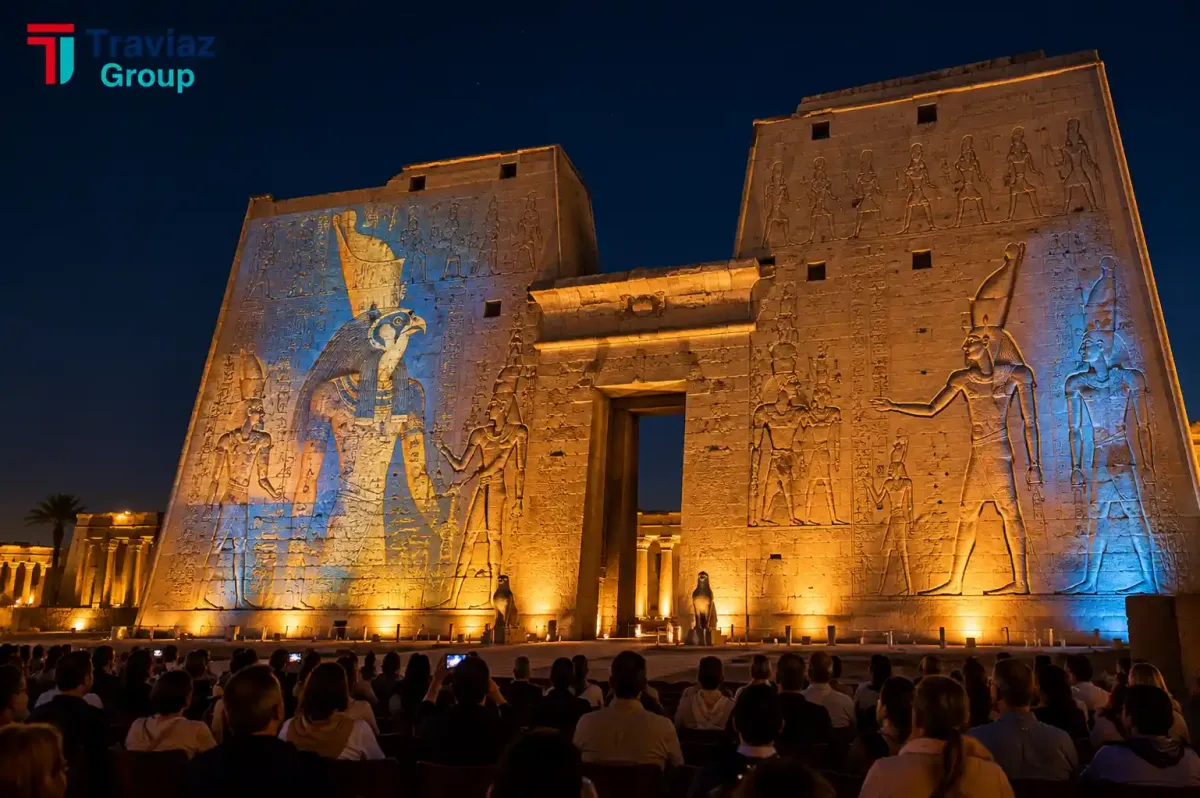
The Sound and Light Show at the Temple of Edfu presents the story of Horus and Seth through dramatic lighting on the facade of the massive gateway and inside the temple court, with the show lasting a full hour.
It is available in six languages, including Arabic, English, French, Spanish, Italian, and German, and begins after nightfall and the closure of the temple to daytime visitors.
Advance booking through approved online booking platforms reduces waiting time and guarantees a seat on busy nights, while the show allows those who visited the temple during the day to see it from a different angle amid the darkness of the desert night and under the sky of Upper Egypt.
Book your tour to the Temple of Edfu with Traviaz now and explore the Temple of Horus with a specialist Egyptologist guide who tells you the legend of Horus and Seth in front of the carvings that the ancient Egyptians etched two thousand years ago: [Edfu packages link]
FAQs
Is the Temple of Edfu Worth Visiting?
Yes, absolutely, and those who have visited multiple Egyptian temples generally describe it as the most complete experience, as the ceilings are standing, the carvings are clear, and the sequence from the gateway to the sanctuary is preserved exactly as it was on the day construction was completed two thousand years ago.
How Long Do You Need to Visit the Temple of Edfu?
A quick visit to the main sections takes an hour and a half, while a thorough visit with a guide to understand the carvings needs two and a quarter to three hours. Nile cruise visitors generally have two hours as a maximum before the ship's departure.
Can You Take Photos Inside the Temple of Edfu?
Phone photography is permitted for free in all parts of the temple, and professional cameras are generally allowed, but using a tripod requires a separate permit from the temple administration. Flash is not recommended in the inner chambers to preserve the carvings.
Is the Temple Safe for Solo Female Travelers?
Yes, the Temple of Edfu and the surrounding city of Edfu are safe, and the archaeological site has guards and tourist police. The most common nuisance comes from street vendors at the entrance, and it is a commercial nuisance rather than a security one. A firm "no thank you" while continuing to walk is enough, and those who prefer having a guide will find the difference in comfort level is clear.