
Luxor Temple: The Ultimate Guide to Egypt’s Living Masterpiece
Luxor Temple offers a remarkable journey through approximately 3,400 years of Egyptian history, combining ancient Egyptian, Roman, Christian, and Islamic heritage in one archaeological site at the heart of Luxor.
Founded around 1400 BC under Amenhotep III and expanded by later rulers, the temple is now connected to Karnak by the restored Avenue of Sphinxes. Its location within the modern city also makes daytime and evening visits distinctly different experiences.
The Architectural Marvel: Why Luxor Temple is a Must-See
The history of Luxor Temple does not only show in its age, but in the layers left by successive civilizations within it. Pharaonic columns stand alongside Roman and Christian traces, while the Mosque of Abu Haggag adds an Islamic layer that is still present today.
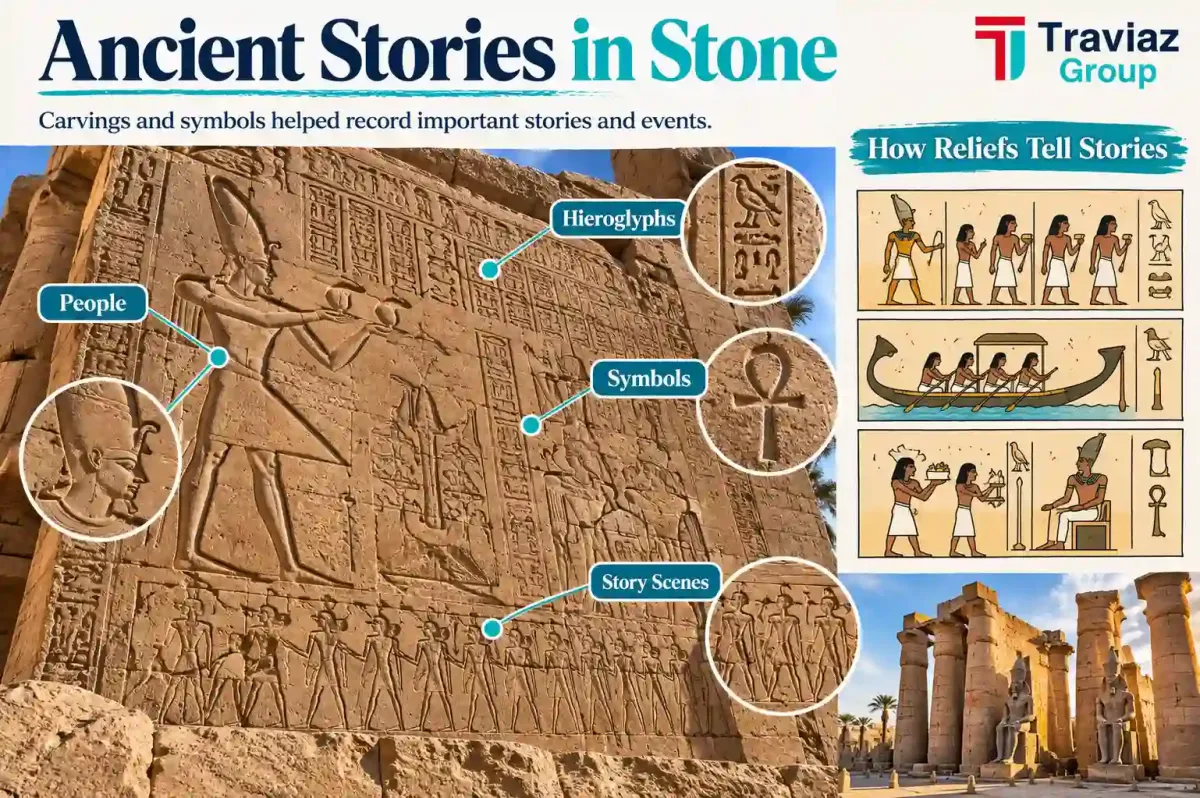
For children, the tour can become a genuine historical adventure thanks to three main elements:
- The colossal statues of Ramesses II: their enormous size makes the visitor feel small before Pharaonic architecture.
- Hieroglyphics: the carvings on the walls present a visual way of understanding the stories of kings and gods, and guides sometimes describe them as "an ancient picture book."
- The temple's connection to the sun: the design of sections of the site and the direction of the light opens an engaging door for discussing the ancient Egyptians' engineering thinking.
Deep Dive: Remarkable History and Purpose
Luxor Temple was not founded merely to hold daily worship rituals. The site was linked to Egyptian kingship, and to the Opet Festival which played an important role in renewing the vigor of royalty and confirming the pharaoh's legitimacy.
The Master Builders
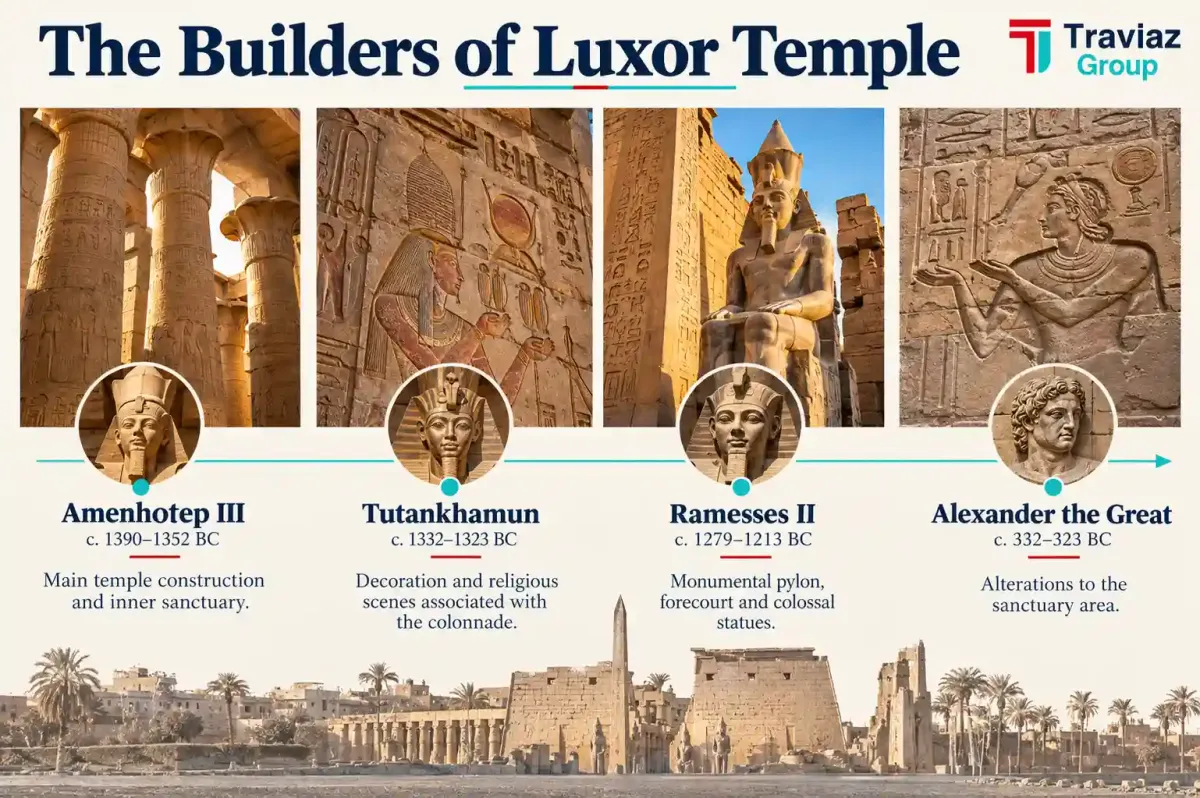
Amenhotep III began building the temple around 1400 BC during the Eighteenth Dynasty. The site was connected to an older shrine built by Queen Hatshepsut, then Amenhotep III expanded it and rededicated it as the "southern seat" of the god Amun.
Tutankhamun and Horemheb took over the completion of later phases of the project. When Ramesses II's turn came in the thirteenth century BC, he added the massive outer courtyard, the front gateway, the colossal statues, and the two obelisks.
After Alexander the Great entered Egypt in 332 BC, a new element appeared inside the complex. A dedicated shrine was added depicting him being crowned as pharaoh with the blessing of the god Amun.
The Cult of Amun and The Royal Ka
The Opet Festival represented the temple's most important religious function. During the celebration, the statues of Amun, his wife Mut, and their son Khonsu were carried in a procession starting from Karnak and heading to Luxor via the Avenue of Sphinxes.
Inside the temple, secret rites of union between Amun and the pharaoh were performed, linked to the renewal of the "Royal Ka," the divine spirit of the king, and the affirmation of his legitimacy for a new year. The celebrations continued for several days, while the essential rites remained within the inner sections of the temple.
Rediscovery and Excavation
The temple was not fully uncovered when European explorers arrived in the nineteenth century. Sand and rubble covered large sections of it, and an entire village had been built above parts of the site.
In that scene, the Mosque of Abu Haggag appeared as though it was separate from the temple, but in fact it rests on sections of the ancient walls and structure.
Organized excavation work began in 1885, and the removal of the village and debris continued over decades until the temple's sections appeared in the form known today.
The mosque was preserved within the site and underwent restoration after suffering from a fire, so its presence became part of the story of the place's religious continuity.
Comparing the Giants: Luxor Temple vs. Karnak Temple
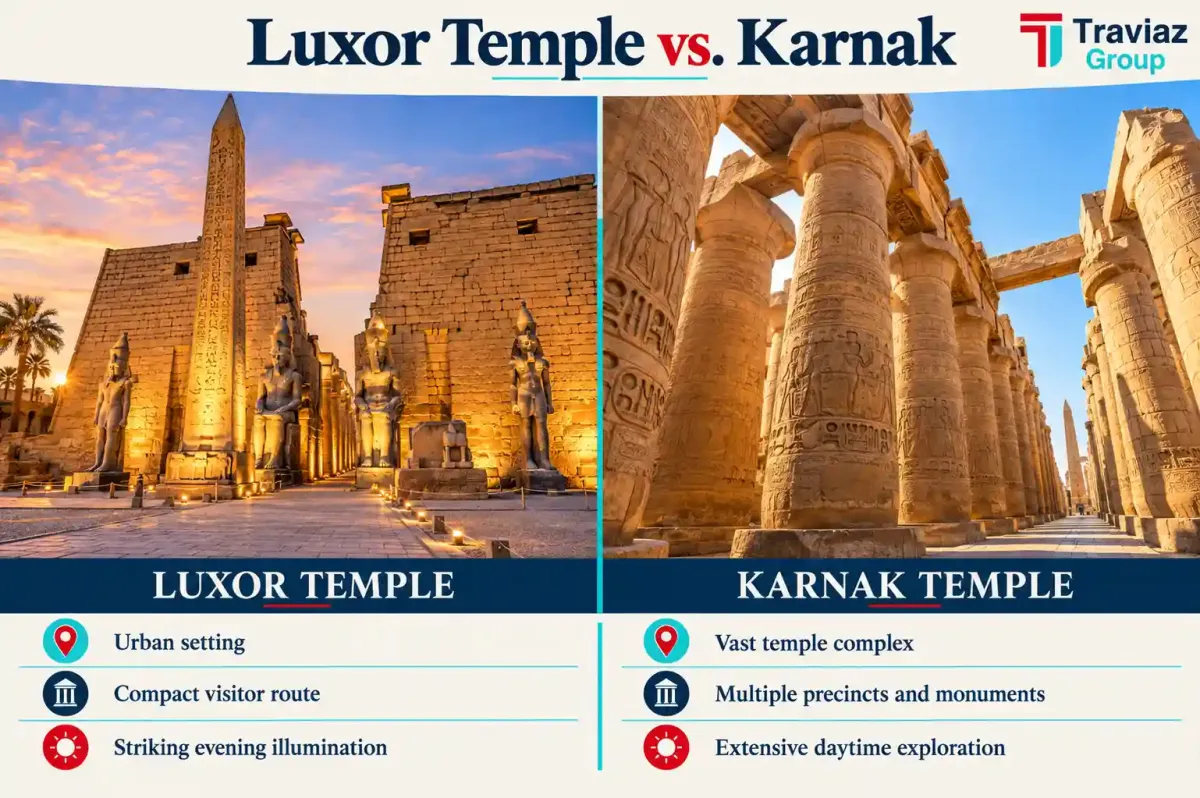
The question of which is better between Luxor Temple and Karnak comes up often, but the two sites do not offer the same experience. Your choice depends on the time available to you and on what you are looking for within the archaeological landmarks.
|
Comparison |
Luxor Temple |
Karnak Temple |
|
Size |
Smaller and more cohesive |
A massive complex extending over 100 hectares |
|
Building and development period |
Main phases beginning in the reign of Amenhotep III |
Development over approximately 2,000 years |
|
Visit experience |
Easier to take in during a single tour |
Needs more time to explore |
|
Nature of the site |
Linear and cohesive structure |
Wide complex holding multiple structures |
|
Historical relationship |
Part of the Theban religious system |
The largest centre of the religious system |
|
Location |
East Bank |
East Bank |
The two temples were not rivals in ancient Egypt. They operated together within the religious system of Thebes, and the Avenue of Sphinxes connected them.
Geographically, both exist on the "bank of the living," while the Valley of the Kings is on the "bank of the dead" on the western side of the Nile. So moving from Luxor Temple to the Valley of the Kings requires crossing the river and then continuing by car, rather than simply walking between the landmarks.
What's Inside? Iconic Landmarks and Meanings
The temple's design progresses from the outer gateway to the inner sections in a way that reveals the religious and political functions of the place. Each space adds a new element to the story of the site.
The First Pylon and the Missing Twin Obelisk
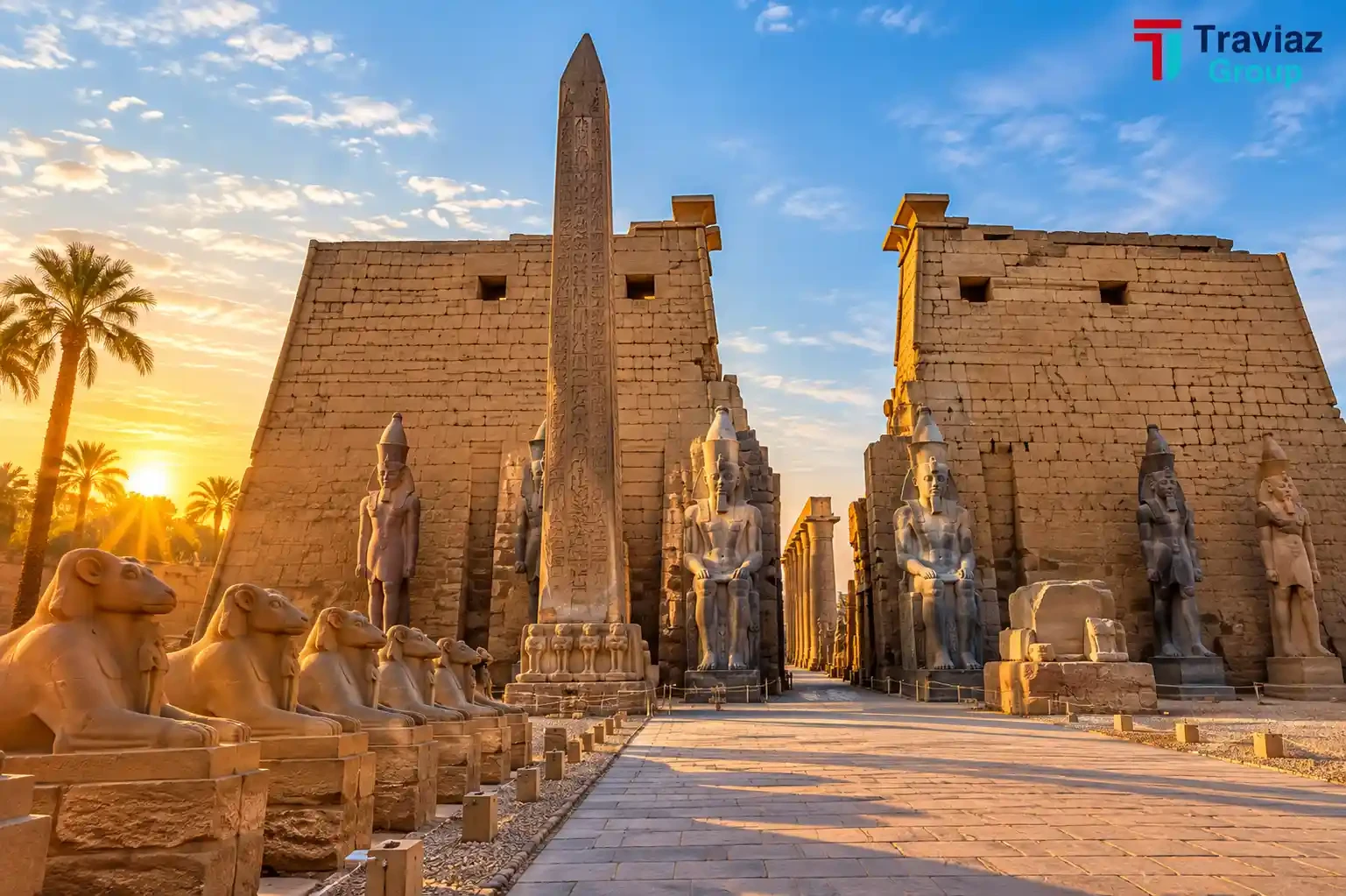
The first pylon reaches approximately 24 meters in height, and Ramesses II decorated it with scenes linked to the famous Battle of Kadesh. Six colossal statues of the king stood in front of it, two standing and four seated.
Only two seated statues and one standing statue remain from the group. The original scene also included two obelisks of black granite, each reaching 25 meters in height.
Only one still stands in front of the temple. The other was given in 1830 to France by the Ottoman rulers, and it today adorns the Place de la Concorde in Paris.
The Great Court of Ramses II and the Colonnade of Amenhotep III
Inside the Great Court of Ramesses II, rows of papyrus columns stand in order. On the southern wall appears a procession including seventeen of Ramesses II's sons with their names and titles.
In the same section the Mosque of Abu Haggag appears above the ancient walls, in a scene that brings together Islamic architecture and Pharaonic elements within a single space.
Directly behind the courtyard extends the Colonnade of Amenhotep III. The corridor consists of fourteen papyrus columns reaching 16 meters in height, and the Opet Festival processions passed through it.
The Mosque of Abu Haggag and Roman Fort
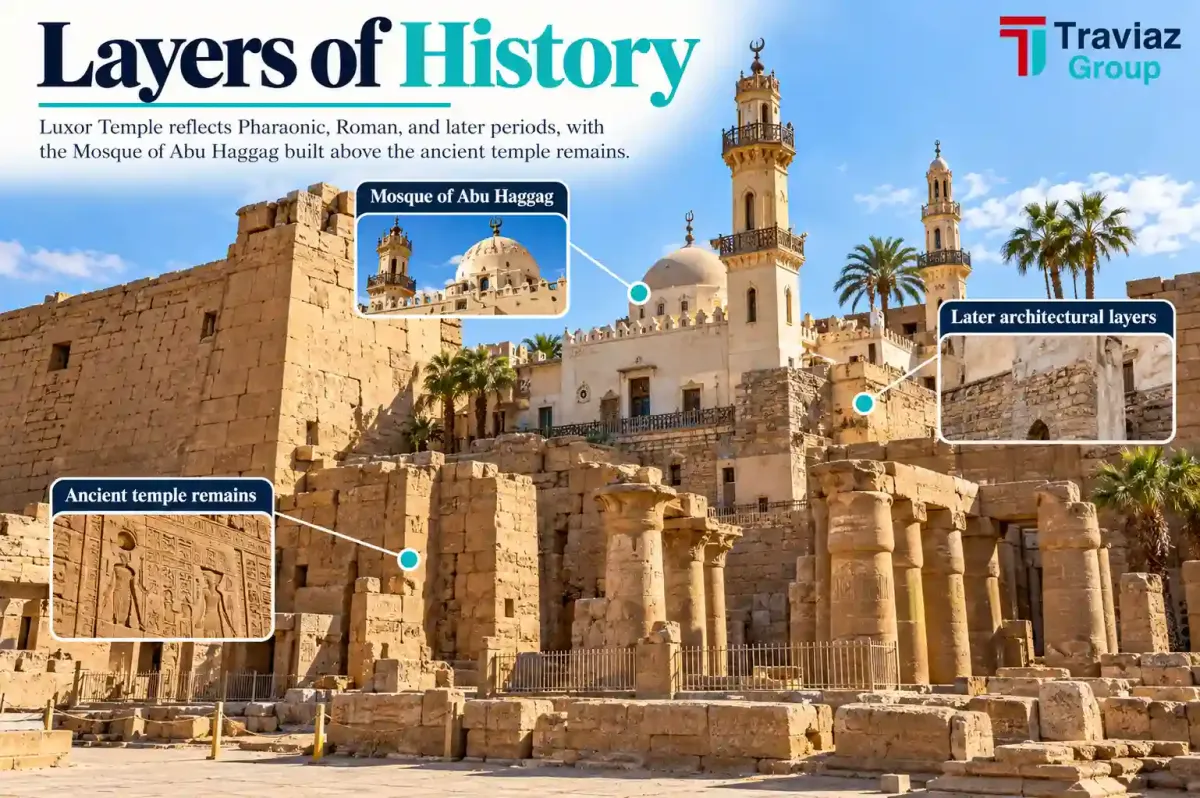
The Mosque of Abu Haggag is located in the north-eastern section of the temple. It was built in the thirteenth century AD during the Fatimid era, and it made use of the Pharaonic columns and walls already present in the place.
The mosque is still active today, and so the site retains a continuous religious character across different eras. Centuries before that, the Romans used sections of the temple as a military base, and some chambers were also converted into a Christian church in the fourth century AD.
In the depths of the temple stands the shrine of Alexander the Great. The Macedonian king appears in Pharaonic dress receiving the crown from the god Amun, in a scene that reflects his attempt to present himself within the Egyptian religious framework.
The Avenue of Sphinxes: The Sacred Way
The Avenue of Sphinxes was the sacred road connecting Luxor Temple to Karnak Temple, extending for 2.7 kilometers. More than 1,200 human-headed sphinx statues lined both sides of it according to what Wikipedia mentions.
The complete section of the avenue was officially reopened in November 2021 during a celebration attended by President Abdel Fattah El-Sisi, which witnessed a historic procession from Karnak to Luxor. Visiting the road today is an opportunity to walk the route linked to the ancient Theban processions.
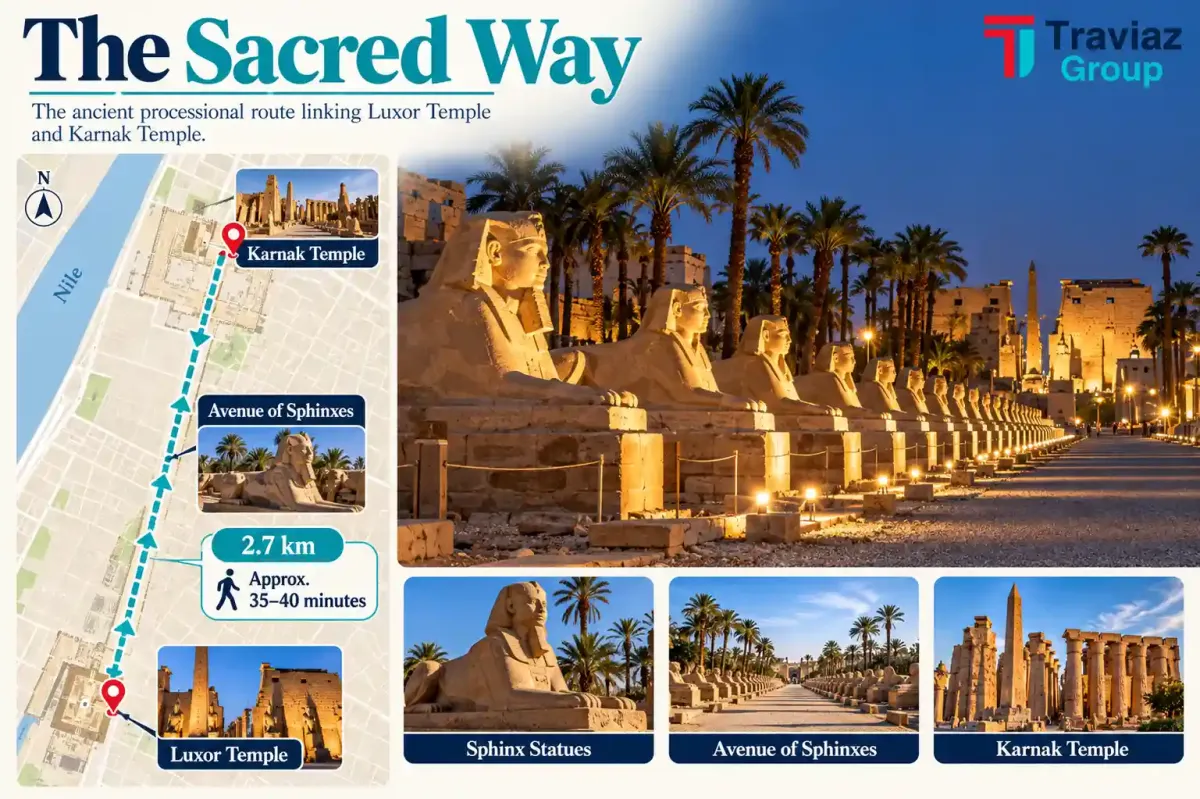
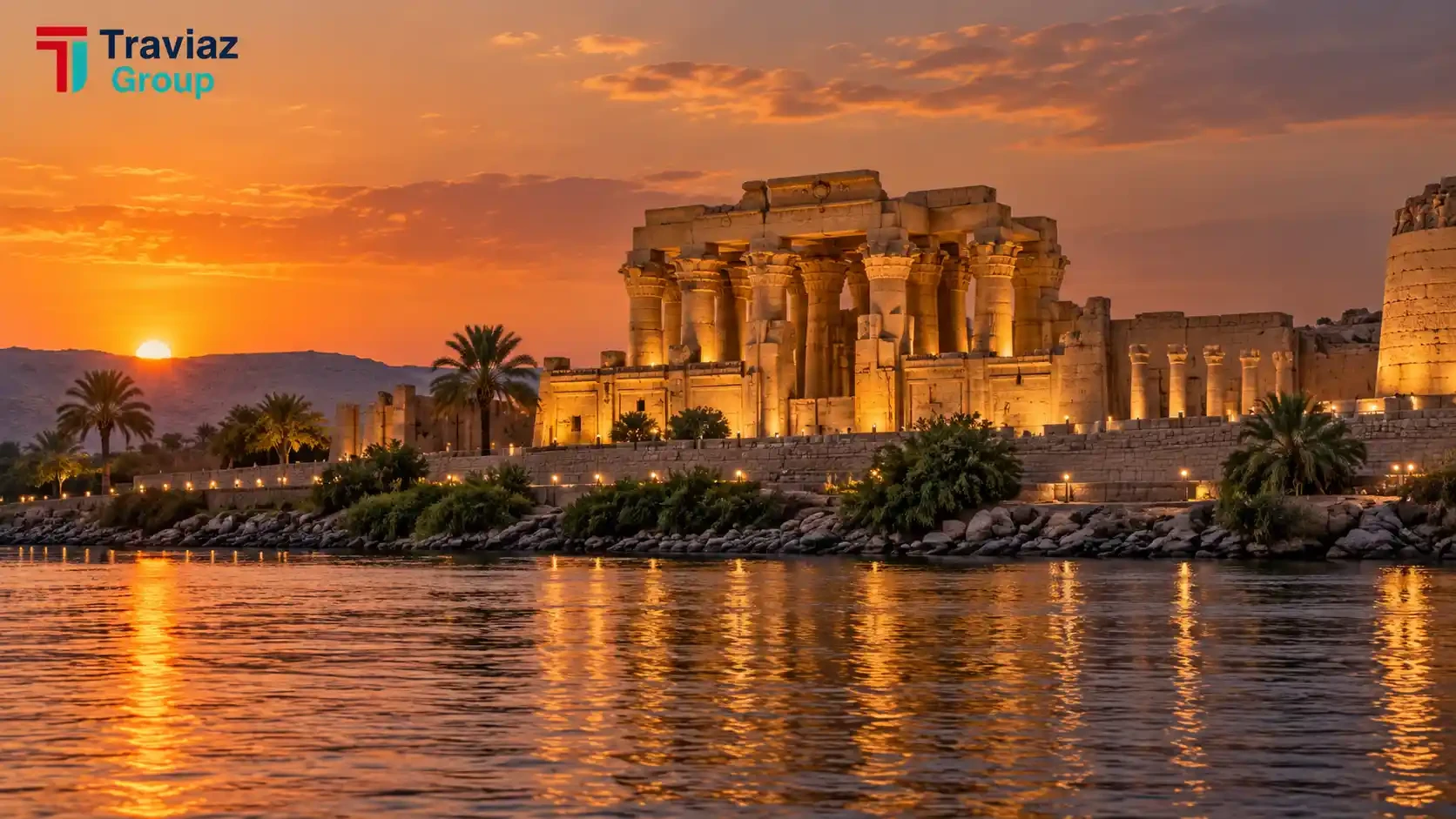
The evening experience has a completely different character:
- The lighting highlights the statues and columns from below.
- The air temperature is lower than the daytime hours.
- The number of visitors may be lower outside peak times.
- Photography gets a more dramatic atmosphere with the night lighting.
Organizing this tour through Traviaz helps in choosing the right timing and connecting the Avenue of Sphinxes to the rest of the East Bank sites.
Planning Your Perfect Visit: Logistics and Practicalities
Luxor Temple is open every day of the week, but the season and the arrival hour directly affect the level of comfort during the tour. Advance planning makes the visit easier, especially during the summer months.
Best Time to Visit
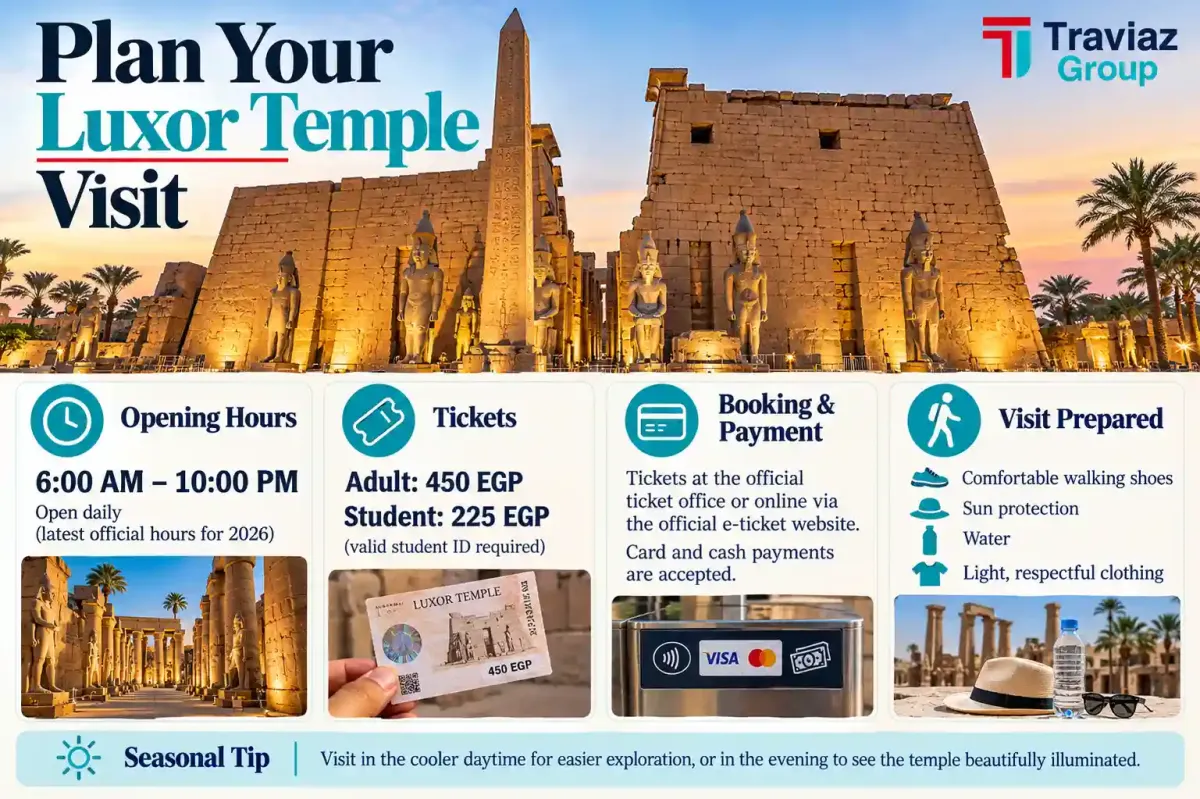
The period from October through April is the most suitable for visiting Luxor Temple weather-wise, with temperatures approximately ranging between 18 and 28 degrees. In summer, especially from June through August, the heat may exceed 38 degrees, which makes moving around during the day more tiring.
|
Timing |
What distinguishes it |
|
After six in the morning |
Greater calm before the crowds arrive |
|
After four in the afternoon |
Lower heat and the possibility of transitioning to the evening experience |
|
After sunset |
Temple and Avenue of Sphinxes lighting in a different atmosphere |
2026 Ticket Prices and Online Booking
The Luxor Temple entry ticket for foreign adults is 500 Egyptian pounds according to the official August 2026 prices announced by Egypt's Ministry of Tourism and Antiquities.
Opening hours begin from six in the morning according to the official website egymonuments.gov.eg, with the possibility of staying longer in the evenings to enjoy the night lighting. Skip-the-line tickets are available through accredited platforms to reduce waiting time during peak months.
Dress Code and Photography
The Mosque of Abu Haggag is still active inside the complex, and so women are advised to cover their shoulders and knees when passing through its surroundings out of respect for the nature of the place.
Light cotton clothing and pale colours are a practical choice during the day because of Luxor's heat. Photography rules include:
- Mobile phone photography is permitted free of charge throughout the temple.
- Using a tripod generally requires advance coordination or a special permit.
- The period between nine and ten in the evening is suitable for photographing the night lighting.
Accessibility
The open corridors between the main sections are wide enough to make large parts of the site accessible to wheelchair users. Some areas, however, contain gravel and uneven ancient stones, and so movement in them requires more attention.
Contacting Traviaz before the visit helps in identifying the most suitable route for any visitor who needs additional support in moving around.
Elevating Your Experience with Traviaz
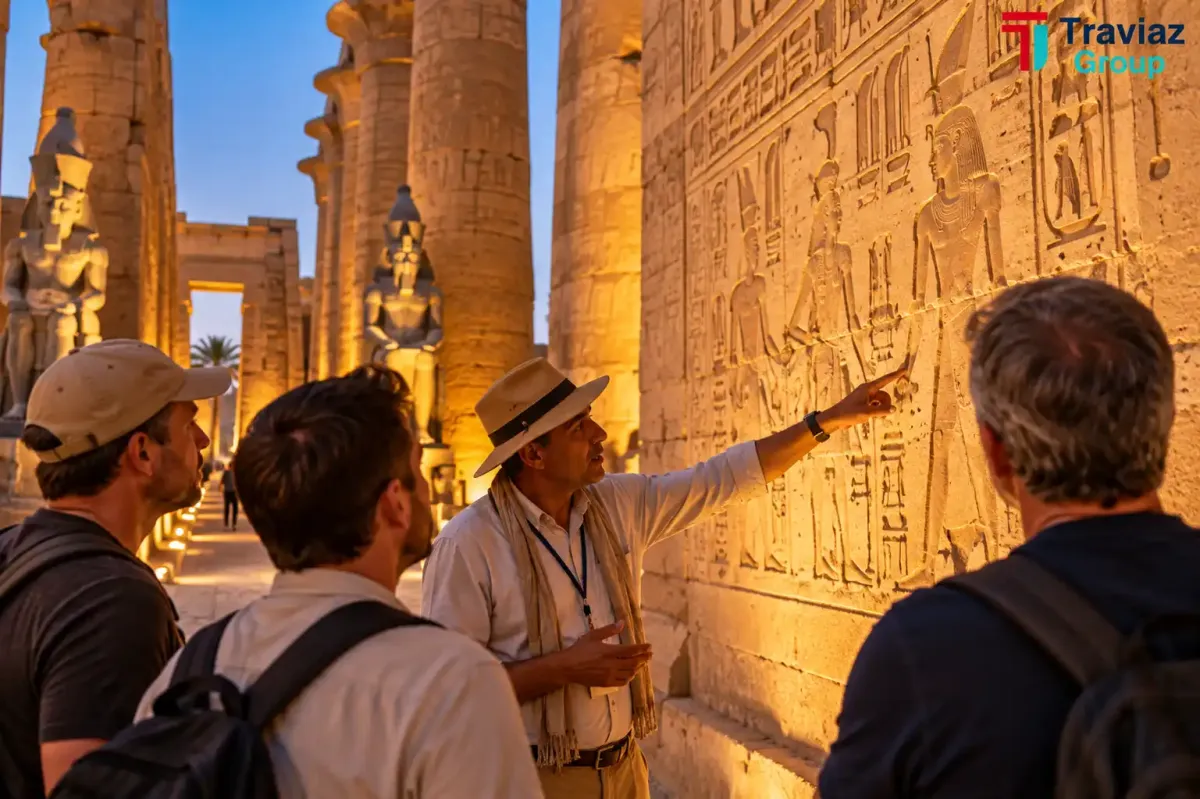
Visiting the temple independently allows you to see the carvings and statues, but a specialist Egyptologist guide adds context that makes the details clearer.
You will know why each scene is there, what happened to the missing elements, and how the use of the site changed as the ages passed.
Traviaz's luxury packages for Luxor Temple include:
- Private air-conditioned transport directly from your hotel in Luxor, or from the Nile cruise mooring, or from the airport to the temple gate.
- Entry tickets arranged in advance with a skip-the-line option.
- An English-speaking archaeological guide specializing in the New Kingdom era.
- Combining Luxor Temple, Karnak Temple, and the Avenue of Sphinxes evening walk in a complete single-day program.
For those looking for accommodation close to the temple with a Nile view, Sofitel Winter Palace Luxor and Steigenberger Nile Palace are within walking distance of the front gate. Several restaurants also exist on the Nile corniche minutes from the site, and some options provide a view of the temple during the night lighting.
Book your private tour of Luxor Temple and the Avenue of Sphinxes with Traviaz.com now and enjoy a complete historical experience with a specialist archaeological guide, comfortable transport, and tickets without waiting queues: [packages link]
Frequently Asked Questions
Is Luxor Temple Worth Visiting?
Yes, clearly. The site brings together approximately three thousand years of history within a single space, and its presence in the heart of Luxor city gives it a different character from isolated archaeological sites.
How Long Do You Need to Visit Luxor Temple?
An hour and a half is enough for a quick tour covering the main sections. If you want to read the carvings and understand the details with a guide, it is better to set aside two to three hours. Adding the Avenue of Sphinxes and Karnak requires more time within the day's program.
Can Luxor Temple Be Visited at Night?
Yes. The temple is illuminated after sunset, and the evening experience differs from the daytime one in atmosphere, lighting, number of visitors, and photography opportunities.
To Which God Was Luxor Temple Built?
The temple was linked to the god Amun and the triad composed of Amun, his wife Mut, and their son Khonsu. Its function was connected to kingship, the Opet Festival rites, and the renewal of the pharaoh's legitimacy, so it was not merely a place for daily worship.
How Far Is Luxor Temple from the Valley of the Kings?
Luxor Temple is on the East Bank, while the Valley of the Kings is on the West Bank. The direct distance is approximately 10 kilometers, but reaching it requires crossing the Nile and then continuing by car, and for this reason it is usually better to dedicate a separate program to the West Bank sites