
Step Pyramid of Djoser: Why It Is Egypt's Most Revolutionary Ancient Wonder
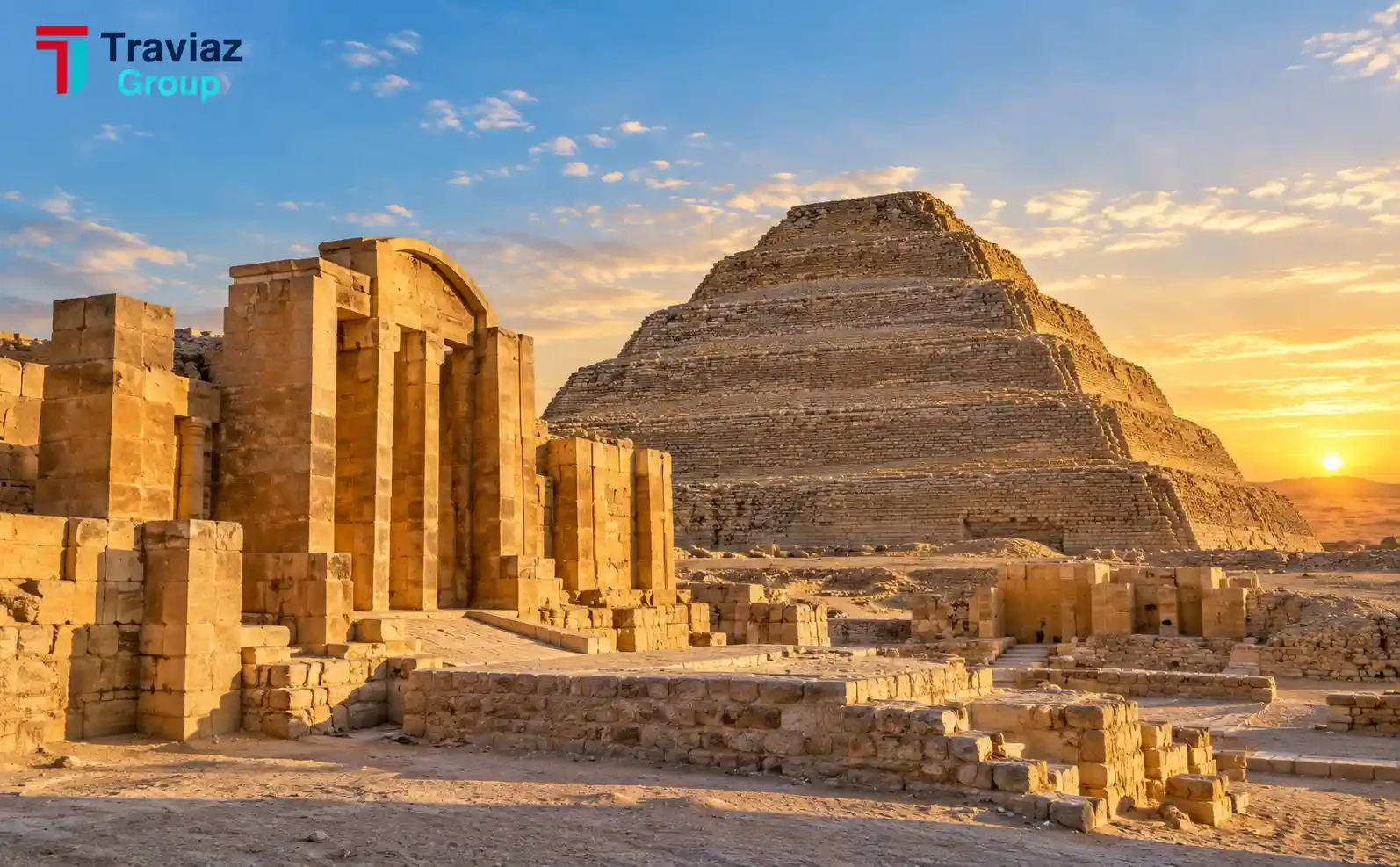
The Step Pyramid of Djoser is Egypt’s most revolutionary ancient wonder because it marked the beginning of monumental stone architecture and established the pyramid form that transformed ancient Egyptian building.
Built around 2667 BC for Pharaoh Djoser by his vizier Imhotep, the 62.5-meter monument consists of six stone levels at Saqqara, about 30 kilometers south of Cairo. Its tunnels, chambers, and surrounding complex reveal how pyramid architecture first developed.
This guide explains what makes the Step Pyramid unique, what to expect when visiting Saqqara in 2026, and how the experience differs from Giza.
Step Pyramid of Djoser: How Does It Compare to Egypt's Later Pyramids?
To understand the importance of the Step Pyramid, it helps to return to the period that preceded it and compare its design with the pyramids that followed:
Which is Older? Saqqara vs. Giza
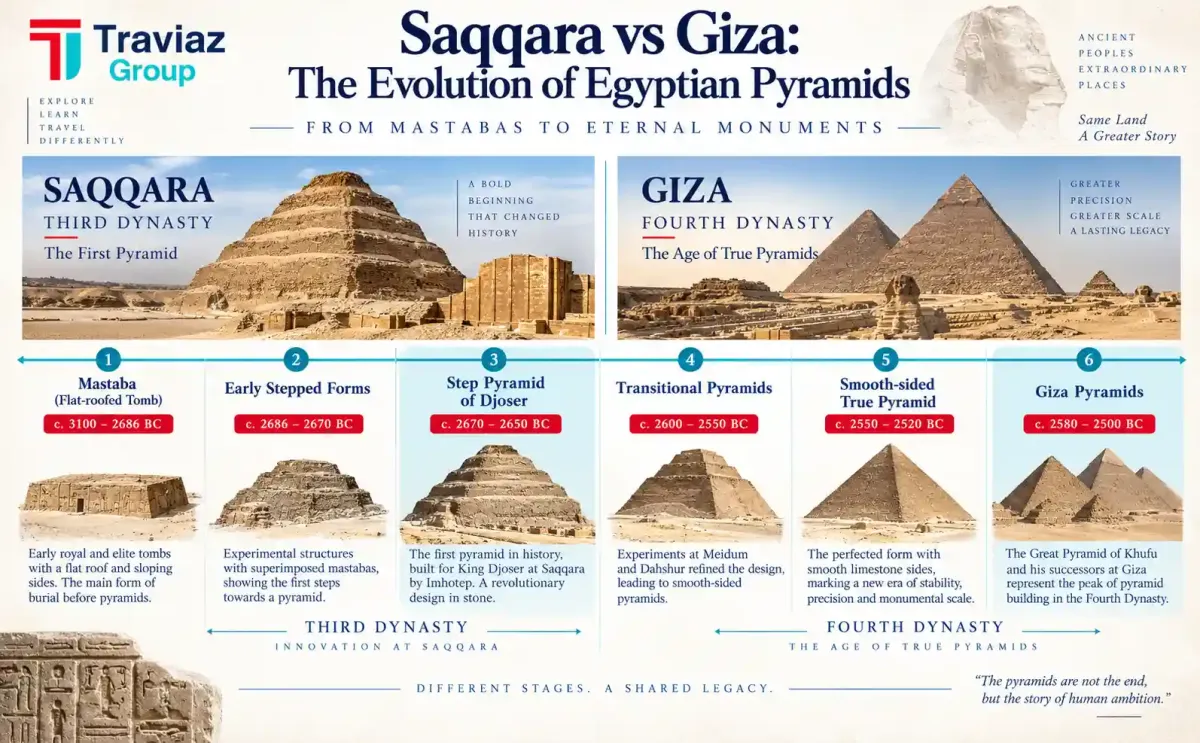
Before the appearance of Djoser's pyramid, Egyptian kings relied on the mastaba as the traditional form of royal burial. The mastaba was a flat-roofed rectangular structure built from mud brick above the underground burial chamber.
With Djoser's project, this approach changed radically. Imhotep proposed stacking six decreasing stone mastabas on top of each other, appearing as ascending steps toward the sky.
Royal architecture thus shifted from fragile mud brick to more durable limestone, and the pyramid has stood as a witness to this transformation for approximately 4,700 years.
The Step Pyramid at Saqqara dates back to the Third Dynasty, around 2667 BC. The larger Pyramid of Khufu at Giza was built during the Fourth Dynasty around 2560 BC.
The gap between the two projects is approximately one hundred years, a period that witnessed rapid engineering development in the history of construction.
The Saqqara experiment paved the way for the Fourth Dynasty pyramids, as builders learned from the Step Pyramid how to develop the shape into a true pyramid with smooth sides.
The historian Miroslav Verner notes that the Djoser complex represents a major turning point in the development of large-scale stone architecture in Egypt and the world.
Why Is It a UNESCO World Heritage Treasure?
The Saqqara site belongs to the Memphis and its Necropolis from Giza to Dahshur region, listed on the UNESCO World Heritage list since 1979 under reference number 86-002.
The designation was based on three main cultural criteria:
- The site represents a masterpiece of human creative genius.
- It bears unique witness to an exceptional civilization.
- It is associated with great ideas and beliefs that have influenced human history.
This international recognition imposes clear responsibilities for protecting the site and obliges Egypt to preserve its monuments for future generations.
The Architect & The Pharaoh: Who Built the Step Pyramid?
The story of the pyramid brings together a king who had the ambition and a vizier who managed to translate that ambition into an unprecedented stone structure:
Imhotep: The Genius Behind the Stone
Imhotep was a physician, priest, architect, and philosopher at the same time, and is considered the first architect known by name in human history.
His decision to use limestone instead of mud brick changed the course of ancient architecture and opened the door to the era of the great stone pyramids.
Djoser, the second king of the Third Dynasty, ruled Egypt for approximately 19 years between 2670 and 2650 BC. He not only surpassed architectural conventions but also allowed his vizier Imhotep's name to be inscribed alongside his own on the temple, which was unusual for that era.
In front of the pyramid, Traviaz guides explain how a single man managed to change the history of construction when he chose stone as the primary material for his project.
In later eras, Imhotep gained great religious standing and the Egyptians came to worship him as a god of wisdom and medicine. The Greeks linked him to the healing god Asclepius.
Who is Buried Inside? The Eternal Inhabitants
At the bottom of the pyramid sits the main burial chamber built from carefully carved red granite. Its opening was sealed after the burial with a massive stone block weighing approximately 3.5 tons.
Human bone remains were found inside the complex, including a hip bone belonging to a woman estimated to be approximately 18 years old, alongside remains dating back to generations before Djoser.
The eastern side of the pyramid holds 11 shafts, each reaching a depth of 32 meters. These shafts connect to horizontal tunnels designated for burying members of the royal family and were filled with thousands of stone vessels inscribed with the names of earlier kings in honor of Djoser's ancestors.
Architecture & Design: More Than Just Six Steps
Behind the visible stepped form lie successive construction phases and engineering details that made the pyramid a launching point for later pyramid architecture:
Underground Labyrinth: What is Hidden Deep Inside?
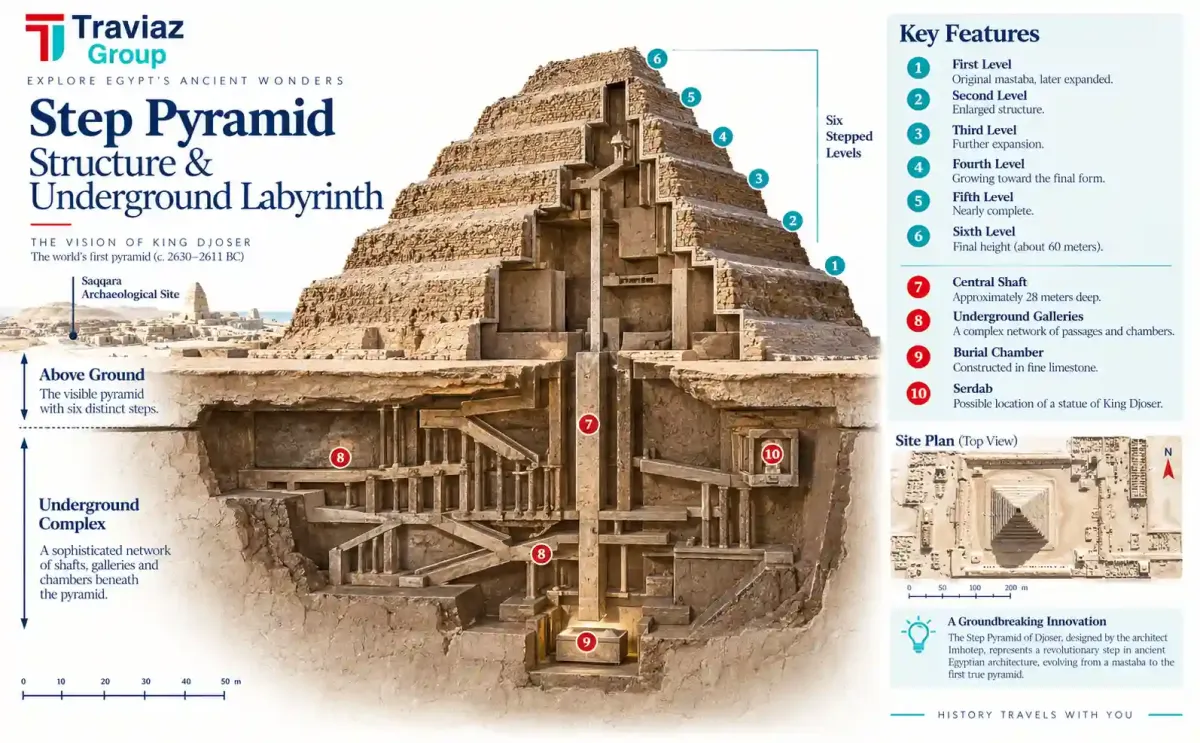
Beneath the pyramid's base extends a complex network of tunnels, chambers, and passages stretching approximately six kilometers in length. At the heart of this network sits a central shaft measuring 7 square meters and reaching a depth of 28 meters.
The intertwining passages were designed to confuse thieves and protect the king's body and his funerary possessions. At the bottom of the shaft, the burial chamber was built from precisely carved granite blocks and then sealed with a massive stone weighing approximately 3.5 tons.
This area offers a completely different experience from visiting open-air temples, as the intense silence, the sudden coolness, and the sense of historical depth are all details difficult to convey in words. The Traviaz team felt this sensation while walking through the tunnels for the first time.
The Blue Tiles: The Pharaoh's Earthly Palace Underground
Thousands of blue and green tiles made from Egyptian faience appear in the interior passages, fixed into the limestone walls with great precision.
These tiles were not merely decorative, as they were designed to replicate the reed and papyrus mat hangings that adorned the walls of Djoser's royal palace in Memphis.
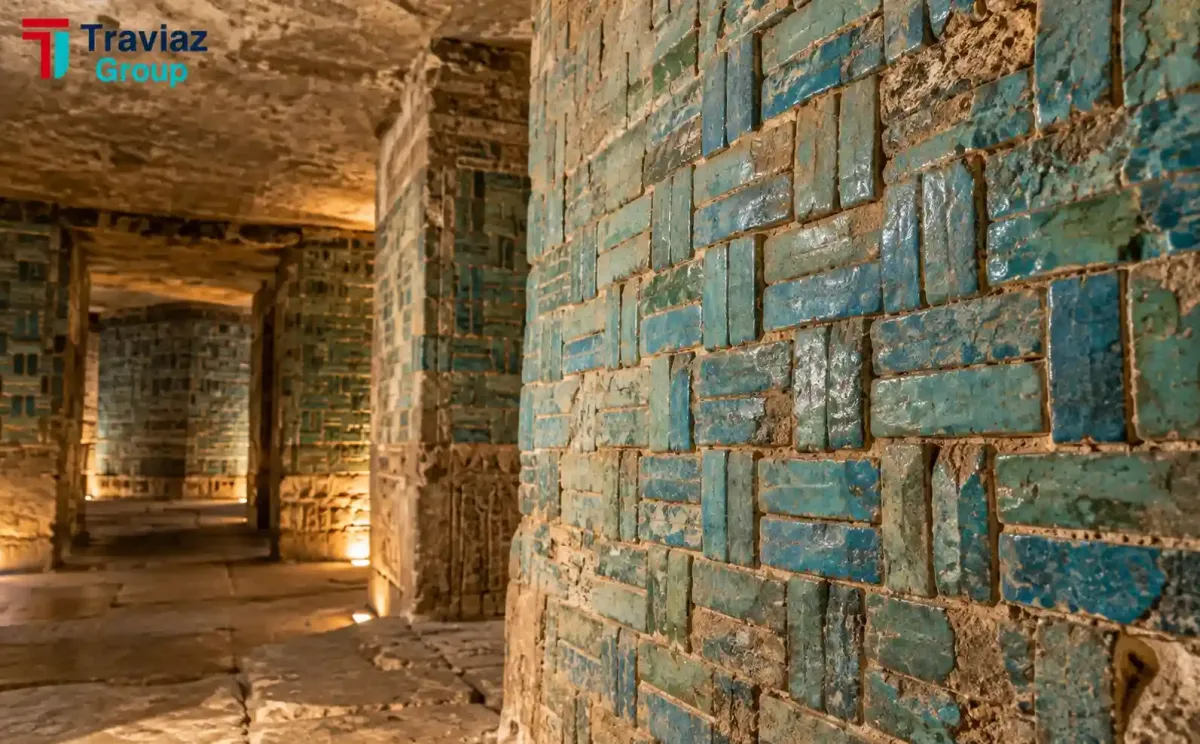
In this way, the burial chamber transformed into a symbolic eternal version of the palace in which the king lived on earth.
More than 36,000 faience tiles were used to decorate the two main chambers. The colors blue and green were chosen because they were associated in ancient Egyptian belief with renewal and resurrection.
This detail particularly attracts photography enthusiasts and heritage lovers, as it reveals a subtle aspect of how the ancient Egyptians conceived of life after death.
Discovering the Djoser Funerary Complex
The Djoser complex does not consist of the pyramid alone but holds a wide collection of ritual and symbolic buildings surrounding it:
The Great Court & Entrance Colonnade
The enclosure wall surrounding the complex extends 540 meters by 280 meters and reaches 10.5 meters in height. The wall was built from white Tura limestone, and its design was inspired by the facade of the royal palace in Memphis.
The wall contains 14 false gateways and only one real entrance, no wider than one meter, which is the entrance visitors use to this day.
Upon entering, the visitor passes through a colonnade consisting of 40 columns arranged in two parallel rows. The columns were designed to resemble bundles of reeds and papyrus made from natural perishable materials.
Imhotep connected the columns to dividing walls between them, as he was not yet confident in their ability to bear loads independently.
This experiment later helped Egyptian architects develop the free-standing columns that appeared at Karnak and Luxor.
The colonnade ends at the Great Southern Court, which extends 180 meters by 100 meters and looks directly onto the pyramid.
The Heb-Sed Court: Rituals of Renewal
The Heb-Sed festival was linked to renewing the pharaoh's legitimacy on the throne. The celebration was traditionally held after thirty years of the king's reign and then repeated every three years.
During the rituals, the pharaoh demonstrated his physical fitness by running a race before the crowds, thereby renewing his divine connection to the gods.
The Heb-Sed court contains two rows of dummy shrines surrounding the courtyard on both sides. Despite their architectural appearance, these structures are built from solid stone inside with no internal spaces, because their function was to provide an eternal stage for the king's celebrations in the afterlife.
Traviaz tours pause in this area for moments of reflection, as the stones that appear still today were originally placed for a king who believed he would need them forever.
The Serdab & South Court
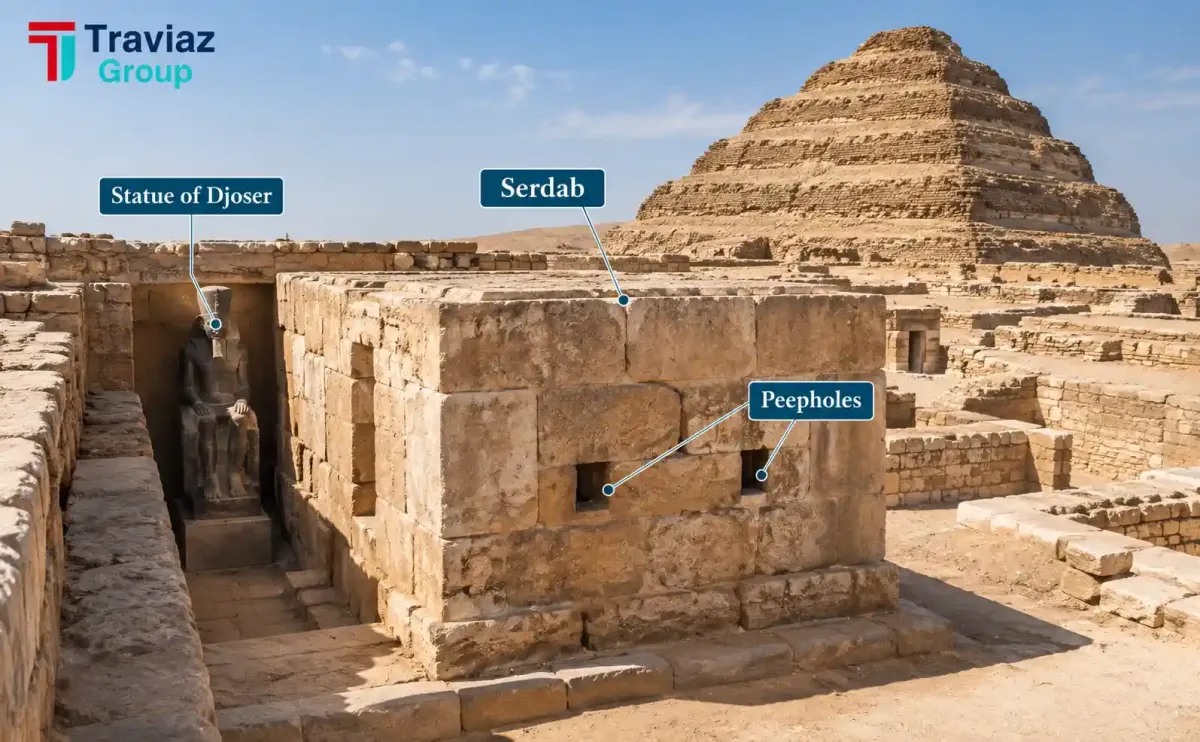
The serdab is a rectangular chamber of polished limestone located adjacent to the northern side of the pyramid. Inside it once sat a painted statue of Djoser, seated on his throne and wearing the royal Heb-Sed robe.
Two small openings in the serdab wall, at eye level, allow the statue to look symbolically toward the northern circumpolar stars that never set.
The original statue was moved to the Grand Egyptian Museum, and an exact replica was placed in its position inside the serdab.
The southern tomb on the southern side of the complex is believed to have been a symbolic shrine for Djoser. Canopic vessels designated for preserving the king's organs were placed inside it.
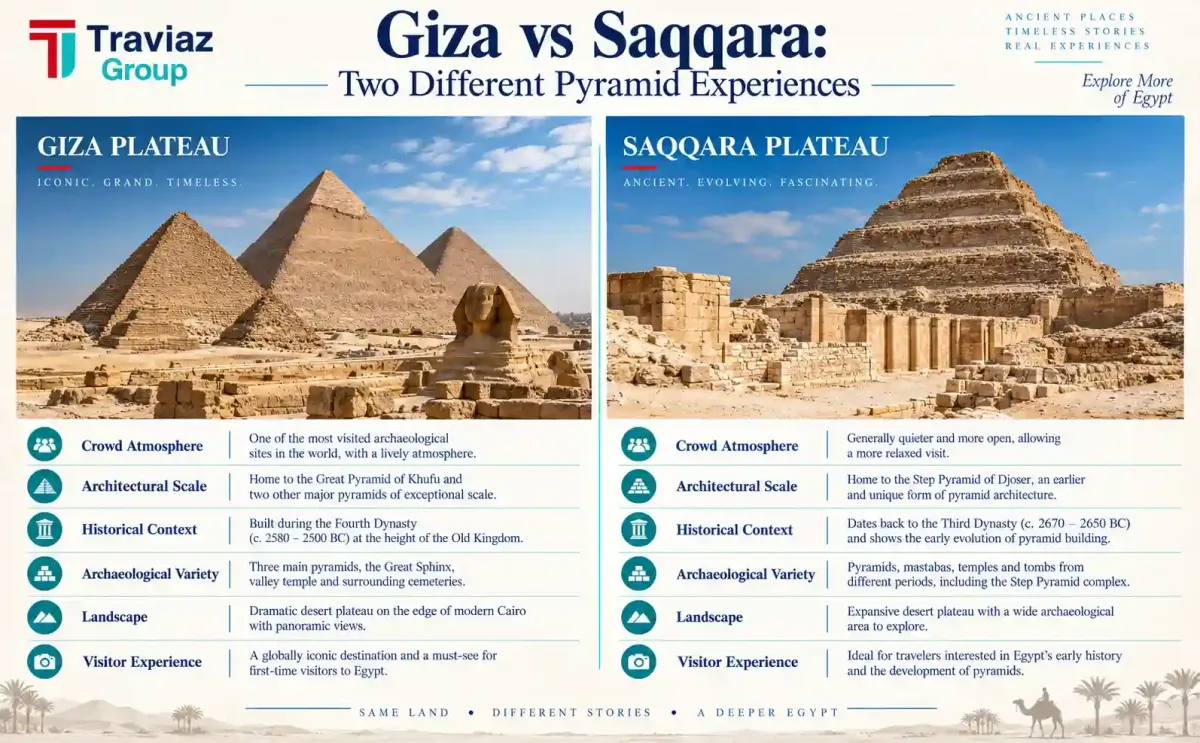
Giza Or Saqqara: Which is Better for Your Egypt Trip?
The choice between Giza and Saqqara depends on the type of experience the visitor is looking for:
Practical Comparison
|
Criterion |
Giza |
Saqqara |
|
Congestion |
Very high |
Quiet and less crowded |
|
Street vendors |
Dense and insistent |
Nearly absent |
|
Historical depth |
Immediate visual impact |
Deeper understanding of pyramid origins |
|
Interior access |
Very high fees |
Available at reasonable cost |
|
Atmosphere |
Fully touristic |
Authentic and quiet |
Traviaz guests ask this question regularly, and many of them describe Saqqara as more intellectually impactful. Giza leaves a massive visual impression, while Saqqara provides a deeper understanding of how the pyramid story began.
For those with two days or more in Cairo, the ideal program combines both sites: Giza for the great visual experience and Saqqara for discovering the roots of pyramid architecture.
Planning Your 2026 Visit: Logistics & Practical Tips
A visit to the Step Pyramid needs some planning, especially because of Saqqara's distance from central Cairo and the limited transport options around the site:
Interior Access: Is It Open?
Yes, interior access to the Step Pyramid has been available to visitors since March 2020, after a comprehensive restoration process lasting 14 years following ceiling damage in the 1992 earthquake.
The interior tunnel ticket is sold separately from the basic entrance ticket. Some passages are narrow and may require the visitor to bend while walking, so the experience suits those who can physically handle these conditions.
Entrance Fees & Opening Hours
The basic entrance ticket for the entire Saqqara area costs 600 Egyptian pounds for foreign adults and 300 pounds for students, and includes the Djoser complex, the pyramids of Unas and Teti, several tombs, and the Imhotep Museum.
The interior access ticket for the Step Pyramid tunnels costs an additional 40 pounds. Operating hours run from 8:00 AM to 5:00 PM daily.
Most Egyptian archaeological sites in 2026 accept bank cards, and tickets can also be purchased in advance through the official website egymonuments.com.
Note: Ticket prices are subject to change, so the official government portal should be checked for the latest prices and dollar-pound conversions.
Distance: How Far from Cairo and Giza?
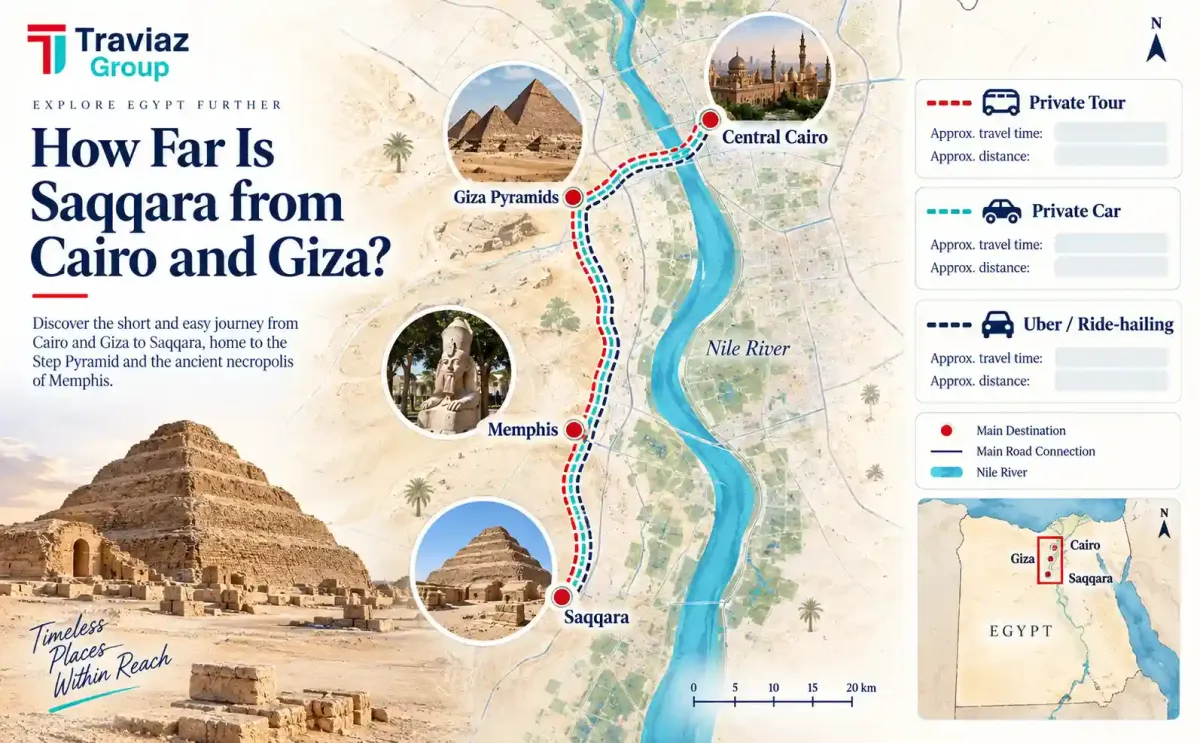
Saqqara sits 30 kilometers southwest of Cairo. The car journey from central Cairo takes between 45 minutes and approximately an hour and a half depending on traffic. Departing from the Giza plateau usually takes between 30 and 45 minutes. The following access options are available:
- Private car with Traviaz: the most comfortable option, with a driver waiting throughout the visit and guaranteeing the return without concern.
- Pre-agreed taxi: the round trip with waiting costs between 600 and 900 pounds.
- Uber or Careem: reaching Saqqara is relatively easy, but finding a car for the return may be difficult, which is a problem many independent visitors face.
The Best Time to Visit
The period from October to April is suitable for visiting Saqqara, when temperatures usually range between 15 and 28 degrees Celsius. During summer, from June to August, the heat may exceed 40 degrees, while most areas of the site remain open with no natural shade.
Within the day itself, arriving between eight and ten in the morning is preferable. At this time temperatures are milder, the light is more suitable for photography, and crowds are less dense. The Traviaz team therefore makes a point of choosing this timing for their guests whenever the program allows.
Accessibility & Comfort: Information for Every Traveler
A visit to Saqqara requires appropriate physical preparation, especially because of the desert terrain and the distances between sections of the complex:
Mobility Assessment: Is Saqqara Wheelchair Accessible?
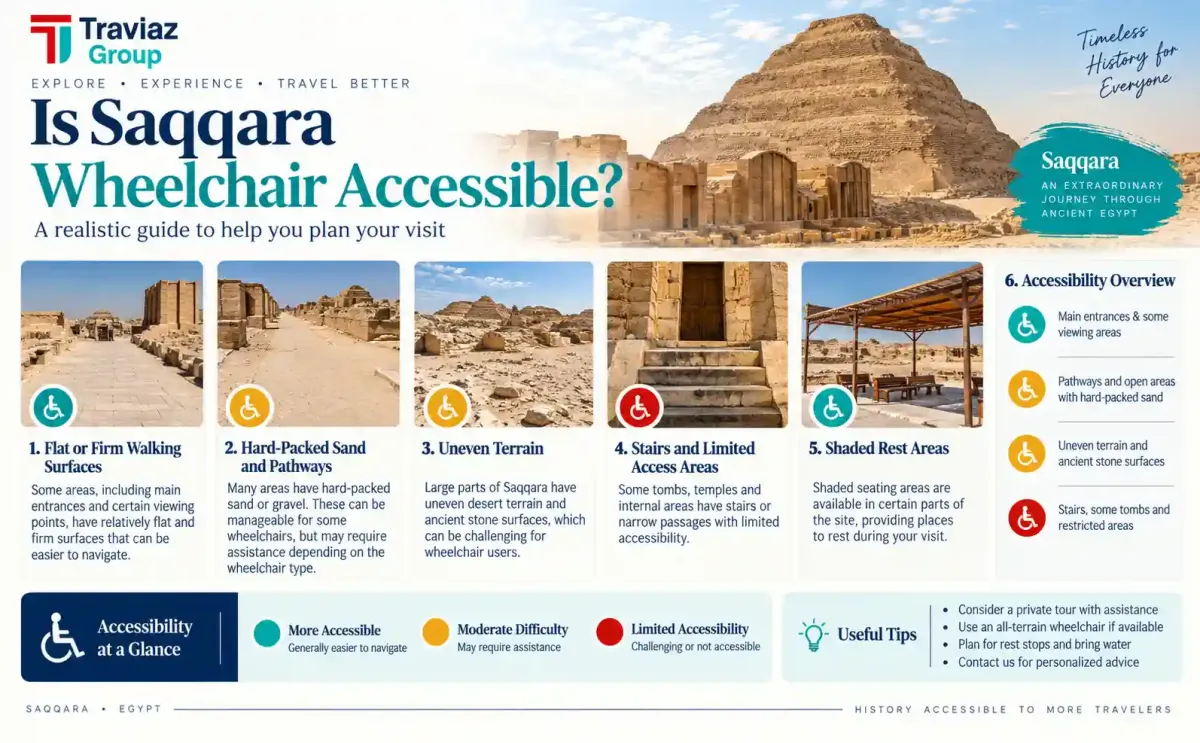
Sand and uneven stone floors dominate most areas of Saqqara, making wheelchair use difficult on some narrow paths and distant areas.
Visitors with mobility impairments can focus on the areas near the complex entrance and the Great Court, while avoiding sections that require crossing long sandy expanses.
The Traviaz team coordinates a customized visit plan in advance for each guest with special needs, taking their physical capabilities into account and identifying the sites that can be reached within the limits of their comfort.
Visitor Facilities
Bathrooms are located in the main entrance area at the gate, which is the primary point where this service is available inside the site.
Shaded areas are very limited and do not provide adequate rest in most parts of the complex. A hat, adequate water, and suitable clothing therefore become essential during the visit.
Parking with sufficient capacity is available at the main entrance. No restaurants or cafes exist inside the site, while the nearest food options are in the neighboring village of Saqqara a few minutes away by car.
Safety & Scams
Some individuals near the entrance may offer guiding services at low prices, but these offers sometimes end with requests for additional amounts after the tour. Some may involve directing the visitor to commercial shops instead of archaeological sites.
Booking a certified guide in advance helps avoid these situations and provides an archaeological expert at a clear and fixed price without pressure or unexpected surprises.
Why Choose a Guided Tour with Traviaz?
A specialist guide can completely change the way the visitor understands Saqqara. The site does not rely on observation alone but needs interpretation that connects the stone, the inscription, the era, and the historical story.
Traviaz guides are certified by the Egyptian Ministry of Antiquities and specialize in pharaonic history. They explain the engineering differences between the Step Pyramid and the later pyramids, and help visitors read hieroglyphic symbols in their original settings.
Some Traviaz packages combine Saqqara, Memphis, Giza, and Dahshur in a single full day. Luxury private tours are also available starting from $60 per person, including air-conditioned transport, a specialist guide, and entrance tickets with no hidden fees.
To design a customized itinerary that suits your time and interests, visit traviaz.com.
FAQs
How Old is the Step Pyramid Today?
The Step Pyramid was built around 2667 BC, so its age today exceeds 4,700 years. It is considered the oldest large-scale stone structure built by humans and predates the larger Pyramid of Khufu at Giza by approximately one hundred years.
Can You Go Inside the Step Pyramid?
Yes, interior access has been available since March 2020 after the site reopened following comprehensive restoration work. The interior ticket costs an additional 40 pounds on top of the basic entrance ticket. The passages are narrow in some places and may require bending while walking, so the experience suits visitors who can physically handle these conditions.
Is Saqqara Worth Seeing?
Yes, Saqqara offers an important experience for those who want to understand the history of the pyramids from its roots. The site is quieter and less crowded than Giza, and the comprehensive entrance ticket provides good value compared to the number of sites that can be visited.
What Should I Wear to Visit?
Light cotton or linen clothing in pale colors suits the desert heat. Wearing clothes that cover the shoulders and knees is preferable when visiting archaeological sites. Closed sports shoes are necessary because of the sand and uneven stones. A wide-brimmed hat, sunscreen, and a water bottle of at least two liters should also be brought along.