
Temple of Dendera: Is This the Best-Preserved Ancient Site in Egypt?
The Temple of Dendera is the answer to a question that many travelers ask after feeling that Egypt's major sites did not give them the experience they were looking for.
Here you walk in and find the original colors on the ceiling, the carvings holding their details intact, and the architecture standing inside and out in an exceptional way.
In this guide, you will learn about the history and secrets of the Temple of Dendera, along with how to get there and everything you need to know about visiting in 2026.
Why Dendera is Egypt's Hidden Masterpiece
The Temple of Hathor sits inside a vast archaeological complex approximately 2.5 kilometers southeast of the city of Dendera in Qena Governorate, while the entire complex stretches across roughly 40,000 square meters enclosed by massive mud-brick walls.
The clearest difference between Dendera and other famous Egyptian temples lies in the level of preservation. Karnak is enormous in scale and history, but it lost its ceilings and much of its original color, while Luxor Temple stands imposingly though most of it is open to the sky.
Dendera, by contrast, still has its ceilings standing and its original colors preserved to a striking degree, and this is tied to the temple remaining buried under sand for centuries until Napoleon's expedition discovered it in 1798 in a condition close to how it looked when it was closed in antiquity.
Is the Temple of Dendera worth visiting? The answer is yes. It ranks among the best-preserved and most color-rich temples in Upper Egypt, and it houses one of the most famous circular astronomical maps in the ancient world, alongside the controversial carvings known as the "Dendera Light."
The History and Mythology of the Hathor Temple
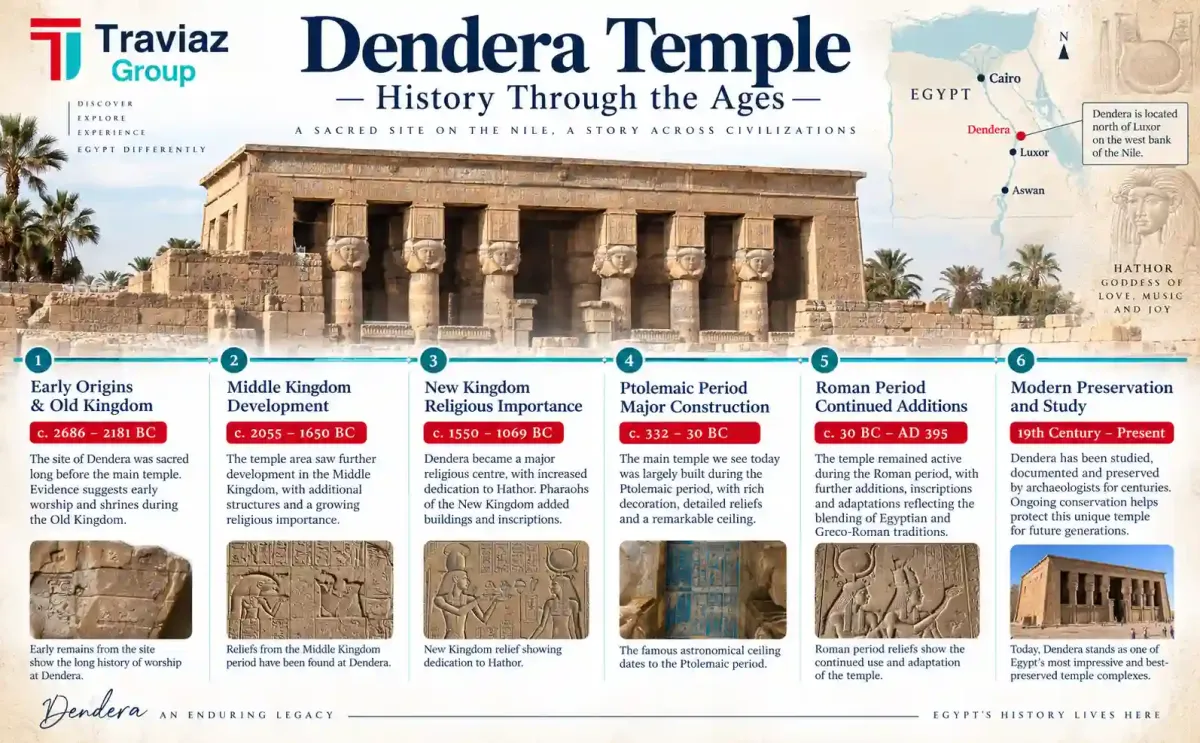
The history of the Temple of Dendera spans multiple phases of Egyptian history, from the ancient Pharaonic eras all the way through the Ptolemaic and Roman periods, in a rare sequence within a single site.
Who Built Dendera?
Archaeological evidence points to the existence of a temple on the site since the reign of King Pepi I during the Old Kingdom, around 2250 BC. Remains also exist that are linked to a temple from the 18th Dynasty, around 1500 BC.
The oldest structure still standing today is the Mammisi of Nectanebo II, the last native Egyptian pharaoh, who ruled between 360 and 343 BC.
The main structure we see today began construction in 54 BC during the late Ptolemaic period under Ptolemy XII Auletes.
Cleopatra VII later added some touches to the project, before the Romans continued completing sections of the temple under Tiberius.
The Goddess Hathor
Hathor held a wide-ranging place in ancient Egyptian belief and was associated with a broad set of religious and social domains:
- Love, beauty, and femininity, and the Greeks linked her to the goddess Aphrodite.
- Music, dance, and joy, with the sistrum being one of her sacred symbols and instruments.
- Fertility, motherhood, and childbirth, and pregnant women visited her temples seeking healing.
- Healing from illness, which gave Dendera a therapeutic dimension alongside its religious function.
Hathor appears in carvings with a cow's head or as a woman with cow's ears above her head.
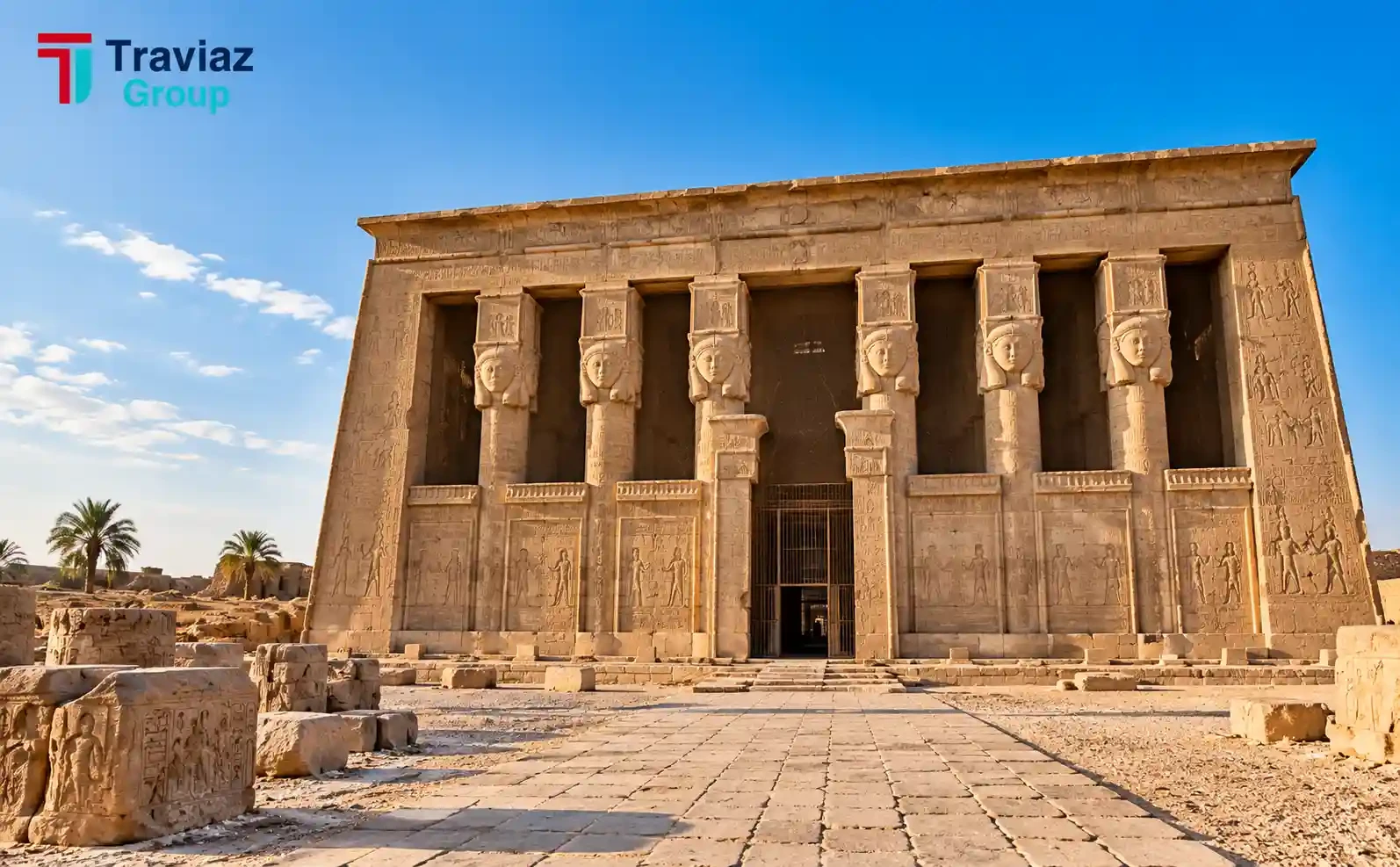
On the columns of the Hypostyle Hall she also appears with her face shown frontally, which is a relatively rare style in ancient Egyptian art.
Greek vs. Egyptian: The Ptolemaic Blend
The Ptolemaic kings were careful to build temples according to Egyptian traditions in form and symbolism, and this served more than one purpose.
On one hand, respecting local beliefs helped solidify their legitimacy in the eyes of the Egyptians, and on the other hand, the temples were institutions with administrative and economic roles alongside their religious functions.
The Temple of Dendera therefore combines traditional Egyptian art and symbolism with the Greek names of the rulers and the dates used in the Ptolemaic period.
Architectural Highlights: From Blue Ceilings to Secret Crypts
What makes the Temple of Dendera remarkable is that its architectural details allow visitors to form a clear picture of what the temple looked like in antiquity without relying entirely on imagination or virtual reconstruction.
The Hypostyle Halls
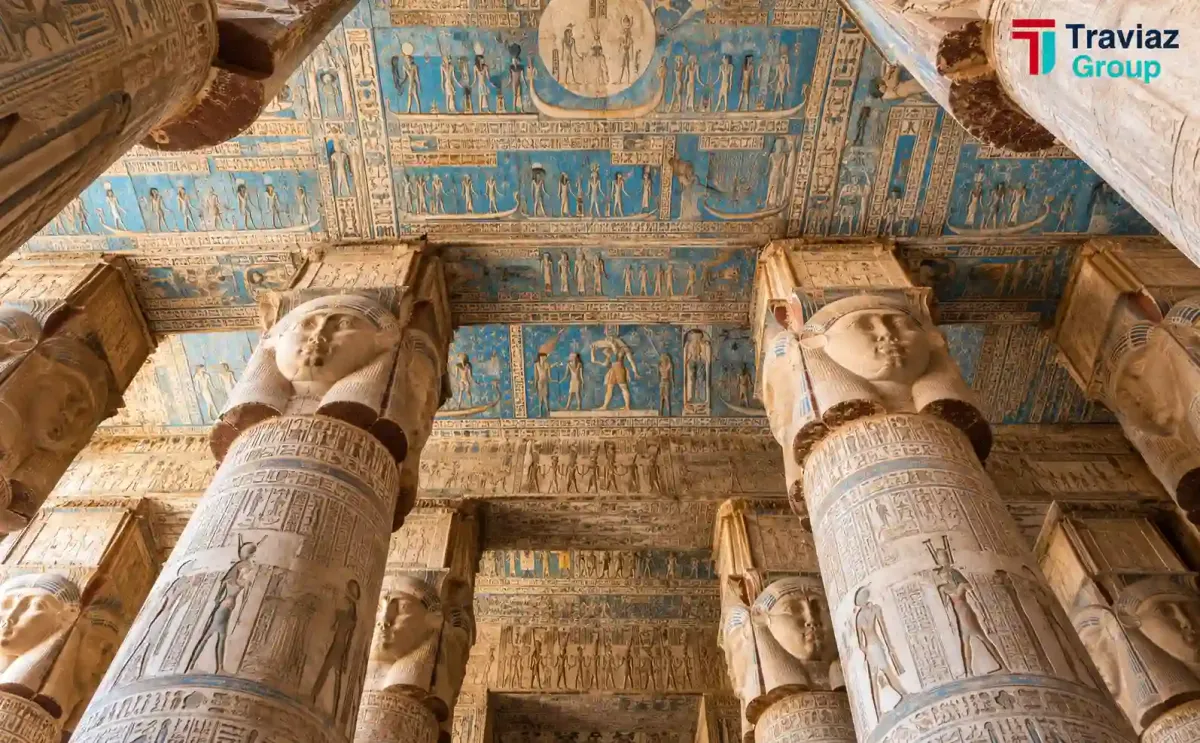
The large first hall greets the visitor with 18 towering columns reaching 15 meters in height, topped with capitals associated with Hathor.
From the walls to the ceilings and down to the column bases, detailed carvings spread densely and make the decorated surfaces a core part of the visual experience.
This hall was added in the Roman period during the reign of Emperor Tiberius.
The smaller second hall was associated with the processions and ceremonies during which the statue of Hathor was carried.
The Blue Ceilings
Looking up at the ceiling of the large hall, a deep blue background appears carrying golden and astronomical carvings, and this is among the most striking sights in the temple for visitors.
Restoration work that the Egyptian Antiquities Authority began in 2005 and completed in its second phase in 2021 revealed original colors that had been hidden beneath accumulated layers.
The goddess Nut appears representing the sky as she swallows the sun each evening to give birth to it again each morning, while cosmic and astronomical elements surround her including zodiac signs and symbols tied to the ancient Egyptians' vision of the heavens.
The Secret Crypts
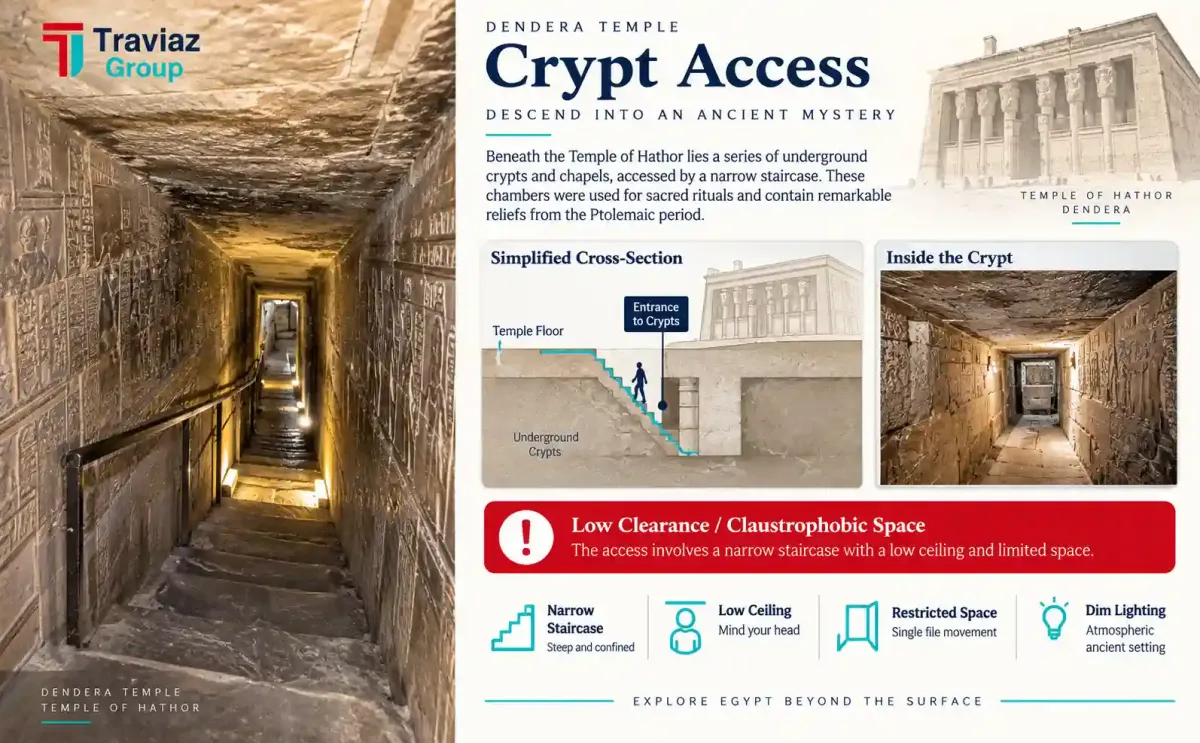
Below the temple floor lies a series of secret storage chambers known as the Crypts, and they were associated with storing ritual vessels, divine symbols, and tools tied to the sacred mysteries of the temple.
Access is through narrow stairs and passages carved into the ground, and their walls hold some of the most debated scenes in the site.
A note for those who experience claustrophobia: some of Dendera's passages are very narrow and require bending, and in certain points only one person can pass at a time.
Anyone who feels uncomfortable can limit their visit to the upper areas and the temple roof without descending into these sections.
The Dendera Light Bulb
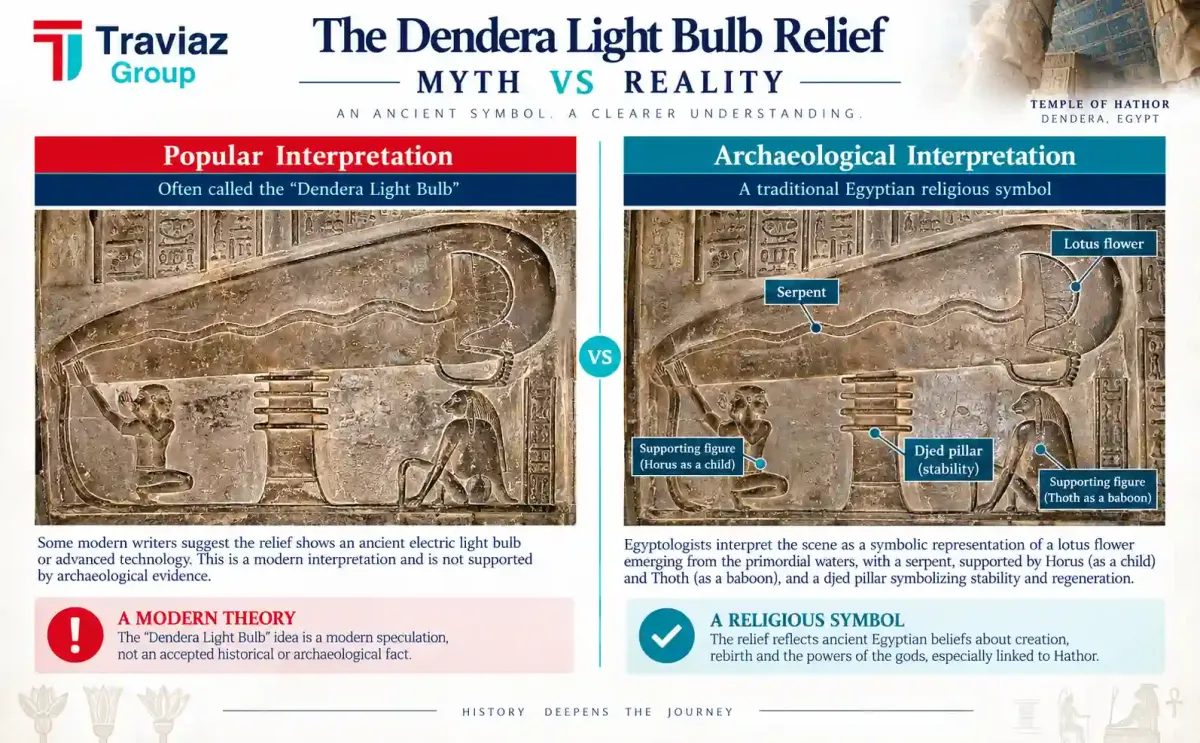
In one of the Crypt corridors, carvings depict Harsomtus, the god of creation, in the form of a snake emerging from a lotus flower inside an oval vessel.
Some conspiracy theory supporters in the twentieth century interpreted this scene as representing an ancient electric light bulb, pointing to the shape of the vessel and the glowing line visible inside it.
The archaeological interpretation is different. The oval vessel is associated with creation concepts and the cosmic womb, while the snake represents the god Harsomtus in one of his mythological manifestations.
No evidence exists in ancient Egyptian texts suggesting this scene has any connection to electricity.
The Dendera Zodiac
On the ceiling of one of the rooms in the Osiris building on the upper part of the temple sits what became one of the most famous circular celestial maps in the ancient world.
It displays a number of constellations that overlap with astronomical concepts known today, including Taurus and Libra, and Sirius also appears, a star that held special importance in ancient Egyptian beliefs.
The original is no longer at Dendera. The French cut it out in 1820 and transported it to Paris, where it now sits in the Louvre. What visitors see on the ceiling today is a replica of the original work.
Cleopatra VII and Caesarion
On the southern exterior wall of the temple, a large carving shows Cleopatra VII alongside her son Caesarion, whom she bore by Julius Caesar.
The scene is among the most prominent surviving depictions of the queen inside an Egyptian monument, and her name is tied to completing certain phases of the temple's construction.
Exploring the Complex Beyond the Main Temple
The Dendera complex is not limited to the Temple of Hathor alone. Inside its walls stand multiple structures representing historical and religious layers that stretched from ancient Egyptian times through the early Christian era.
The Mammisi
The complex holds two Mammisi, or birth houses. The first dates to Nectanebo II and is the oldest standing structure on the site, while the second began during the Roman period under Emperor Nero and was completed under Trajan.
The second structure was associated with Harsomtus, son of Hathor and Horus.
Its columns display decorations associated with the god Bes, who was depicted facing forward rather than in the sideways position more common in many Egyptian artistic traditions.
The Sanatorium and Sacred Lake
The Dendera complex served functions that went beyond traditional worship, and the area was associated with something resembling a healing center.
In the Sanatorium, patients would stay in hopes of seeing the goddess in their dreams and receiving her healing, while the waters of the Sacred Lake were considered blessed, and pilgrims would carry water from it in vessels for use in healing rituals.
Coptic Church and Temple of Isis
Inside the complex walls stands a Coptic church dating to the fifth century AD, representing a later religious layer built over a site that had been associated for centuries with the worship of Hathor.
The remains of a Temple of Isis also exist, though they are less well-preserved than the main temple.
The Gateway of Domitian and Trajan
The main gateway stands on the northern side of the complex, and its construction is associated with the Roman emperors Domitian and Trajan during the first century AD.
Their images appear on its walls depicted as Egyptian rulers making offerings to the gods.
Logistics: How to Reach Dendera in 2026
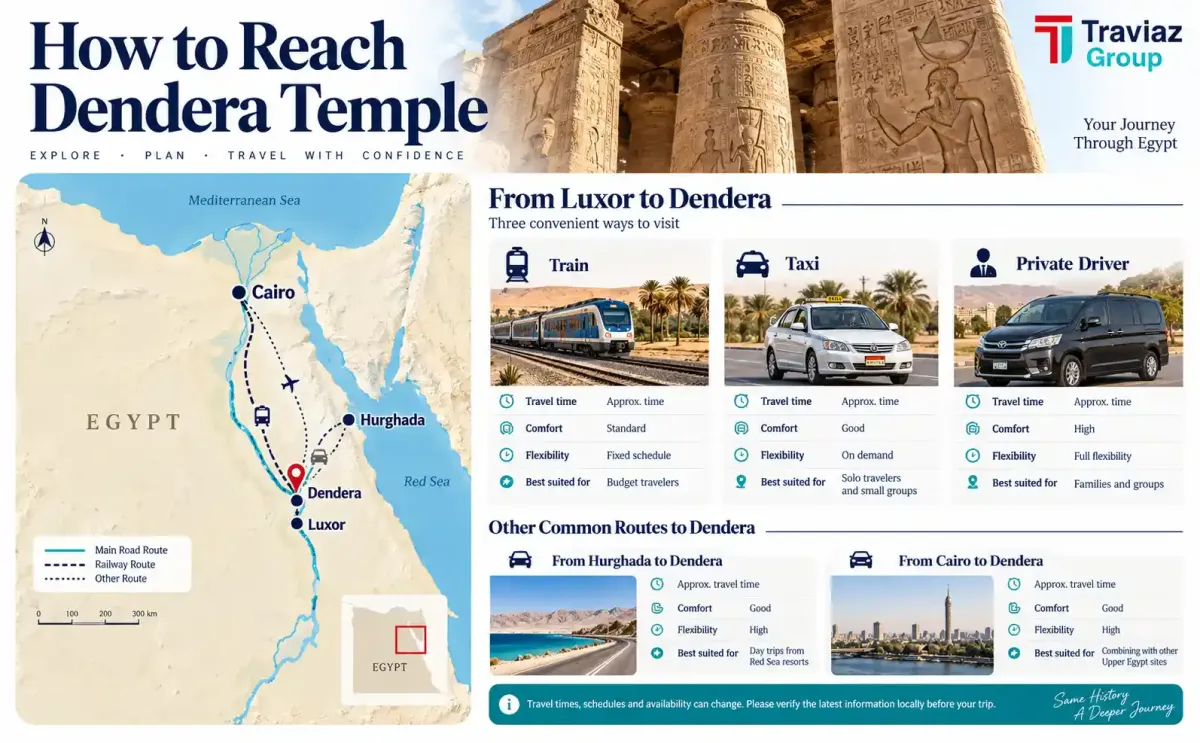
The Temple of Dendera is about 2.5 kilometers from the city of Dendera in Qena Governorate, roughly 60 kilometers north of Luxor.
This distance makes a visit possible as a half-day trip from Luxor, with the experience differing clearly from the more crowded sites.
From Luxor
Three main routes are available when setting out from Luxor, and each option differs in cost and comfort:
- Private taxi: the distance is about 60 kilometers and the trip usually takes between one hour and one hour and fifteen minutes. The driver waits in front of the temple until the visit is done, and negotiating the price is an important part of the arrangement, with better rates often available by negotiating away from the entrances of large hotels.
- Train to Qena: the trip from Luxor to Qena takes about 45 minutes, then a taxi can be taken from the station to the temple. This option costs less but requires extra coordination for the return.
- Organized private tour: includes transport to and from the hotel in Luxor in an air-conditioned car with a specialist guide. The cost ranges between 50 and 125 dollars per person depending on what the package includes in terms of guide, entrance tickets, and lunch, and it suits those who want to arrange the visit without worrying about transport.
- Uber: operates in Luxor but is not reliable for longer inter-governorate distances, so it is not recommended as the primary option for reaching Dendera.
From Hurghada and Cairo
Dendera can be reached from Hurghada, and the trip becomes more worthwhile when combined with Abydos on the same day:
- The distance from Hurghada to Dendera is about 210 kilometers and the car journey takes roughly two and a half hours.
- Some organized tours from Hurghada start at six in the morning and return in the evening, with the total trip duration ranging between 7 and 15 hours depending on the itinerary and whether Abydos is added.
- Combining Dendera and Abydos from Hurghada makes good use of the long travel time and fits two archaeological sites into one day.
- From Cairo the distance is about 480 kilometers and can be covered in one day, but the journey is tiring, so it is better to include Dendera within a longer itinerary along the Nile.
Best Time to Visit
Choosing when to visit can significantly affect comfort, lighting, and crowd levels:
- The temple opens from seven in the morning until five in the evening according to information from the official Egyptian Antiquities Authority website.
- Morning hours before ten are better for natural light inside the halls and for avoiding part of the midday heat.
- June, July, August, and September are the hottest months in Upper Egypt.
- October, November, and March generally combine the best weather with lower crowd levels.
- Compared to Karnak and the Valley of the Kings, Dendera typically receives fewer visitors, giving the site a quieter atmosphere.
Essential Visitor Information and 2026 Fees
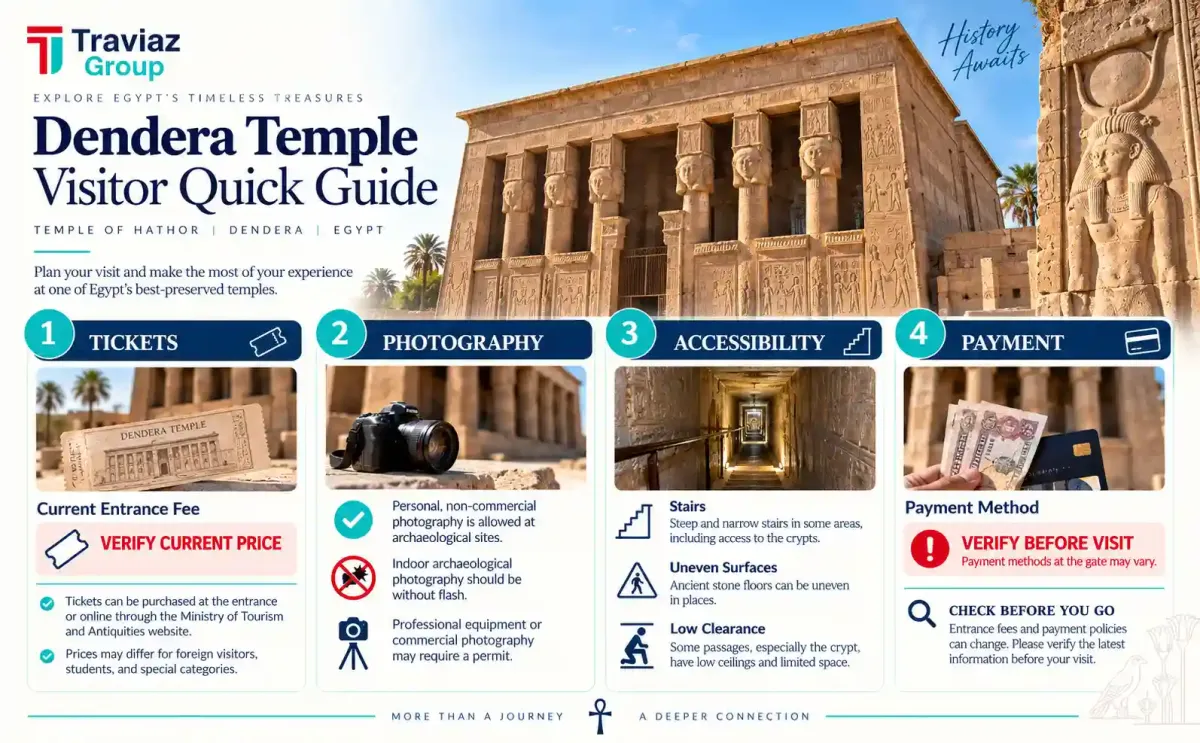
According to information listed on the official Egyptian Antiquities Authority website at egymonuments.gov.eg, the Temple of Dendera ticket prices are as follows:
- Foreign adult entry: 300 Egyptian pounds.
- Foreign student entry: 150 Egyptian pounds.
- Panorama rooftop ticket: an additional 100 Egyptian pounds.
- Serdab crypt ticket: an additional 100 Egyptian pounds.
- Egyptian adult entry: 20 Egyptian pounds.
- Egyptian student entry: 10 Egyptian pounds.
- Vehicle ticket at the entrance: 25 Egyptian pounds for a private car or taxi.
Payment Policy
An important note: the temple operates on a cashless payment system only and does not accept banknotes at the ticket window according to the information available here. Make sure your bank card is enabled for international payments before arriving. If you prefer to pay in cash, you can arrange with a travel agency in advance to include tickets in the organized tour price.
Photography Rules
Since 2019, photography with phones and cameras without flash has been permitted at Egyptian archaeological sites without additional fees, while commercial and film photography is subject to a separate permit system. Inside Dendera, it is best to confirm the rules in effect on the day of the visit with the guard at the entrance, especially when using professional cameras.
Dress Code and Facilities
Dendera is a historic religious site, so modest clothing is recommended out of respect for the place and the local community. Carrying a water bottle is also important, as the complex spans roughly 40,000 square meters and a visit can require extended walking, especially during the hot months.
Accessibility
Some organized tour arrangements indicate that the main areas of the Temple of Dendera are accessible by wheelchair, while sections such as the roof and the Crypts require narrow stairs and movements that do not suit all visitors with mobility limitations. Contacting tour organizers in advance helps determine which sections are accessible based on individual needs.
Why a Traviaz Private Tour is the Superior Choice
The difference between visiting the Temple of Dendera on your own and exploring it with a specialist Egyptologist guide shows up in the depth of understanding, not just in how you get to the site. The astronomical and religious carvings that appear to the untrained eye as beautiful decorations carry a complete system of beliefs about the sky, time, and ritual.
Sirius, for example, appears within an astronomical system tied to Egyptian beliefs and the Nile flood, while the ceilings and walls carry scenes that need interpretation to understand the relationships between the gods, the rituals, and the cosmic vision.
Traviaz offers on Dendera tours:
- A guide specializing in the history of the Ptolemaic period and ancient Egyptian astronomy, to explain the symbols and carvings within their context.
- A private air-conditioned car between Luxor or Hurghada and the temple, to make the journey and return comfortable.
- The option to combine Dendera and Abydos in one day for travelers coming from Hurghada or for anyone who wants to make the most of their day by visiting two archaeological sites.
Dendera vs. The Rest: Which Temple is Right for You?
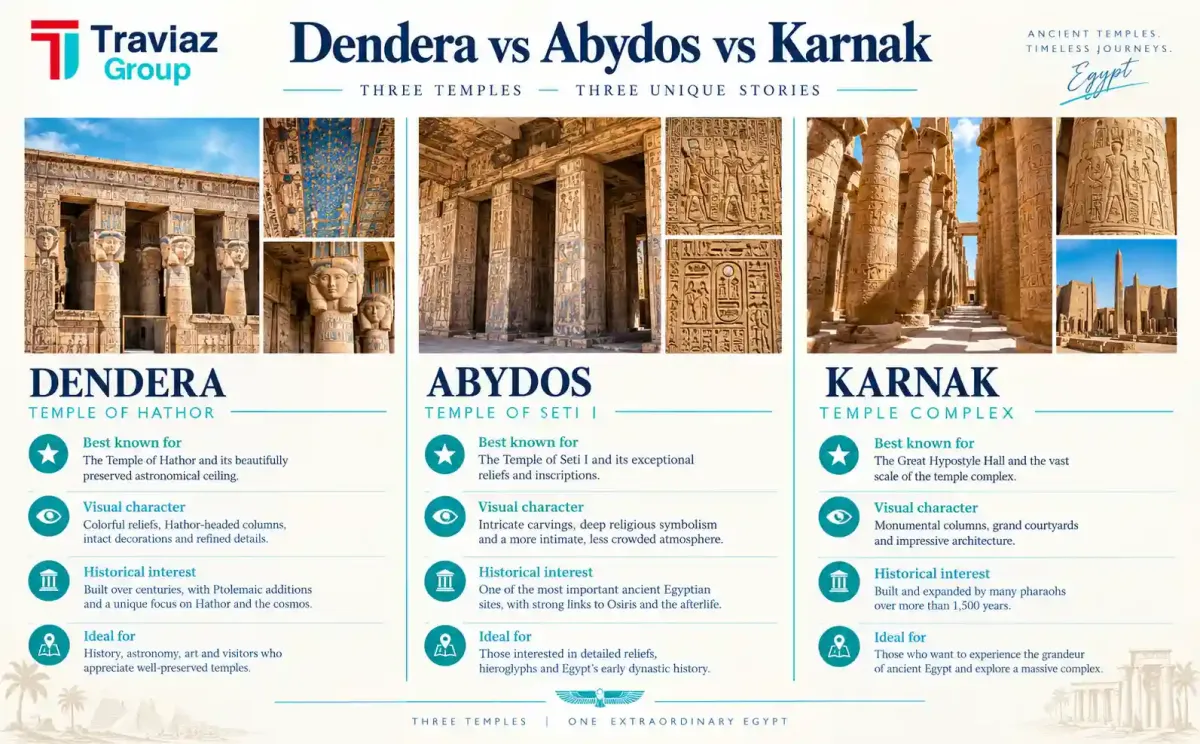
This comparison helps clarify the difference in the nature of the experience between Egypt's main temples:
|
Criterion |
Dendera |
Abydos |
Karnak |
Edfu |
|
Preservation |
The best, without competition |
Excellent |
Good but exposed |
Good |
|
Original Colors |
Yes, extensively |
In some areas |
Rare |
In some areas |
|
Size |
Medium to large |
Medium |
Very large |
Large |
|
Character |
Astronomical, religious, and aesthetic |
Spiritual and ritualistic |
Imperial and architectural |
Classic Ptolemaic |
|
Crowds |
Much fewer |
Fewer |
Very heavy |
Moderate |
Dendera vs. Abydos
The visual experience at Dendera centers on colors, raised carvings, and preserved architectural details, while Abydos carries a clearly spiritual and theological character through its association with the Temple of Seti I and the worship of Osiris. Combining both sites in one day allows you to see two different sides of architecture and religion in ancient Egypt.
Dendera vs. Karnak
Karnak surpasses Dendera in size, historical scope, and first visual impact, while Dendera stands out for its level of preservation, its colors, and its less crowded atmosphere. Someone with only one day in Luxor may prioritize Karnak, while someone with three days in the area can add Dendera to the itinerary without giving up the temple experience.
Dendera vs. Edfu
Both are well-preserved Ptolemaic temples, but Edfu is larger and more structurally complete, while Dendera is distinguished by the richness of its astronomical elements, the Zodiac, and the carvings known as the "Dendera Light." Visiting both temples together gives a broader picture of the development of Ptolemaic art and architecture.
FAQs
Is the Qena Area Safe for Tourism?
The Qena and Dendera area is visited regularly as part of Egypt's tourism routes, and the temple receives foreign visitors on a continuous basis. As with any tourist site, it is better to be aware of vendors at the entrance and not accept unsolicited services that may be followed by requests for a tip.
How Long Does It Take to Explore the Full Complex?
A thorough visit to the Temple of Dendera and the main areas of the complex takes about two to three hours. Anyone who wants to add the roof, the Crypts, the Mammisi, and the side buildings needs at least three hours to explore them without rushing.
Is There a Sound and Light Show at Dendera?
There is currently no sound and light show at the Dendera complex, so the experience here differs from Karnak and the Pyramids where shows of this kind are available.
Can You Enter the "Dendera Light" Room?
Yes, it is possible to descend into the Crypts that contain these carvings, but the passages are very narrow and require bending, and in some sections only one or two people can pass at the same time. It is best to be physically prepared for the visit and to avoid carrying large bags when descending.