
Tomb of Sety I: Why KV17 is the Most Magnificent Site in the Valley of the Kings
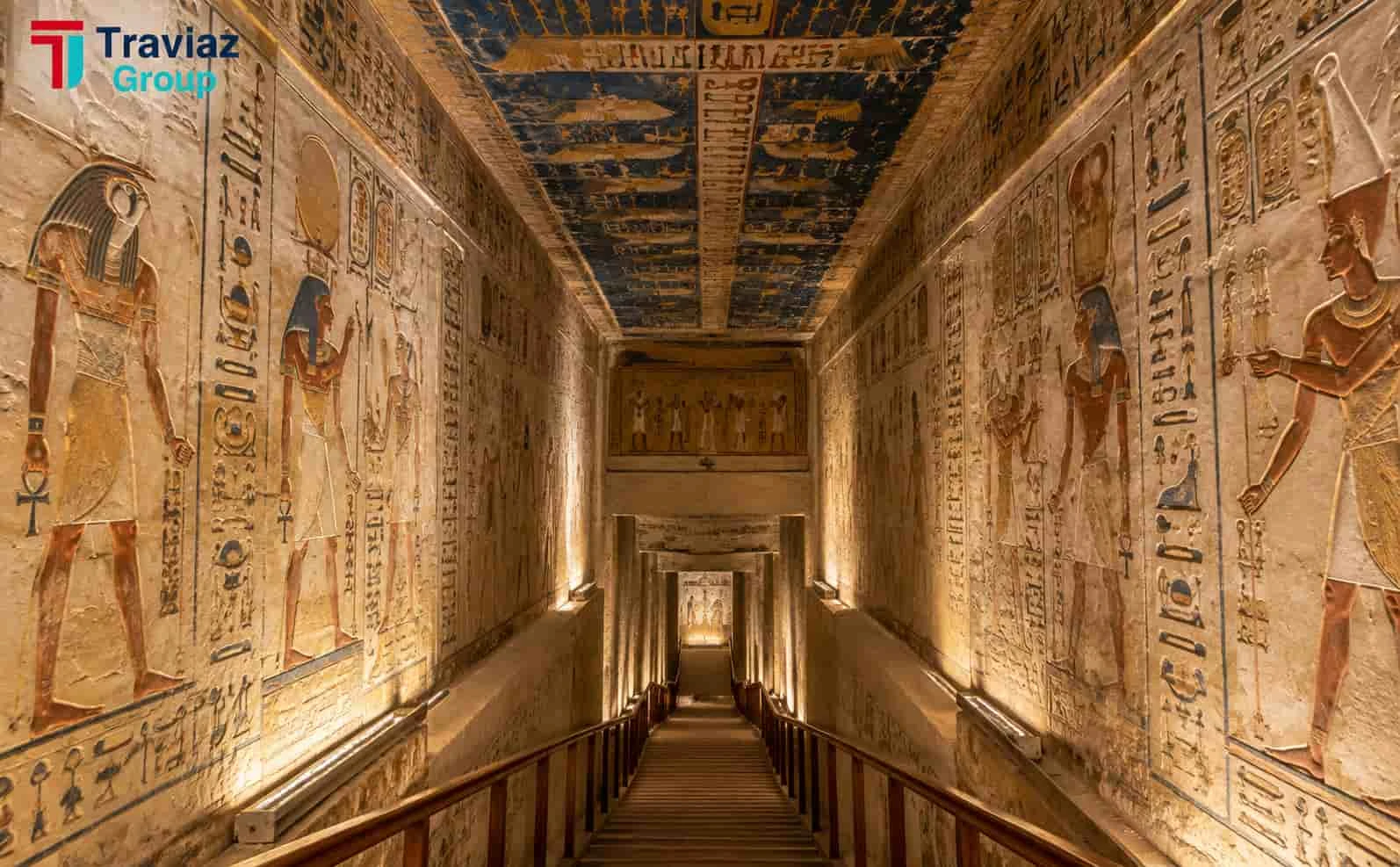
In the Valley of the Kings on the West Bank of Luxor, there is a tomb that stands apart from most of what surrounds it, and it is the Tomb of Sety I (KV17), which combines record-breaking depth and length with exceptional artistic decorations that have endured for more than three thousand years.
From the history of its discovery to the details of visiting it in 2026, this guide covers everything you need to know about this one-of-a-kind tomb.
Quick Facts: The Gold Standard of Pharaonic Art
- Location: West Bank, Luxor
- Dynasty: 19th Dynasty
- Records: Longest and deepest tomb in the Valley of the Kings
- Discovery: October 16, 1817, by Giovanni Belzoni
- Key Highlights: The astronomical ceiling, the alabaster sarcophagus, the Hall of Beauties
The Legacy of the 19th Dynasty: Why KV17 Matters
Royal funerary architecture underwent a major transformation during the reign of Sety I, after centuries of religious and political upheaval tied to the reign of Akhenaten.
With the 19th Dynasty, Egyptian artistic and religious traditions returned to the forefront, and this shift appeared clearly inside the Tomb of Sety I (KV17), which stands as one of the most prominent expressions of that era.
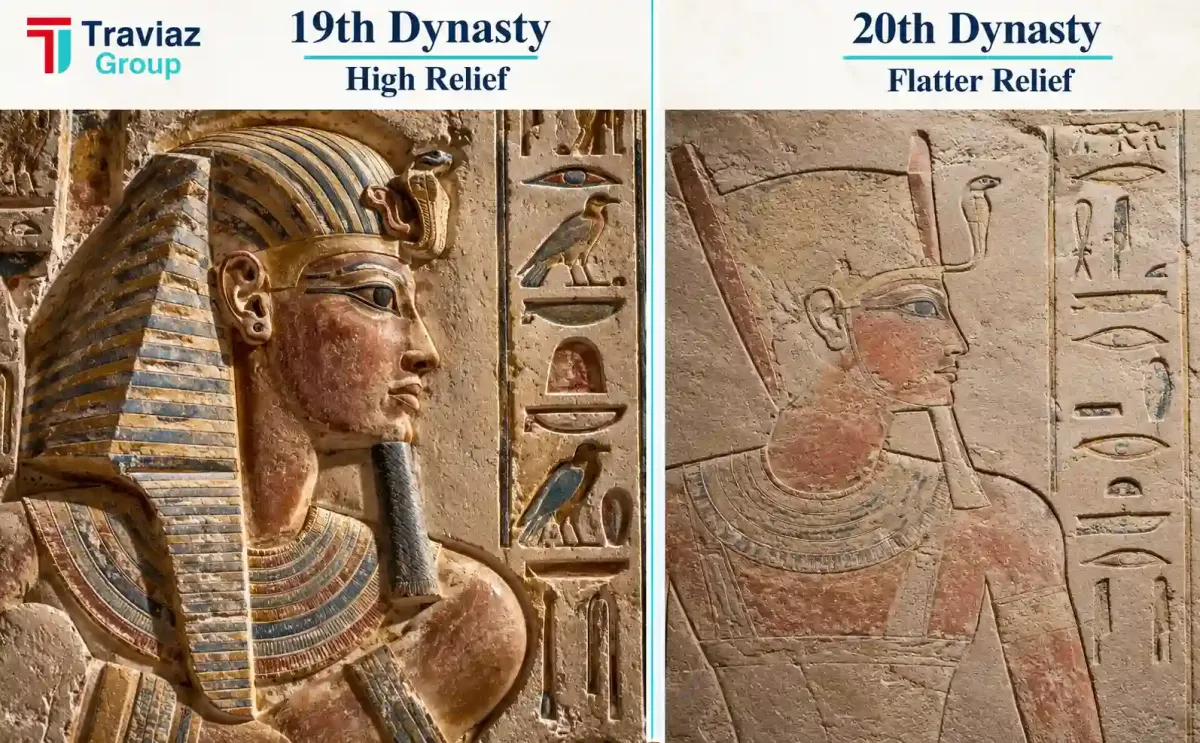
The artists covered the surfaces with raised relief carvings of clear depth, sharp edges, and cohesive colors, in a style that differs from the simpler flat carvings that appeared later in the 20th Dynasty.
The result is that the colors of KV17 have remained remarkably vivid despite more than three thousand years passing.
Within this context, Traviaz deep-access tours allow visitors to explore the theological dimensions of the Book of Gates and the religious texts carved on the walls, away from the pressure of crowds and time restrictions.
The Discovery of a Masterpiece: Belzoni's 1817 Breakthrough
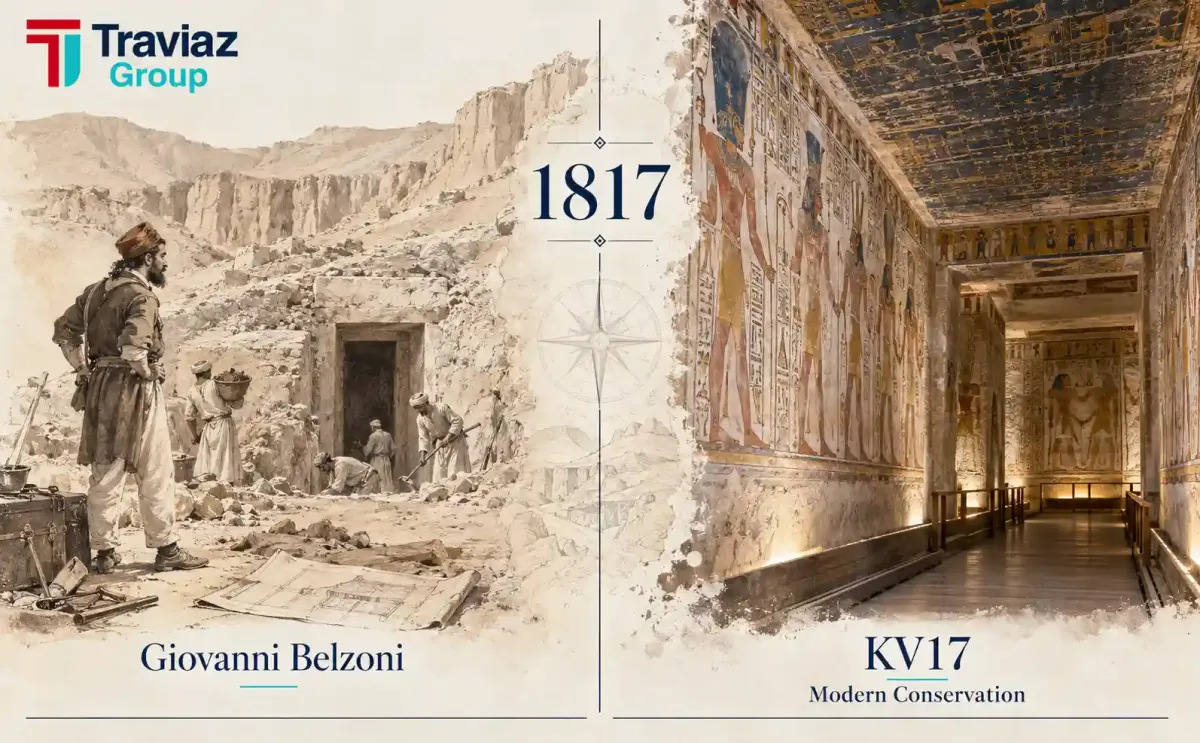
The discovery of the Tomb of Sety I (KV17) is tied to one of the most prominent phases of Valley of the Kings exploration in the nineteenth century.
In 1817, in an area that some excavators considered prone to flooding and collapse and not promising, Giovanni Belzoni managed to reach an exceptional royal tomb.
The story of the discovery later became linked to a long history in which the handling of Egyptian antiquities moved from early exploration toward more refined concepts of preservation and restoration.
Who Was Giovanni Belzoni?
Giovanni Belzoni was not an academic in the traditional sense of archaeology, but he combined physical strength with engineering expertise. He was born in Padua, Italy, in 1778, and at the age of sixteen he joined a Roman monastery to study hydraulic engineering.
The conditions of the French occupation pushed him to leave Italy and head to England, where he worked in a traveling circus as a strongman, and the public gave him the title "The Great Belzoni" because of his height, which exceeded six feet and six inches, and his massive physical build.
After leaving the circus, he arrived in Egypt carrying his hydraulic invention, and there he met the British Consul Henry Salt, who directed him toward excavation work in the Valley of the Kings.
History of Exploration
On October 16, 1817, Belzoni entered KV17 for the first time and found the walls retaining colors that appeared almost fresh, with some of the painters' brushes and tools still lying on the floor.
The spread of news about the discovery led to a wide wave of interest in ancient Egyptian civilization that extended to Europe, and Belzoni later took wax molds from the tomb walls and in 1821 held an exhibition at the Egyptian Hall in Piccadilly in London that recreated the tomb, which contributed to the spread of Egyptomania across Europe.
That early interest had a direct impact on the condition of the tomb, as some of the first visitors removed layers of paint while using wax and plaster molds, and Champollion cut away sections of certain reliefs, which are now in the Louvre in Paris and the Museo Archeologico in Florence.
Standards for handling the site later changed significantly, and the tomb was reopened in 2016 after a closure of nearly three decades for restoration, benefiting from three-dimensional digital documentation techniques to preserve details without touching the original surfaces.
Architecture and Measurements: Descending into the Earth
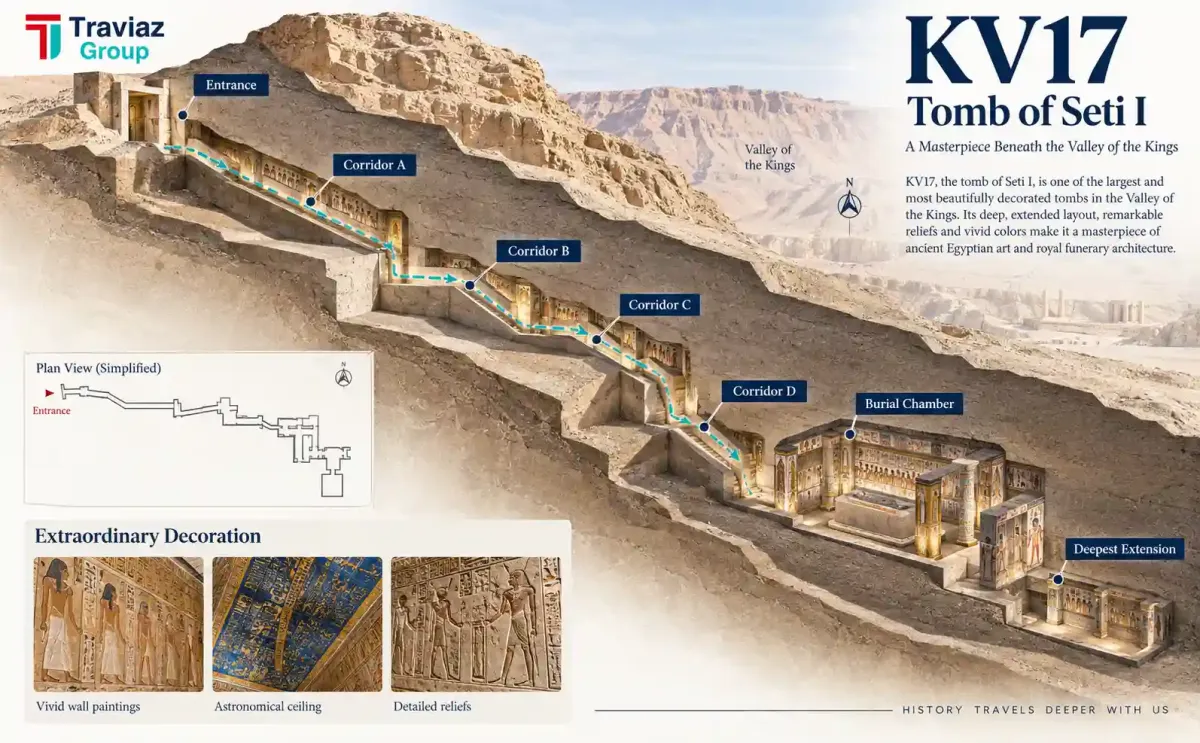
The dimensions of the Tomb of Sety I (KV17) give it a special status among the tombs of the Valley of the Kings, as its design extends through seven corridors and ten chambers, with an architectural organization that reflects the pharaoh's journey in the underworld within an integrated religious and engineering vision.
Record-Breaking Dimensions
KV17 stretches to approximately 137 meters in length and was the longest known tomb in the Valley of the Kings until the discovery of the tomb of the sons of Ramesses II.
It is also the deepest among the royal tombs in the valley, and its structure is distributed across a set of main elements:
- Seven main corridors that follow one another along a descending axis into the depths of the mountain.
- Ten chambers, along with a number of side rooms branching off the main axis.
- An additional Corridor K that extends 174 meters below the sarcophagus location and descends into the depths of the mountain.
The Descent: Corridors A to D
The descent inside KV17 begins at Entryway A, where 26 ancient steps lead to the start of the corridors. After that, the main corridors follow one another in the direction of the depths:
- Corridor B: the first of the corridors decorated with raised relief carvings, and its left wall displays the first known depiction of the opening scene of the Litany of Ra in a royal tomb, while the ceiling is covered with alternating vultures with cobra heads.
- Corridor C: contains texts from the Book of the Dead and carvings from the Litany of Ra, with the descent continuing at a sharper angle.
- Corridor D: the depth increases through it, and the religious program expands as depictions of Sety I with the gods appear more clearly.
- Lower Corridors: these corridors lead to the First Pillared Room and then to the Burial Chamber at the heart of the mountain.
The Hidden Tunnels Mystery
Directly below the sarcophagus location, Corridor K extends, and it is one of the most question-raising elements of KV17.
The first attempt to excavate it began in 1960, during which approximately 136 meters were cleared before work stopped because of the poor quality of the rock.
Between 2007 and 2010, the Egyptian Antiquities Authority resumed excavation work after installing steel supports and a railway to remove debris.
During this phase, two steps appeared inside the tunnel, and then the passage ended abruptly at the base of the second step, bringing the total length to 174 meters without revealing the secret of its end to this day.
Artistic Grandeur: Reliefs, Colors, and the Astronomical Ceiling
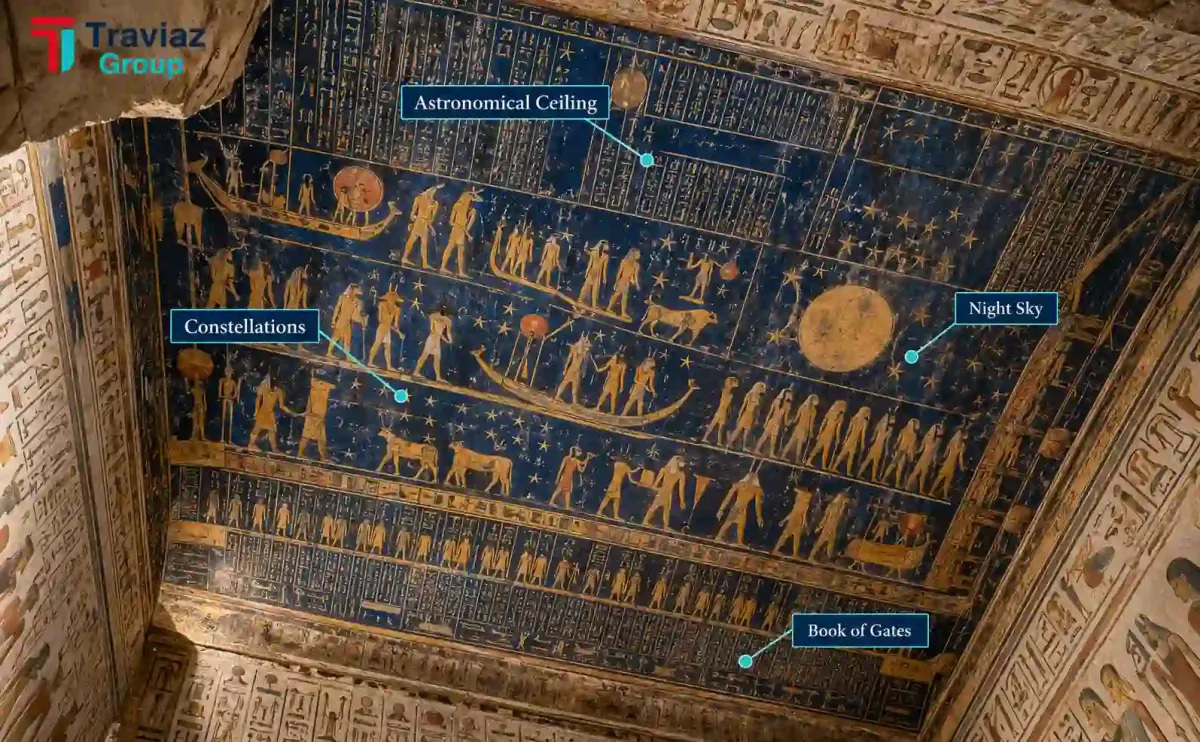
The Tomb of Sety I (KV17) presents a vast artistic and religious program covering the walls, ceilings, columns, and floors, with raised relief carvings and colors that have remained clear despite more than three thousand years passing.
The tomb also represents an early model of an integrated textual religious program that extends from the entrance all the way to the burial chamber.
The Hall of Beauties
The Hall of Beauties is among the most famous and most photographed chambers of KV17, and it ranks among the most striking archaeological spaces in Luxor.
On its walls, Sety I appears before a number of gods, including Hathor, Horus, Neith, and Osiris, in scenes that combine anatomical detail with expressive vitality.
The absence of a glass barrier between the visitor and the carvings allows for direct viewing of the details, which adds a clear visual dimension to the experience.
Unique High-Relief Work
The raised relief carving style reached an advanced level during the 19th Dynasty, and this is clearly evident in KV17.
This technique differs from the simpler flat carvings that appeared later in several ways:
- The height and depth of the carving from the surface allow light to form clear shadows on the figures and scenes.
- The fine details in faces, hands, and clothing reveal a high level of craftsmanship.
- The cohesion of the paint layer over the raised carvings helped resist erosion, which contributed to the colors remaining clear to this day.
The Astronomical Ceiling
The ceiling of the burial chamber in KV17 holds special importance in the history of Egyptian royal tombs, as it is considered the first known astronomical ceiling to depict constellations in the form of figures and animals. Its main elements are distributed as follows:
- Golden stars against a deep blue background cover most of the ceiling, presenting a vision of the ancient Egyptian night sky.
- Depictions of the Circumpolar Stars alongside Egyptian underworld scenes that embody the journey of the sun in the underworld.
- Scenes from the Book of Gates presenting the pharaoh's journey through the twelve hours of the night and on to resurrection.
- Rare depictions of Taweret the hippopotamus goddess and Sobek, which are elements found in no other tomb in the Valley of the Kings.
The Book of Gates
The Book of Gates forms one of the central religious texts in KV17, presenting the pharaoh's journey through twelve gates that represent the twelve hours of the night.
The journey begins with the setting of the sun and the pharaoh's entry into the underworld, then ends with its rising and the resurrection.
The carvings of the Book of Gates spread across large sections of the walls of Pillared Chamber F, Side Chamber Ja, and Burial Chamber J, presenting one of the most complete programs of this text inside a royal tomb.
The Sarcophagus and The Mummy: Where Are They Now?
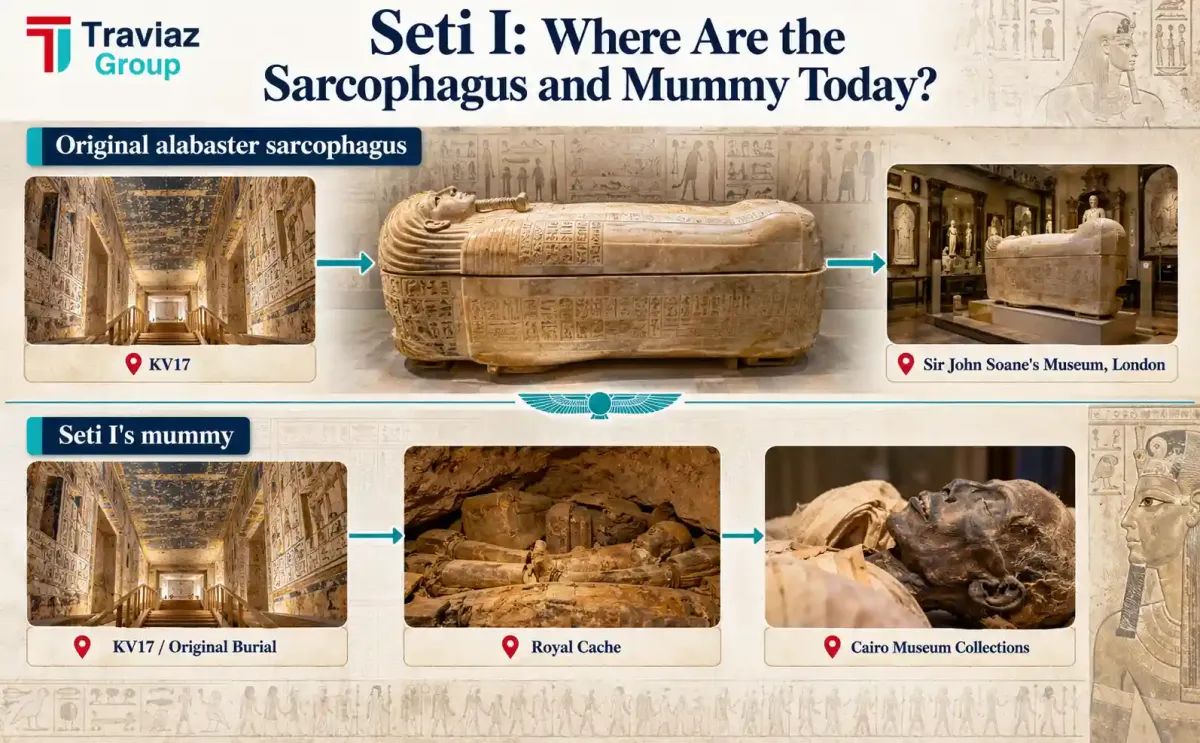
The sarcophagus of Sety I is no longer inside his tomb, and the pharaoh's mummy did not remain in KV17 either. When Belzoni reached the burial chamber in 1817, he found a fine alabaster sarcophagus, while the pharaoh's remains were later distributed among institutions and sites separated by thousands of miles.
The Alabaster Sarcophagus Story
The alabaster sarcophagus of Sety I is among the outstanding works of ancient Egyptian sarcophagus-making. It was carved from a single piece of translucent alabaster, and its interior and exterior sides were decorated with fine carvings from the Book of Gates.
On the inner base, Nut the sky goddess appears as protector and guide for the soul during its journey.
Belzoni later sold the sarcophagus to the British antiquarian Sir John Soane, while the British Museum declined to purchase it. The sarcophagus is today in Sir John Soane's Museum in London, inside the Sepulchral Chamber on the lower floor.
After that, two carved door jambs were also removed from the tomb, with one now in the Louvre in Paris and the other in the Museo Archeologico in Florence.
The Pharaoh's Journey: Where Is the Mummy of Sety I?
The mummy of Sety I did not remain inside his tomb, as the priests of the 21st Dynasty hid it in a secret collective cache to protect it from tomb robbers.
This cache, known as the Royal Cache or TT320 near Deir el-Bahari, was discovered in 1881 by the local Abd el-Rassul family, and the French scholar Emile Brugsch then oversaw the transfer of the mummies to Cairo.
When the mummy of Sety I was unwrapped, it was in exceptional condition, and his facial features remained clear to a degree that allowed scholars to reconstruct his appearance. The mummy is currently in the National Museum of Egyptian Civilization in Cairo.
Planning Your 2026 Visit: Logistics and Pro Tips
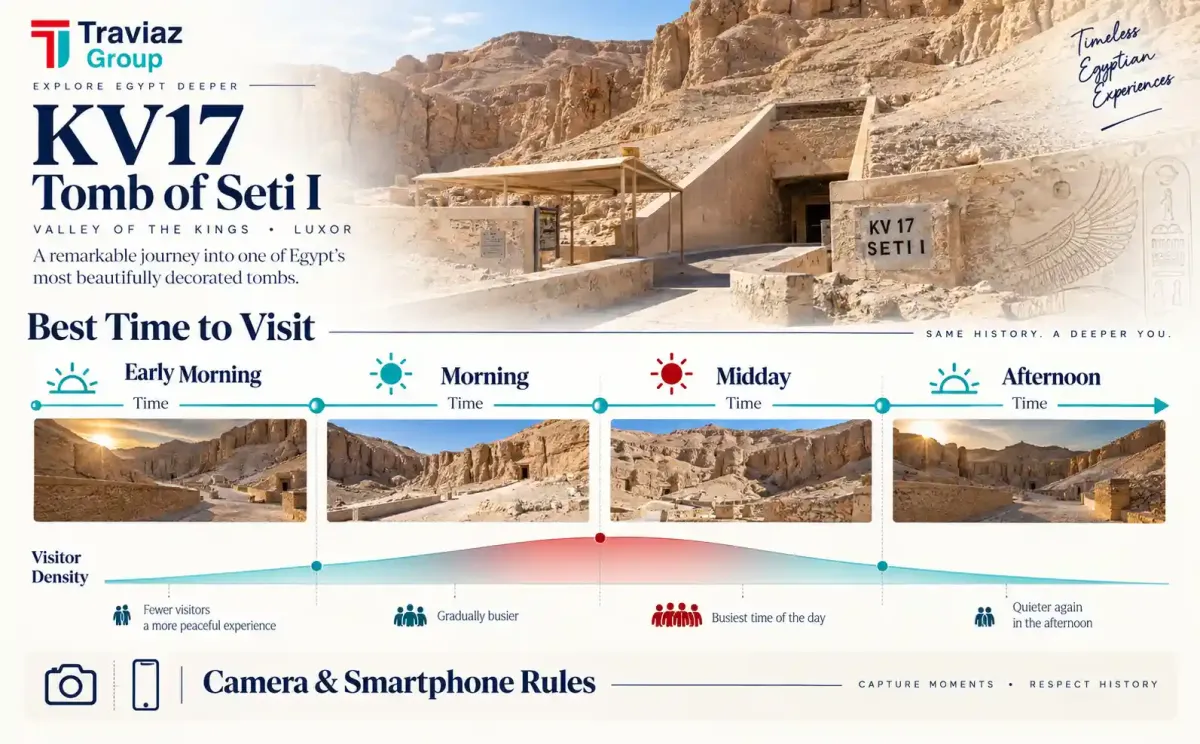
Visiting the Tomb of Sety I (KV17) requires more careful arrangements than visiting many other tombs in the Valley of the Kings, as the tomb's length and depth make the experience different from simply adding a quick site to a Luxor itinerary. Here are the most important details you need to know before the visit:
2026 Ticket Requirements
The ticketing system in the Valley of the Kings has more than one level, so you need to know what you require before arriving:
- Basic entry ticket: 750 Egyptian pounds for adults and 375 for students, which allows entry to three tombs from the general list.
- The additional KV17-specific ticket: an extra 2,000 Egyptian pounds, with no student discount, and it is required regardless of the type of basic ticket.
- Tram ticket: 20 Egyptian pounds for a round trip from the valley entrance to the tombs area.
- KV17 location: approximately 260 meters from the valley entrance, reachable on foot after taking the tram.
Luxor Pass vs. Premium Tickets
Choosing the Premium Luxor Pass or individual tickets depends on the number of sites you plan to visit in Luxor:
- Premium Luxor Pass: costs 250 dollars for adults and 130 dollars for students, covers sites on both the East and West Banks of Luxor, includes free entry to KV17 and the Tomb of Nefertari, and remains valid for five consecutive days.
- Individual tickets: the basic entry ticket combined with the additional KV17 ticket comes to approximately 55 dollars at the current exchange rate, and this is an option that suits those who want to visit KV17 only without a comprehensive Luxor sites program.
- Important note: the exchange rate between the Egyptian pound and the dollar is variable and may affect the comparison between the two options, so it is better to check the current rate before making a decision.
Photography Pass Rules
Since 2019, photography with phones and cameras without flash has been permitted at Egyptian archaeological sites without fees, but photography rules inside KV17 may differ, so you should pay attention to the instructions in effect on the day of the visit:
- Smartphones: generally permitted in most parts of the tomb without additional fees.
- Professional DSLR cameras: may be subject to more restrictive rules inside KV17 and may be prohibited at certain times.
- Commercial and film photography: subject to a separate permit system issued in 2022.
- Practical advice: do not rely on outdated information about photography, as the rules can change. Bring your camera and ask about the instructions at the entrance.
Timing Is Everything
Choosing the timing of the visit clearly affects the crowds and the way you explore the tomb:
- The first hour after opening in the morning or the last hour before closing in the evening are generally quieter and less crowded.
- An end-of-day visit may give you the chance to see the tomb with fewer visitors, which makes the silence and the archaeological details more present.
- The period between ten in the morning and noon is more crowded with the arrival of large tour groups.
Physical Comfort and Accessibility: Is KV17 Right for You?
The depth of the Tomb of Sety I (KV17) makes it one of those visits that requires clear physical preparation.
The experience involves descending into the depths of the mountain and then returning via the same stairs and slopes, so it is important to assess your physical comfort level before entering.
Stairs and Walking Difficulty
The route begins at Entryway A via 26 ancient steps, and then the stairs and slopes continue along the corridors all the way to the burial chamber.
Wooden ramps fitted with anti-slip strips are available to assist with the ascent and descent, but the nature of the tomb remains challenging for those who have difficulty with stairs or steep slopes.
After reaching the deepest points, exiting requires returning via the same ascent route.
Environment
The depth of KV17 maintains a relatively lower temperature than some other tombs, as its deep location insulates it from the desert surface heat.
There is no actual air conditioning inside the tomb, and an increase in the number of visitors may raise the temperature and humidity.
Light clothing and a water bottle are suitable for the visit, and it is important to avoid peak hours especially for elderly visitors or those affected by heat.
Dealing with Claustrophobia
The narrow corridors, dim lighting, and great depth may affect people who suffer from claustrophobia. Choosing a quiet time helps with moving at a personal pace away from the pressure of other visitors.
If the anxiety is severe, you can limit the exploration to the Hall of Beauties and the First Pillared Room without continuing to the deeper parts of the Burial Chamber.
Site Etiquette
Visitors inside KV17 are usually accompanied by a tomb guardian, who may point out certain details in the carvings or allow entry into some side rooms closed off with ropes.
When the guardian provides actual assistance, a tip is acceptable and expected within Egyptian visiting culture. If you feel pressured to give one without receiving actual service, you can politely decline.
The Comparison: Is Sety I Worth the Extra Cost?
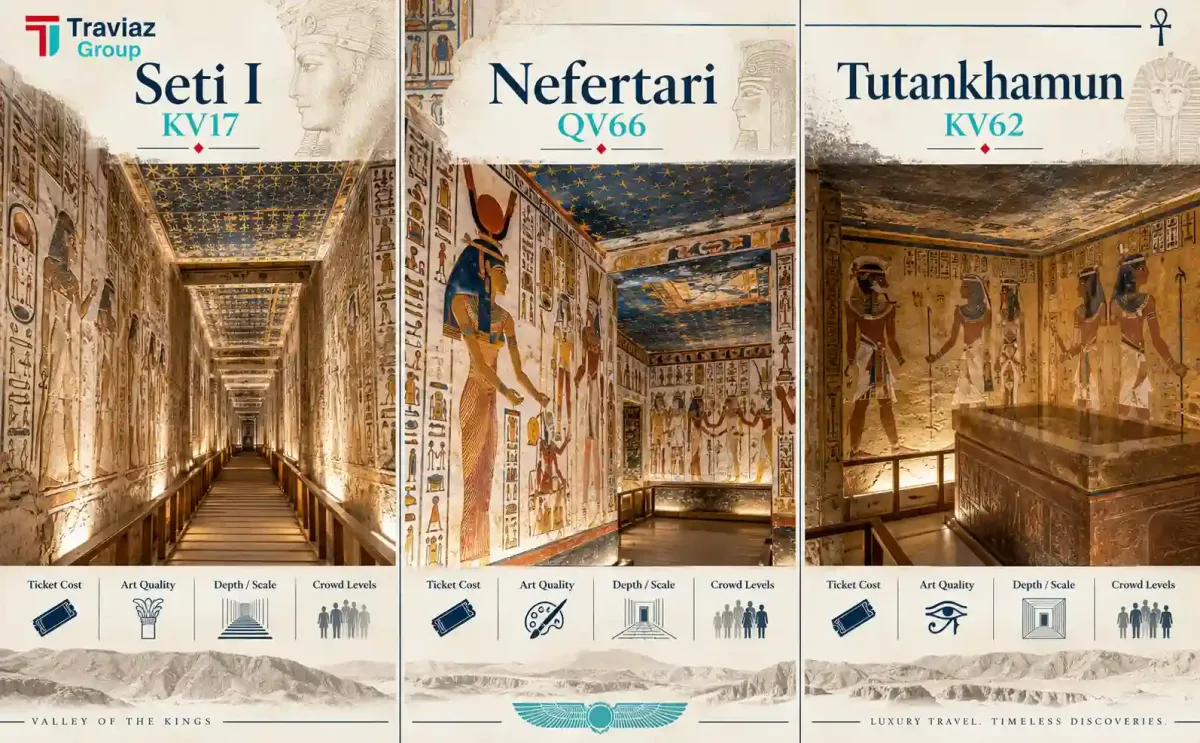
Before purchasing a KV17 ticket, a visitor may want to know the differences between it and the most famous Egyptian tombs.
The following comparison clarifies the difference in the nature of the experience between the sites rather than viewing them as identical alternatives.
Sety I vs. Tutankhamun
KV17 and the Tomb of Tutankhamun present two different types of royal tombs, and the main differences between them can be noted here:
|
Criterion |
Tomb of Sety I (KV17) |
Tomb of Tutankhamun |
|
Size and Depth |
The largest and deepest in the valley |
A relatively small tomb |
|
Artistic Decoration |
17 fully decorated chambers and corridors |
Only three decorated walls |
|
Archaeological Value |
An integrated textual religious program never seen before it |
Its fame comes from its golden contents, not its art |
|
Entry Cost |
An additional 2,000 pounds |
An additional 700 pounds |
|
Nature of Experience |
Art, architectural details, and the religious program |
The most famous historical symbol and tomb contents |
Sety I vs. Nefertari: The Ultimate Rivalry
The Tomb of Nefertari in the Valley of the Queens presents a different artistic model that can be compared to KV17 from several angles, especially in terms of painting style, colors, and the size of the space:
|
Criterion |
Tomb of Sety I (KV17) |
Tomb of Nefertari |
|
Art Level |
Raised relief carvings with exceptional colors |
Soft flat colors that are the most beautiful in Egypt |
|
Size |
Much larger with multiple chambers |
A smaller tomb |
|
Visit Duration |
No official time limit |
Historically limited to ten minutes |
|
Archaeological Atmosphere |
Depth, drama, and mystery |
Delicacy, lightness, and captivating colors |
|
Entry Cost |
2,000 pounds |
More expensive than KV17 |
The Traviaz Recommendation
Traviaz places the Tomb of Sety I (KV17) among its priorities for visitors interested in Luxor antiquities, given the combination of large scale, artistic details, and a vast religious program in a single site.
Traviaz also offers guided deep-access tours that can include the Ritual Shaft and some side chambers that are normally closed, with a guide specializing in the history of the 19th Dynasty and the religious texts associated with KV17.
Contact Traviaz to learn about access details and available dates.
FAQs
Is the Tomb of Sety I Open Now?
Yes, KV17 has been open for visits since 2016 after a closure of nearly three decades. That said, it is recommended to check the current status through the official website of the Egyptian Antiquities Authority at egymonuments.gov.eg or to contact your travel agency directly before the visit, as temporary closures for maintenance work remain possible.
How Long Does a Full Tour of KV17 Take?
A thorough complete visit to the Tomb of Sety I (KV17) takes approximately one to one and a half hours at minimum for those who want to stop in front of the various chambers and carvings. Some visitors with a keen interest in details may spend more time, while the ticket carries no official time limit based on the information available here.
Are There Private Tours That Include the Ritual Shaft?
Some guided private tours allow access to parts of the tomb that are not normally available during a standard visit, including the Ritual Shaft and some side rooms enclosed by ropes. Traviaz organizes deep-access tours for this purpose with a guide specializing in the history of the 19th Dynasty and the religious texts of KV17, and you can contact the team to learn the details and schedule your visit.